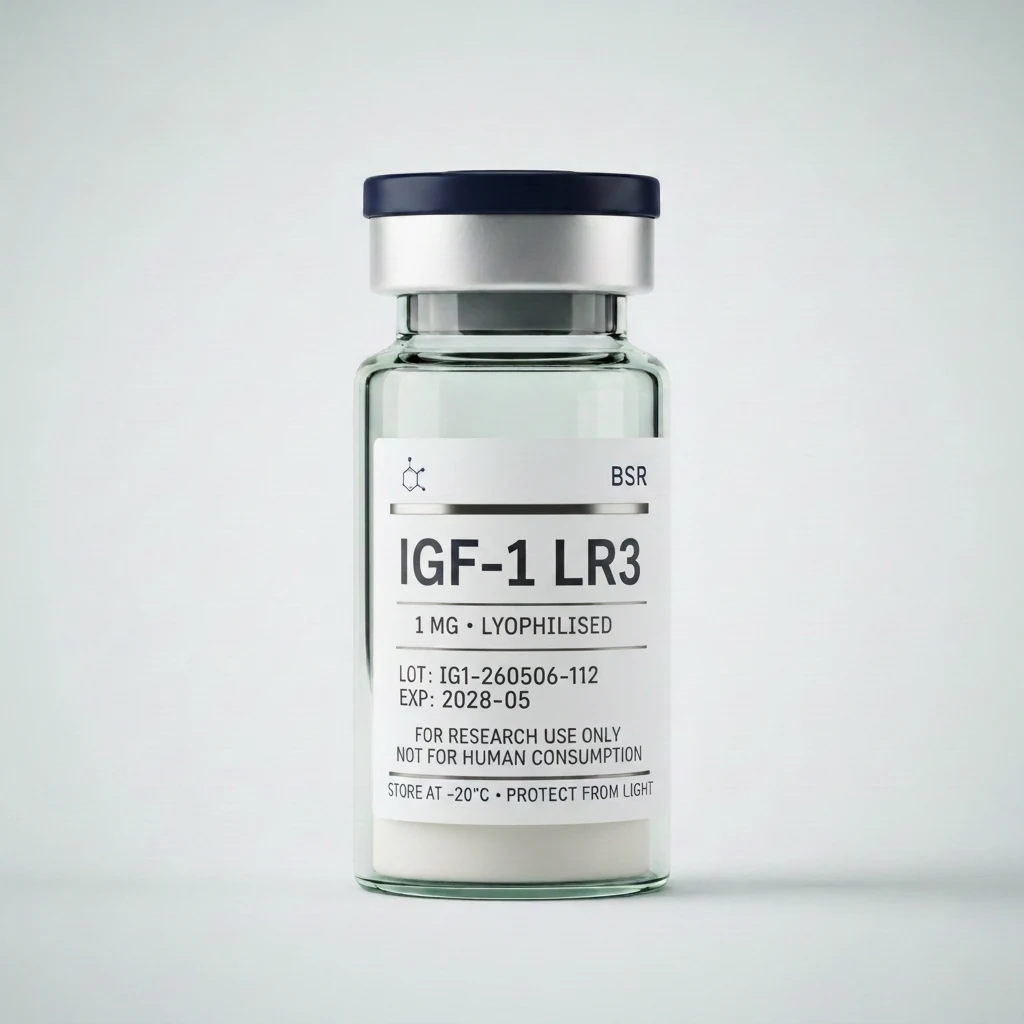
A recombinant analogue of insulin-like growth factor 1, carrying an arginine substitution at position 3 and a 13-residue N-terminal extension. Used in cell-culture work where reduced affinity for IGF binding proteins is the point of the modification.
Add sterile bacteriostatic water to the vial to achieve your target working concentration.
Storage conditions: -20°C, dry
Form: Lyophilised
Solubility: Water, BAC water
Current batch: IG1-260506-112
HPLC purity: 99.61%
MS verified: Yes
Expiry: May 2028
The certificate of analysis for this batch is issued with your order.
C₄₀₀H₆₂₅N₁₁₁O₁₁₅S₉ · 9,111.0 Da
IGF-1 LR3 Long R3 (IGF-1 LR3)
out of stock
Free shipping on orders over £75
Working out volumes? Peptide calculator · Reconstitution guide
IG1-260506-112 · HPLC 99.61%
The batch code matches the vial you will receive. Full analysis — purity, mass spectrometry, residual solvents and microbial limits — is issued with your order.
| Content | 1mg |
| Purity | 99.61% HPLC |
| Form | Lyophilised |
| Storage | -20°C, dry |
| Solubility | Water, BAC water |
Same-day dispatch — order within
Same-day dispatch before 3pm, Mon–Fri. Next dispatch .
via Royal Mail Tracked 24
IGF-1 LR3
1mg · £49.99
IGF-1 LR3 — Long R3 IGF-1 — is a recombinant analogue of insulin-like growth factor 1: the 70-residue human sequence with arginine substituted for glutamic acid at position 3, plus a 13-residue extension on the N-terminus. At 9111 Da it is a small protein rather than a peptide, and by some distance the largest molecule in this catalogue.
Both modifications exist for the same reason. IGF-1 in solution is largely bound by IGF binding proteins, which are produced by most cultured cell types; the arginine substitution sharply reduces that binding, so more of the analogue remains free to reach the receptor. It is supplied at 1mg per vial, the smallest fill we sell.
Mechanism in the literature
The analogue binds the IGF-1 receptor, a receptor tyrosine kinase, and the literature describes downstream PI3K/Akt and MAPK signalling as for native IGF-1. What the published work isolates is the binding-protein question: comparisons of IGF-1 with its analogues in the presence of IGFBP-3 and IGFBP-5 show the reduced-affinity analogues escaping sequestration that blunts the native peptide, which is why cell-culture protocols specify the analogue rather than IGF-1 itself.
This is a potent growth factor and is treated as such in laboratory practice. It appears on the World Anti-Doping Agency prohibited list. Evidence is from cell-culture and animal work, and IGF-1 LR3 holds no marketing authorisation from the MHRA in the United Kingdom or from the FDA in the United States.
Handling and reconstitution
Supplied lyophilised at 1mg per vial. Allow the vial to reach room temperature before reconstituting, add diluent down the inner wall rather than onto the cake, and swirl rather than shake — a 9kDa protein is more susceptible to shear and to surface denaturation than the short peptides in this catalogue. Working dilutions are typically prepared from a concentrated stock rather than by reconstituting the vial at working strength.
Bacteriostatic water contains 0.9% benzyl alcohol as a preservative, which is what permits repeated withdrawals from one vial. Sterile water does not, and is single-use. Protein at low concentration adsorbs to plasticware, which is why culture protocols often specify a carrier.
Storage and stability
Lyophilised material is held at -20°C and protected from light; the certificate for this batch carries a retest date of May 2028. Reconstituted solution is refrigerated and treated as a short-window preparation. Repeated freeze-thaw cycling is particularly damaging to a protein of this size and should be avoided — aliquoting a reconstituted stock is the usual answer.
Common questions
What purity is BSR's IGF-1 LR3, and how is it verified?
The current batch tests at 99.61% by HPLC against a specification of not less than 98%. Identity is confirmed by LC-MS at 9110.9 Da against a theoretical 9111.00 Da, and the certificate also reports related impurities, assay, water content, residual solvents by GC, heavy metals, bacterial endotoxins and microbial limits.
What does LR3 mean, and how does it differ from ordinary IGF-1?
LR3 denotes Long R3: an arginine substitution at position 3 and a 13-residue N-terminal extension. Together these reduce affinity for IGF binding proteins, which otherwise sequester most IGF-1 in a culture system. The receptor target is the same; what changes is how much of the molecule remains free to reach it.
Why is IGF-1 LR3 supplied in 1mg vials when other compounds are 10mg?
Because the working concentrations in the cell-culture literature are orders of magnitude lower than for the short peptides in this catalogue, and because it is a 9kDa protein rather than a peptide. The certificate for this batch specifies a fill of 1mg per vial and the vial you receive matches it.
How should IGF-1 LR3 be stored?
Lyophilised vials are stored at -20°C, protected from light. Once reconstituted the solution is kept refrigerated and used within a short window; aliquot rather than repeatedly freezing and thawing, which is particularly damaging to a protein of this size.
Is a certificate of analysis included?
Yes. The certificate for your batch is issued with your order rather than published openly, and covers HPLC purity, mass spectrometry identity, assay, water content, residual solvents, heavy metals and microbial limits.
- Pampusch M.S. et al. (2005) — Production of recombinant porcine IGF-binding protein-5 and its effect on proliferation of porcine embryonic myoblast cultures in the presence and absence of IGF-I and Long-R3-IGF-I, J Endocrinol
- Devi G.R. et al. (2001) — Effect of IGFBP-3 on IGF- and IGF-analogue-induced insulin-like growth factor-I receptor signalling, Growth Horm IGF Res
Cited as research context. BSR has no involvement in these studies and they do not constitute claims about this product.
No reviews of this compound yet. Reviews come only from customers who have bought it.
Sign in to review a compound you have bought.