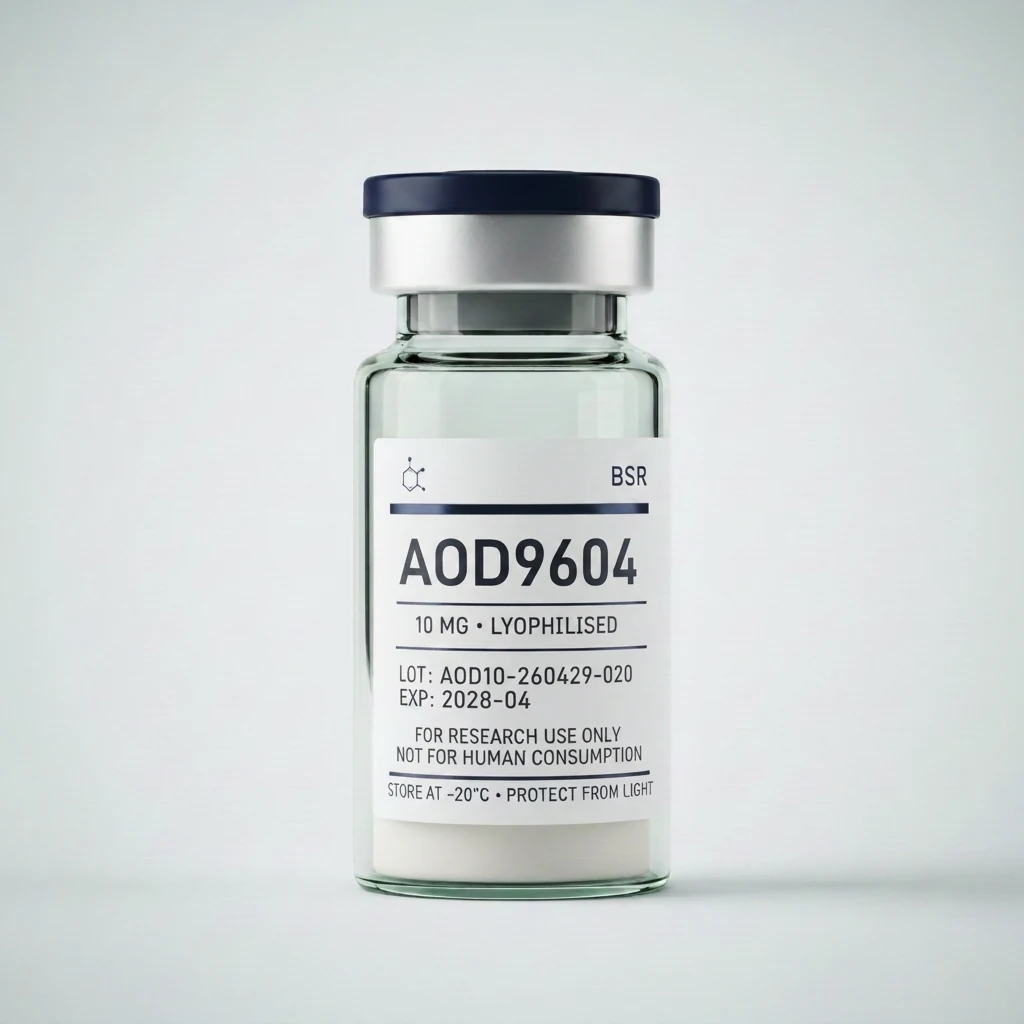
A synthetic fragment of the C-terminal region of human growth hormone with an added N-terminal tyrosine. Studied in adipocyte models for activity on lipid metabolism, separately from the growth-promoting action of the whole hormone.
Add sterile bacteriostatic water to the vial to achieve your target working concentration.
Storage conditions: -20°C, dry
Form: Lyophilised
Solubility: Water, BAC water
Current batch: AOD10-260429-020
HPLC purity: 99.62%
MS verified: Yes
Expiry: Apr 2028
The certificate of analysis for this batch is issued with your order.
C₇₈H₁₂₃N₂₃O₂₃S₂ · 1,815.1 Da
AOD-9604 (AOD9604)
out of stock
Free shipping on orders over £75
Working out volumes? Peptide calculator · Reconstitution guide
AOD10-260429-020 · HPLC 99.62%
The batch code matches the vial you will receive. Full analysis — purity, mass spectrometry, residual solvents and microbial limits — is issued with your order.
| Content | 10mg |
| Purity | 99.62% HPLC |
| Form | Lyophilised |
| Storage | -20°C, dry |
| Solubility | Water, BAC water |
Same-day dispatch — order within
Same-day dispatch before 3pm, Mon–Fri. Next dispatch .
via Royal Mail Tracked 24
AOD9604
10mg · £34.99
AOD9604 is a synthetic fragment of the C-terminal region of human growth hormone — residues 177 to 191 — with a tyrosine added at the N-terminus. The design question behind it was whether the metabolic activity attributed to that region of the hormone could be separated from the growth-promoting and glucose effects of the whole molecule.
The underlying work on the parent fragment dates to the early 1990s at Monash University; AOD9604 itself went through clinical development for obesity that did not reach approval, and the compound is now of interest to anti-doping testing laboratories as well as metabolic research.
Mechanism in the literature
Published work on the parent sequence describes antilipogenic activity in adipose tissue — reduced lipogenesis rather than a direct receptor agonism of the growth hormone receptor. Later analytical work confirms the structure as the 177-191 fragment with an added tyrosine, and characterises its in vitro metabolism. The literature is explicit that the fragment does not reproduce the growth-promoting action of intact growth hormone.
The primary evidence is rodent adipose tissue and in vitro work from the 1990s. Clinical development for obesity did not result in a marketing authorisation, and AOD9604 holds none from the MHRA in the United Kingdom or from the FDA in the United States.
Handling and reconstitution
Supplied lyophilised at 10mg per vial. Allow the vial to reach room temperature before reconstituting, add bacteriostatic water down the inner wall rather than onto the cake, and swirl rather than shake. The sequence contains two cysteine residues forming a disulphide bridge, so avoid reducing conditions in any buffer prepared from it.
Bacteriostatic water contains 0.9% benzyl alcohol as a preservative, which is what permits repeated withdrawals from one vial. Sterile water does not, and is single-use.
Storage and stability
Lyophilised material is held at -20°C and protected from light; the certificate for this batch carries a retest date of April 2028. Reconstituted solution is refrigerated and treated as a short-window preparation, and repeated freeze-thaw cycling should be avoided.
Common questions
What purity is BSR's AOD9604, and how is it verified?
The current batch tests at 99.62% by HPLC against a specification of not less than 98%. Identity is confirmed by LC-MS at 1814.7 Da against a theoretical 1815.10 Da, and the certificate also reports related impurities, water content, residual solvents by GC, heavy metals, bacterial endotoxins and microbial limits.
What part of growth hormone is AOD9604?
The C-terminal region, residues 177 to 191, with a tyrosine added at the N-terminus. It is sometimes described in supplier material as fragment 176-191; the analytical literature characterises the compound as the 177-191 sequence plus that added tyrosine.
Does AOD9604 act like growth hormone?
No. The published work distinguishes the two: the fragment is studied for activity on lipid metabolism in adipose tissue, and the literature is explicit that it does not reproduce the growth-promoting action of the intact hormone. That separation was the reason the fragment was investigated in the first place.
How should AOD9604 be stored?
Lyophilised vials are stored at -20°C, protected from light. Once reconstituted with bacteriostatic water the solution is kept refrigerated and used within a short window; avoid repeated freeze-thaw cycles.
Is a certificate of analysis included?
Yes. The certificate for your batch is issued with your order rather than published openly, and covers HPLC purity, mass spectrometry identity, water content, residual solvents, heavy metals and microbial limits.
- Cox H.D. et al. (2015) — Detection and in vitro metabolism of AOD9604, Drug Test Anal
- Wu Z. & Ng F.M. (1993) — Antilipogenic action of synthetic C-terminal sequence 177-191 of human growth hormone, Biochem Mol Biol Int
Cited as research context. BSR has no involvement in these studies and they do not constitute claims about this product.
No reviews of this compound yet. Reviews come only from customers who have bought it.
Sign in to review a compound you have bought.