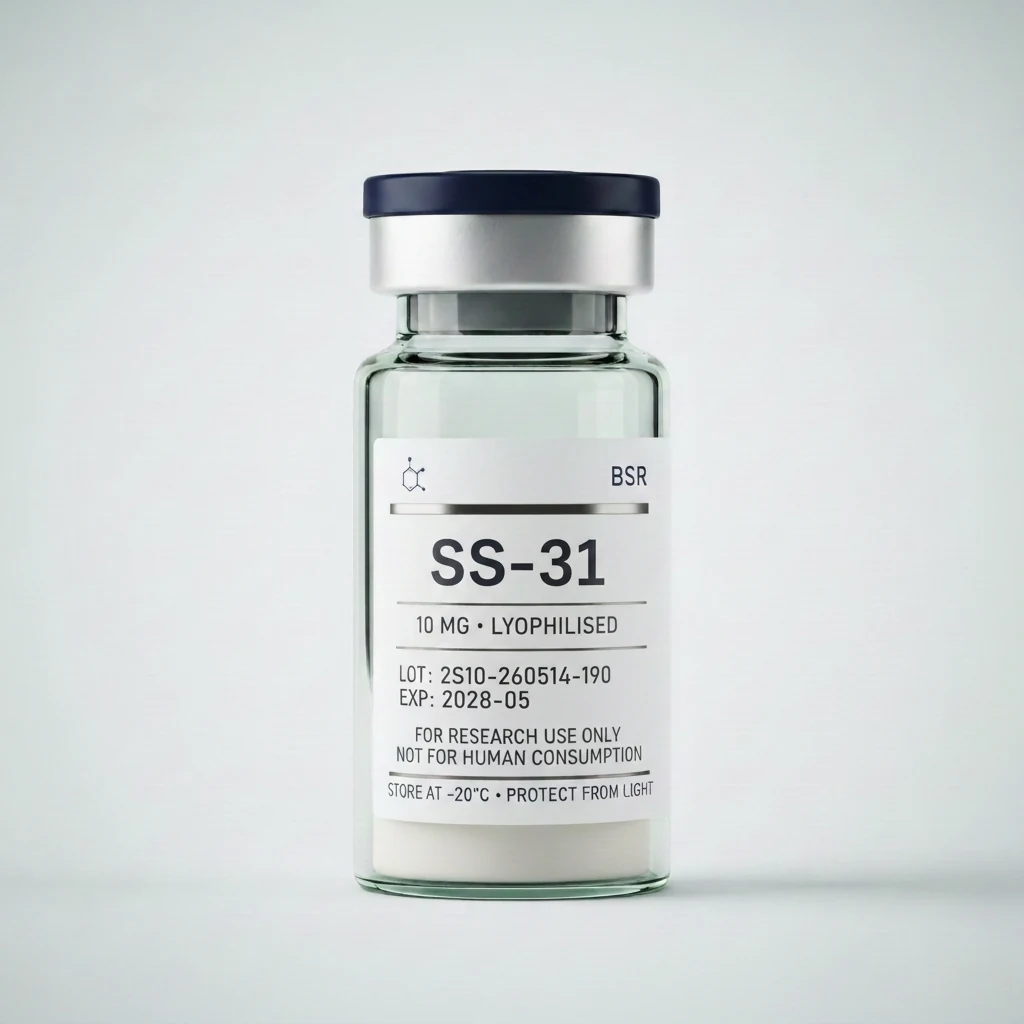
A mitochondria-targeted tetrapeptide of the Szeto-Schiller class, studied for its association with cardiolipin on the inner mitochondrial membrane.
Add sterile bacteriostatic water to the vial to achieve your target working concentration.
Storage conditions: -20°C, dry
Form: Lyophilised
Solubility: Water, BAC water
Current batch: 2S10-260514-190
HPLC purity: 99.63%
MS verified: Yes
Expiry: May 2028
The certificate of analysis for this batch is issued with your order.
C₃₂H₄₉N₉O₅ · 639.8 Da
SS-31 Elamipretide (SS-31)
out of stock
Free shipping on orders over £75
Working out volumes? Peptide calculator · Reconstitution guide
2S10-260514-190 · HPLC 99.63%
The batch code matches the vial you will receive. Full analysis — purity, mass spectrometry, residual solvents and microbial limits — is issued with your order.
| Content | 10mg |
| Purity | 99.63% HPLC |
| Form | Lyophilised |
| Storage | -20°C, dry |
| Solubility | Water, BAC water |
Same-day dispatch — order within
Same-day dispatch before 3pm, Mon–Fri. Next dispatch .
via Royal Mail Tracked 24
SS-31
10mg · £29.99
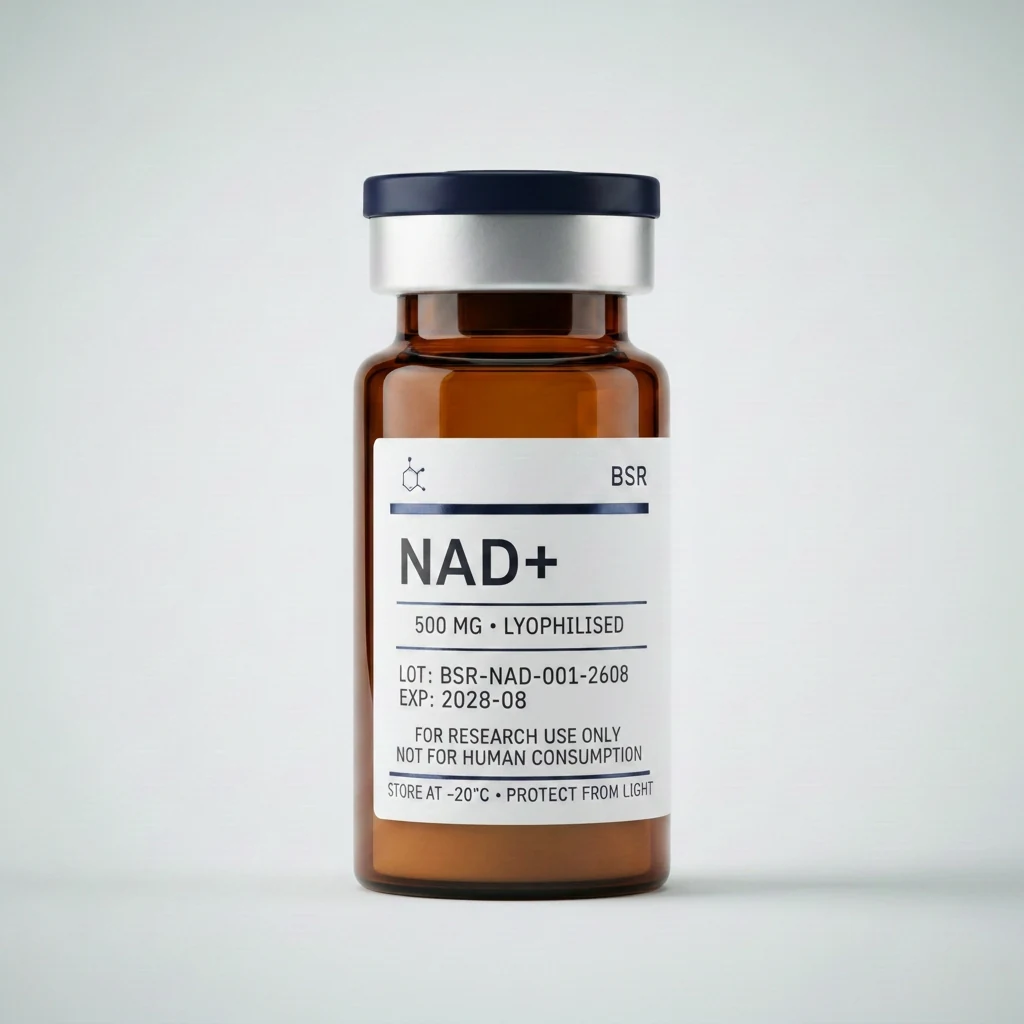
SS-31 is an aromatic-cationic tetrapeptide of the Szeto-Schiller class, also known as elamipretide. It is designed to concentrate in mitochondria independently of membrane potential, which is unusual: most mitochondrial targeting depends on the very membrane potential that is lost in dysfunctional mitochondria.
The literature spans ischaemia-reperfusion models, cardiac and skeletal muscle physiology and mitochondrial disease, and the compound has been through clinical development under the name elamipretide.
Mechanism in the literature
The mechanism most consistently reported is association with cardiolipin, a phospholipid confined to the inner mitochondrial membrane. Published work describes the interaction as stabilising cristae architecture and the supercomplexes of the electron transport chain, with downstream effects on ATP production and reactive oxygen species. Later work has examined adenine nucleotide translocator function as a related route.
Evidence is drawn from cell-culture, isolated mitochondria and animal models. Elamipretide remains investigational: it has been through human trials with mixed results across indications and holds no marketing authorisation from the MHRA in the United Kingdom or from the FDA in the United States.
Handling and reconstitution
Supplied lyophilised at 10mg per vial. Allow the vial to reach room temperature before reconstituting, add bacteriostatic water down the inner wall rather than onto the cake, and swirl rather than shake. A tetrapeptide tolerates handling better than the long chains in this catalogue, but condensation into a cold vial is worth avoiding either way.
Bacteriostatic water contains 0.9% benzyl alcohol as a preservative, which is what permits repeated withdrawals from one vial. Sterile water does not, and is single-use.
Storage and stability
Lyophilised material is held at -20°C and protected from light; the certificate for this batch carries a retest date of May 2028. Reconstituted solution is refrigerated and treated as a short-window preparation, and repeated freeze-thaw cycling should be avoided.
Common questions
What purity is BSR's SS-31, and how is it verified?
The current batch tests at 99.63% by HPLC against a specification of not less than 98%. Identity is confirmed by LC-MS at 639.6 Da against a theoretical 639.80 Da, and the certificate also reports related impurities, water content, residual solvents by GC, heavy metals, bacterial endotoxins and microbial limits.
Is SS-31 the same as elamipretide?
Yes. SS-31 is the research designation for the compound developed clinically as elamipretide, and both names appear across the literature for the same aromatic-cationic tetrapeptide. Papers before roughly 2015 tend to use SS-31; clinical trial reports use elamipretide.
How does SS-31 reach mitochondria?
Published work describes uptake that does not depend on mitochondrial membrane potential, followed by association with cardiolipin in the inner mitochondrial membrane. That distinguishes it from targeting strategies that rely on membrane potential, which is itself reduced in the dysfunctional mitochondria such compounds are studied in.
How should SS-31 be stored?
Lyophilised vials are stored at -20°C, protected from light. Once reconstituted with bacteriostatic water the solution is kept refrigerated and used within a short window; avoid repeated freeze-thaw cycles.
Is a certificate of analysis included?
Yes. The certificate for your batch is issued with your order rather than published openly, and covers HPLC purity, mass spectrometry identity, water content, residual solvents, heavy metals and microbial limits.
- Birk A.V. et al. (2013) — The mitochondrial-targeted compound SS-31 re-energizes ischemic mitochondria by interacting with cardiolipin, J Am Soc Nephrol
- Tung C. et al. (2025) — Elamipretide: A Review of Its Structure, Mechanism of Action, and Therapeutic Potential, Int J Mol Sci
- Vahle B. et al. (2026) — Targeting Mitochondrial Dysfunction With Elamipretide (SS-31) Improves Skeletal Muscle Performance in a HFpEF Rat Model, Circ Heart Fail
Cited as research context. BSR has no involvement in these studies and they do not constitute claims about this product.
No reviews of this compound yet. Reviews come only from customers who have bought it.
Sign in to review a compound you have bought.