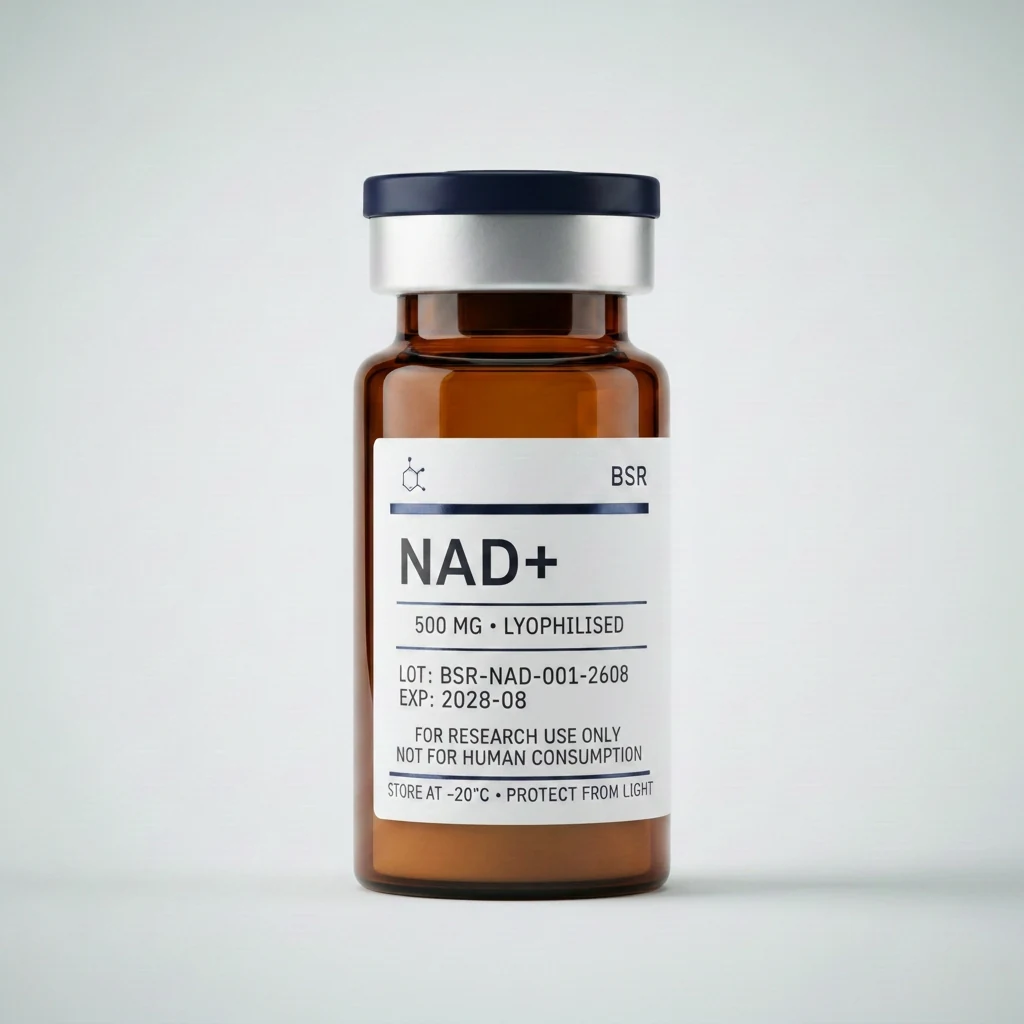
Nicotinamide adenine dinucleotide (NAD+) is a coenzyme found in all living cells, central to energy metabolism and DNA repair. Studied extensively in cellular ageing research, mitochondrial function and sirtuin activity in laboratory contexts.
Add sterile bacteriostatic water to the vial to achieve your target working concentration.
Storage conditions: -20°C, dry
Form: Lyophilised
Solubility: Water, BAC water
Current batch: NJ500-260506-144
HPLC purity: 99.44%
MS verified: Yes
Expiry: May 2028
The certificate of analysis for this batch is issued with your order.
NAD+
out of stock
Free shipping on orders over £75
Working out volumes? Peptide calculator · Reconstitution guide
NJ500-260506-144 · HPLC 99.44%
The batch code matches the vial you will receive. Full analysis — purity, mass spectrometry, residual solvents and microbial limits — is issued with your order.
| Content | 500mg |
| Purity | 99.44% HPLC |
| Form | Lyophilised |
| Storage | -20°C, dry |
| Solubility | Water, BAC water |
Same-day dispatch — order within
Same-day dispatch before 3pm, Mon–Fri. Next dispatch .
via Royal Mail Tracked 24
NAD+
500mg · £44.99
NAD+ — nicotinamide adenine dinucleotide — is a coenzyme present in every living cell, central to redox reactions and to the activity of the sirtuin family of enzymes. Unlike the peptides elsewhere in this catalogue it is a small molecule and a naturally occurring metabolite rather than a synthetic construct.
Research interest concentrates on cellular ageing and mitochondrial function. Covarrubias and colleagues reviewed NAD+ metabolism and its roles in cellular processes during ageing in Nature Reviews Molecular Cell Biology in 2021; the connection to sirtuins was set out by Imai and Guarente in Trends in Cell Biology.
Mechanism in the literature
NAD+ acts as an electron carrier in redox reactions and as a required substrate for sirtuins and PARP enzymes. Because those enzymes consume it rather than merely binding it, availability of NAD+ is itself treated in the literature as a limiting factor for their activity.
This literature concerns NAD+ biology in cells and model organisms. It is not a statement about supplementation in people, and material supplied here is for laboratory research only.
Handling and reconstitution
Supplied lyophilised in amber glass at 500mg and 1000mg. The amber vial is not decorative — NAD+ is photosensitive, which is why it ships in tinted glass where the rest of the catalogue uses clear borosilicate. Keep it out of direct light during handling as well as in storage.
Storage and stability
Stored at -20°C and protected from light, with a two-year retest date. NAD+ in solution is less stable than the lyophilised powder and degrades faster at room temperature than the peptides in this catalogue; prepare working solutions close to the point of use.
Common questions
What purity is BSR's NAD+?
The current batch tests at 99.44% by HPLC against a not-less-than-99% specification, with assay at 99.1% and mass confirmed by ESI-MS at 663.5 Da against a theoretical 663.40. The certificate accompanies your order.
Why is the NAD+ vial amber rather than clear?
NAD+ is photosensitive. Amber borosilicate blocks the wavelengths that degrade it, which is why this product ships in tinted glass while the peptides in the catalogue use clear vials.
Is the 1000mg vial better value than two 500mg vials?
Per milligram, yes — £99.99 against £89.98 for two 500mg vials, for twice the material in one vial. The consideration is that a single vial is reconstituted in one go, and NAD+ in solution is less stable than the dry powder.
- Covarrubias A.J. et al. (2021) — NAD+ metabolism and its roles in cellular processes during ageing, Nature Reviews Molecular Cell Biology
- Imai S. & Guarente L. (2014) — NAD+ and sirtuins in aging and disease, Trends in Cell Biology
Cited as research context. BSR has no involvement in these studies and they do not constitute claims about this product.
No reviews of this compound yet. Reviews come only from customers who have bought it.
Sign in to review a compound you have bought.