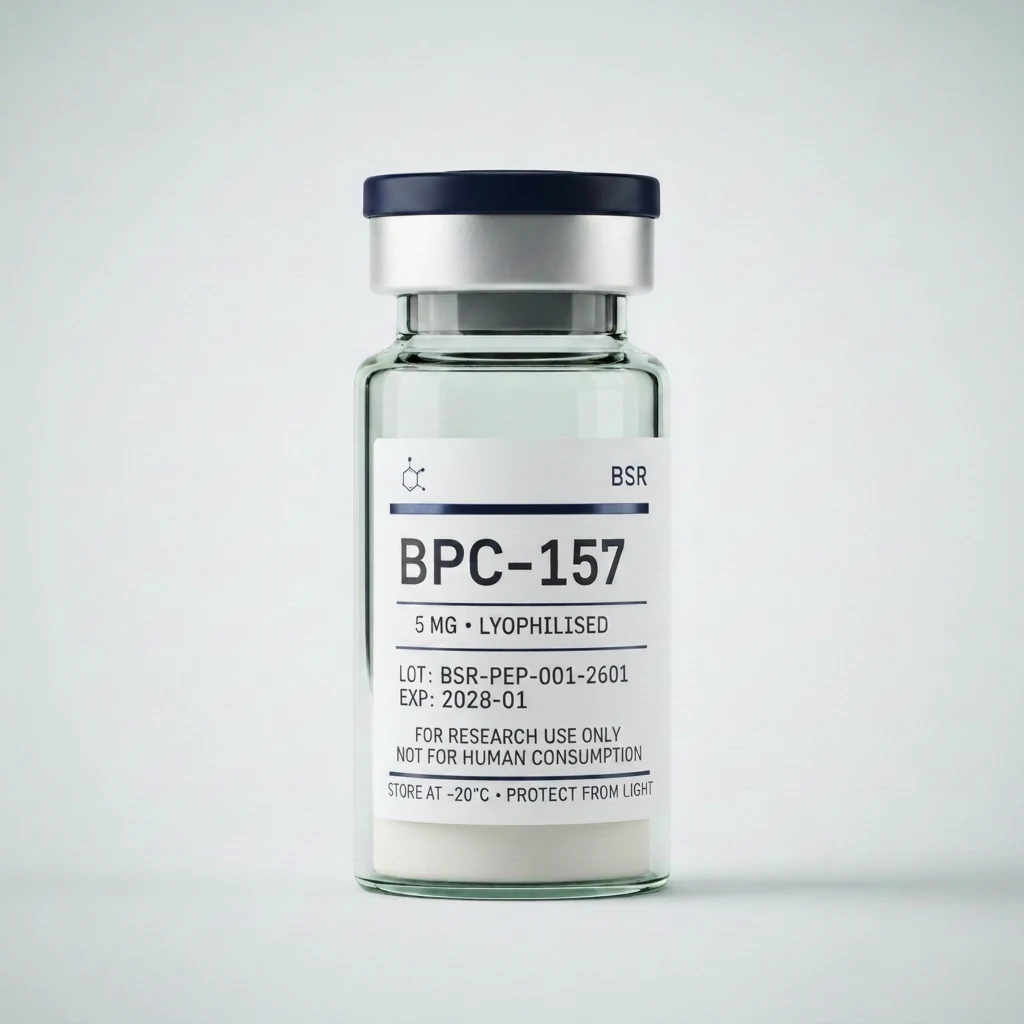
A pentadecapeptide composed of 15 amino acids. BPC-157 is widely studied in research models for its cytoprotective and tissue-protective properties in various cell-based assay systems.
Add sterile bacteriostatic water to the vial to achieve your target working concentration.
Storage conditions: -20°C, dry
Form: Lyophilised
Solubility: Water, Acetic acid (dilute)
Current batch: BC10-260429-035
HPLC purity: 99.52%
MS verified: Yes
Expiry: Apr 2028
The certificate of analysis for this batch is issued with your order.
C₆₂H₉₈N₁₆O₂₂ · 1,419.5 Da
BPC-157
out of stock
Free shipping on orders over £75
Working out volumes? Peptide calculator · Reconstitution guide
BC10-260429-035 · HPLC 99.52%
The batch code matches the vial you will receive. Full analysis — purity, mass spectrometry, residual solvents and microbial limits — is issued with your order.
| Content | 2mg |
| Purity | 99.52% HPLC |
| Form | Lyophilised |
| Storage | -20°C, dry |
| Sequence | GEPPPGKPADDAGLV |
| Solubility | Water, Acetic acid (dilute) |
Same-day dispatch — order within
Same-day dispatch before 3pm, Mon–Fri. Next dispatch .
via Royal Mail Tracked 24
BPC-157
2mg · £12.99
BPC-157 is a synthetic pentadecapeptide — fifteen amino acids, sequence GEPPPGKPADDAGLV — corresponding to a partial sequence of a protein isolated from human gastric juice. It is among the most heavily studied compounds in the research peptide field, and unusually stable: the literature reports it remains intact in gastric acid, which is why it appears in oral as well as parenteral study designs where most peptides do not.
Research interest centres on cytoprotection and tissue repair. Published work spans tendon and ligament fibroblast models, gastrointestinal mucosal integrity, and angiogenesis, with the majority of the evidence base drawn from rodent models rather than human trials.
Mechanism in the literature
The most commonly reported pathway is upregulation of VEGFR2 signalling, associated in published models with endothelial cell migration and the formation of new vasculature in injured tissue. Separate work describes interaction with the nitric oxide system and with growth hormone receptor expression in tendon fibroblasts.
Mechanistic detail across this literature is drawn predominantly from animal and cell-culture models. No completed randomised controlled trial in humans has been published, and BPC-157 holds no marketing authorisation from the MHRA in the United Kingdom or from the FDA in the United States.
Handling and reconstitution
Supplied lyophilised. Allow the vial to reach room temperature before reconstituting — introducing diluent to cold glass encourages condensation inside the vial. Add bacteriostatic water down the inner wall rather than directly onto the cake, and swirl rather than shake; peptides of this length are susceptible to shear from vigorous agitation.
Bacteriostatic water contains 0.9% benzyl alcohol as a preservative, which is what permits repeated withdrawals from a single vial. Sterile water does not, and is a single-use diluent.
Storage and stability
Lyophilised material is stored at -20°C and protected from light; in that state the certificate carries a two-year retest date. Once reconstituted, the solution is refrigerated and the literature generally treats it as a short-window preparation measured in weeks rather than months. Repeated freeze-thaw cycling degrades peptide material and should be avoided — where a protocol calls for small volumes over a long period, several smaller vials will outlast one large one.
Common questions
What purity is BSR's BPC-157, and how is it verified?
The current batch tests at 99.52% by HPLC, against a specification of not less than 98%. Identity is confirmed by LC-MS against a reference standard, and the certificate also reports related impurities, residual solvents by GC, heavy metals, bacterial endotoxins and microbial limits. The batch code on the certificate matches the code printed on the vial you receive.
Is a certificate of analysis included?
Yes. The certificate for your batch is issued with your order rather than published openly, and covers purity, mass spectrometry identity, water content, residual solvents and microbial limits.
How should BPC-157 be stored?
Lyophilised vials are stored at -20°C, protected from light. Once reconstituted with bacteriostatic water, the solution is kept refrigerated and used within a short window; avoid repeated freeze-thaw cycles, which degrade peptide material.
What is the difference between the 2mg, 5mg and 10mg vials?
Only the quantity of lyophilised material in the vial. All three come from the same batch and carry the same certificate. The choice is usually driven by reconstituted stability: a larger vial costs less per milligram, but the solution has to be used inside its stable window once made up, so shorter protocols are often better served by smaller vials.
What diluent should be used, and how much?
Bacteriostatic water is the standard diluent for lyophilised peptides, as its benzyl alcohol preservative permits multiple withdrawals from one vial. The volume depends on the working concentration a protocol calls for; our peptide calculator converts between vial mass, diluent volume and concentration.
Is BPC-157 legal to buy in the UK?
It is supplied strictly for laboratory research use and is not for human or animal consumption. BPC-157 holds no MHRA marketing authorisation as a medicine in the United Kingdom, and nothing on this site should be read as suggesting use in people.
- Seiwerth S. et al. (2021) — Stable Gastric Pentadecapeptide BPC 157 and Wound Healing, Frontiers in Pharmacology
- Chang C.H. et al. (2011) — The promoting effect of pentadecapeptide BPC 157 on tendon healing, J Appl Physiol
- Hsieh M.J. et al. (2017) — Pro-angiogenic BPC157 is associated with VEGFR2 activation, J Mol Med
- McGuire F.P. et al. (2025) — Regeneration or Risk? A Narrative Review of BPC-157 for Musculoskeletal Healing, Curr Rev Musculoskelet Med
Cited as research context. BSR has no involvement in these studies and they do not constitute claims about this product.
No reviews of this compound yet. Reviews come only from customers who have bought it.
Sign in to review a compound you have bought.