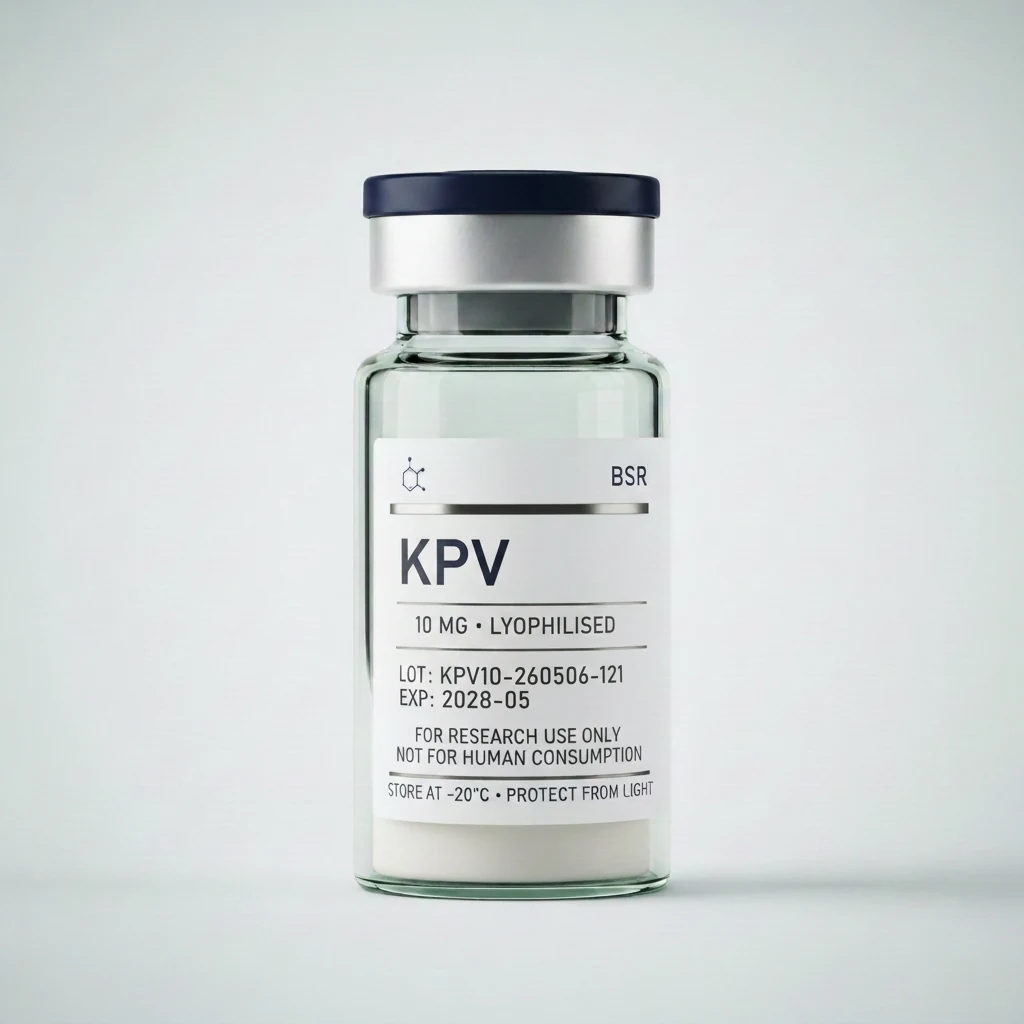
The C-terminal tripeptide of alpha-melanocyte-stimulating hormone. Studied for anti-inflammatory activity in intestinal epithelial models, where uptake through the PepT1 transporter has been described.
Add sterile bacteriostatic water to the vial to achieve your target working concentration.
Storage conditions: -20°C, dry
Form: Lyophilised
Solubility: Water, BAC water
Current batch: KPV10-260506-121
HPLC purity: 99.61%
MS verified: Yes
Expiry: May 2028
The certificate of analysis for this batch is issued with your order.
C₁₉H₂₇N₅O₄ · 389.5 Da
KPV Lys-Pro-Val (KPV)
out of stock
Free shipping on orders over £75
Working out volumes? Peptide calculator · Reconstitution guide
KPV10-260506-121 · HPLC 99.61%
The batch code matches the vial you will receive. Full analysis — purity, mass spectrometry, residual solvents and microbial limits — is issued with your order.
| Content | 10mg |
| Purity | 99.61% HPLC |
| Form | Lyophilised |
| Storage | -20°C, dry |
| Sequence | Lys-Pro-Val |
| Solubility | Water, BAC water |
Same-day dispatch — order within
Same-day dispatch before 3pm, Mon–Fri. Next dispatch .
via Royal Mail Tracked 24
KPV
10mg · £27.99
KPV is a tripeptide — lysine, proline, valine — corresponding to the C-terminal three residues of alpha-melanocyte-stimulating hormone. It is the smallest compound in this catalogue at 389.45 Da, and the part of the parent hormone that carries anti-inflammatory activity without the pigmentary action of the full sequence.
The research literature centres on intestinal and mucosal inflammation, with published work in murine colitis models, cell-culture systems and, more recently, materials science, where the peptide has been carried in hydrogels to hold it at a mucosal surface.
Mechanism in the literature
Published work describes uptake into intestinal epithelial and immune cells through PepT1, an oligopeptide transporter, with downstream reduction in NF-kappaB signalling and pro-inflammatory cytokine expression. Because the tripeptide is a PepT1 substrate rather than a receptor ligand at this size, transport is the step the literature treats as rate-determining.
The evidence base is murine and cell-culture. No completed randomised controlled trial in humans has been published, and KPV holds no marketing authorisation from the MHRA in the United Kingdom or from the FDA in the United States.
Handling and reconstitution
Supplied lyophilised at 10mg per vial. Allow the vial to reach room temperature before adding diluent, direct the water down the inner wall rather than onto the cake, and swirl rather than shake. A tripeptide is considerably more robust than the longer chains in this catalogue, but the same handling costs nothing.
Bacteriostatic water contains 0.9% benzyl alcohol as a preservative, which is what permits repeated withdrawals from one vial. Sterile water does not, and is single-use.
Storage and stability
Lyophilised material is held at -20°C and protected from light; the certificate for this batch carries a retest date of May 2028. Reconstituted solution is refrigerated and treated as a short-window preparation. Repeated freeze-thaw cycling degrades peptide material and should be avoided.
Common questions
What purity is BSR's KPV, and how is it verified?
The current batch tests at 99.61% by HPLC against a specification of not less than 98%. Identity is confirmed by LC-MS against a reference standard at 389.4 Da, and the certificate also reports related impurities, water content, residual solvents by GC, heavy metals, bacterial endotoxins and microbial limits.
What is KPV, and how does it relate to alpha-MSH?
KPV is the C-terminal tripeptide of alpha-melanocyte-stimulating hormone — lysine, proline and valine, the last three residues of the parent hormone. It is studied because it retains anti-inflammatory activity described for alpha-MSH while lacking the melanocortin receptor agonism responsible for pigmentation.
How should KPV be stored?
Lyophilised vials are stored at -20°C, protected from light. Once reconstituted with bacteriostatic water the solution is kept refrigerated and used within a short window; avoid repeated freeze-thaw cycles.
Is a certificate of analysis included?
Yes. The certificate for your batch is issued with your order rather than published openly, and covers HPLC purity, mass spectrometry identity, water content, residual solvents, heavy metals and microbial limits.
Is KPV legal to buy in the UK?
It is supplied strictly for laboratory research use and is not for human or animal consumption. KPV holds no MHRA marketing authorisation as a medicine in the United Kingdom, and nothing on this site should be read as suggesting use in people.
- Kannengiesser K. et al. (2008) — Melanocortin-derived tripeptide KPV has anti-inflammatory potential in murine models of inflammatory bowel disease, Inflamm Bowel Dis
- Dalmasso G. et al. (2008) — PepT1-mediated tripeptide KPV uptake reduces intestinal inflammation, Gastroenterology
- Shao W. et al. (2021) — In situ mucoadhesive hydrogel capturing tripeptide KPV, Biomater Sci
Cited as research context. BSR has no involvement in these studies and they do not constitute claims about this product.
No reviews of this compound yet. Reviews come only from customers who have bought it.
Sign in to review a compound you have bought.