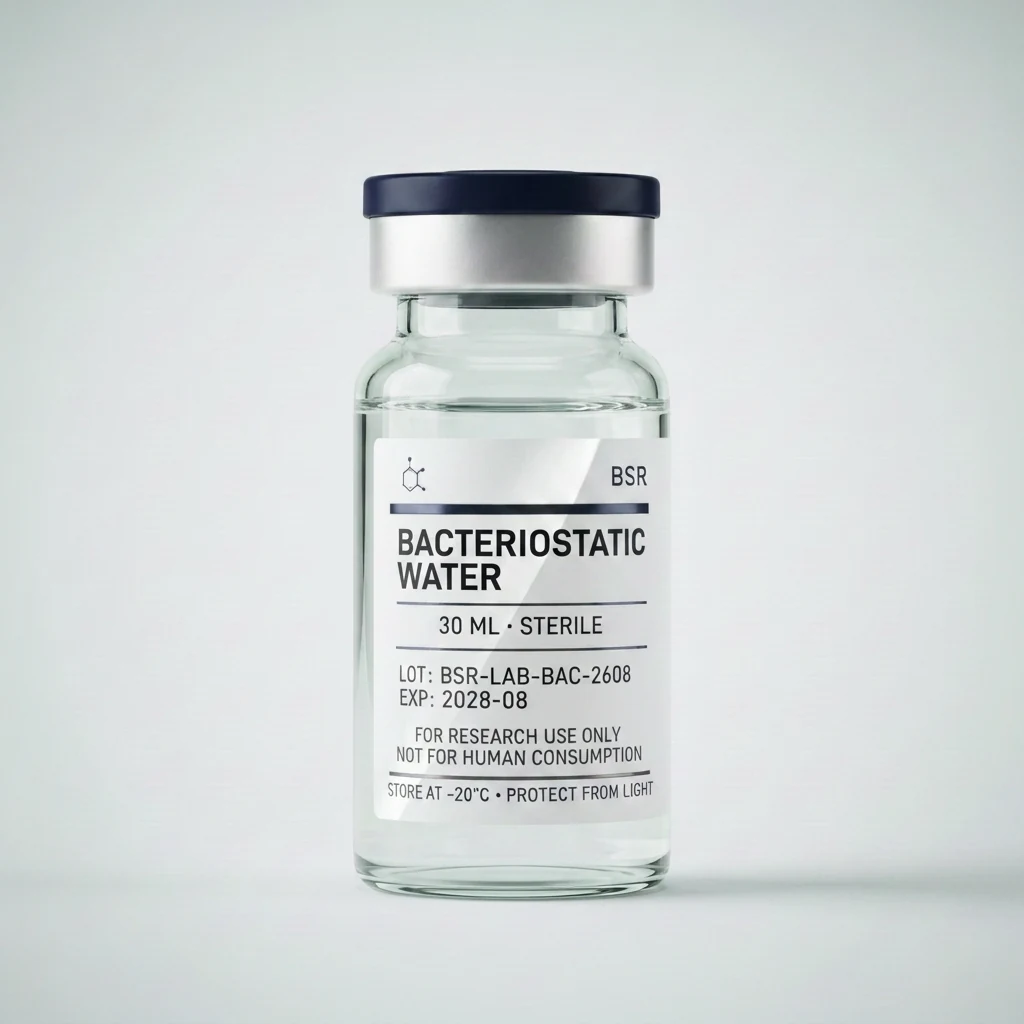
Sterile water containing 0.9% benzyl alcohol as a bacteriostatic preservative. For use in reconstituting lyophilised peptides and research compounds in laboratory settings. Supplied in a sealed 10mL multi-dose vial.
Storage conditions: Room temperature, away from direct light
Form: Sterile solution
Bacteriostatic Water
out of stock
Free shipping on orders over £75
Working out volumes? Peptide calculator · Reconstitution guide
BSR-LAB-BAC-2608
The batch code matches the vial you will receive.
| Content | 10mL × 1 |
| Form | Sterile solution |
| Storage | Room temperature, away from direct light |
Same-day dispatch — order within
Same-day dispatch before 3pm, Mon–Fri. Next dispatch .
via Royal Mail Tracked 24
Bacteriostatic Water
10mL × 1 · £4.99
Bacteriostatic water is sterile water containing 0.9% benzyl alcohol as a preservative. The preservative is the entire point: it inhibits bacterial growth, which is what allows a single vial to be entered more than once rather than discarded after one withdrawal.
It is the standard diluent for reconstituting lyophilised peptides, and the item most often forgotten when ordering them. Supplied here in 30mL, which is enough to reconstitute a great many vials — the volumes involved in peptide work are usually one to three millilitres at a time.
What the preservative does
Benzyl alcohol is bacteriostatic rather than bactericidal: it suppresses the multiplication of organisms introduced on a needle rather than sterilising the contents outright. That distinction is why an entered vial has a usable window measured in weeks rather than an indefinite shelf life, and why aseptic technique still matters when drawing from one.
Benzyl alcohol is not inert. The published literature includes work on its toxicity, and it is the reason preparations containing it are avoided in neonates. It is also not pharmacologically silent around the material it carries — recent work characterises how preservatives of this class interact with peptides in solution, and how far that interaction reverses.
How it is used
Add to a lyophilised vial to bring the material into solution at a chosen working concentration. Let the vial reach room temperature first, direct the water down the inner wall rather than onto the cake, and swirl rather than shake. The volume you add determines the concentration, so it is worth calculating before you start rather than after.
Sterile water is not the same thing. Without the benzyl alcohol preservative it is a single-use diluent, and a vial reconstituted with it should not be entered repeatedly. Sodium chloride solution is a third thing again and is not interchangeable with either.
Storage
Stored at room temperature, away from direct light — this is one of the few items in the catalogue that does not want a freezer. Unopened, the vial carries the expiry printed on it. Once entered, the preservative is what permits further withdrawals, but that is not indefinite: an opened vial is conventionally treated as usable for a matter of weeks, and the date of first entry is worth writing on the label.
Common questions
What is the difference between bacteriostatic water and sterile water?
Bacteriostatic water contains 0.9% benzyl alcohol, which inhibits bacterial growth and allows a vial to be entered multiple times. Sterile water contains no preservative and is intended for a single use. For reconstituting a peptide vial that will be drawn from more than once, bacteriostatic water is the one the protocols specify.
How much bacteriostatic water do I need per vial?
It depends on the concentration your protocol calls for and the mass in the vial — the same 5mg of peptide can be made up to very different concentrations depending on the volume added. Our peptide calculator converts between vial mass, diluent volume and resulting concentration, which is the calculation most often got wrong.
How long does bacteriostatic water last once opened?
The preservative permits repeated withdrawals rather than granting indefinite life. An entered vial is conventionally treated as usable for a matter of weeks, and it is worth writing the date of first entry on the label. Unopened, the vial is good until the expiry date printed on it.
Does bacteriostatic water need to be refrigerated?
No. It is stored at room temperature, away from direct light. It is one of the few items in this catalogue that does not want a freezer — the lyophilised compounds it is used to reconstitute generally do.
Can bacteriostatic water be used instead of saline?
They are not interchangeable. Sodium chloride solution is isotonic and contains no preservative; bacteriostatic water is neither. Which one a protocol specifies depends on what is being prepared, and substituting one for the other changes both the tonicity and whether the vial can be entered again.
Why is there benzyl alcohol in it?
Benzyl alcohol at 0.9% is the antimicrobial preservative, and it is the only reason a multiple-entry vial is possible. It is bacteriostatic rather than bactericidal — it suppresses the growth of organisms introduced on a needle rather than sterilising the contents.
What size does BSR supply, and is it made in the UK?
Supplied in 30mL vials, dispatched from the UK the same working day when ordered before 3pm Monday to Friday. As with everything on this site it is supplied for laboratory research use and is not for human or animal consumption.
- Xie D. et al. (2025) — Characterization of Peptide-Preservative Interaction and Reversibility by NMR Spectroscopy, Molecular Pharmaceutics
- Maharjan R. et al. (2025) — Effects of antimicrobial preservatives on protein folding stability and subvisible particle formation, European Journal of Pharmaceutics and Biopharmaceutics
- McCloskey S.E. et al. (1986) — Toxicity of benzyl alcohol in adult and neonatal mice, Journal of Pharmaceutical Sciences
Cited as research context. BSR has no involvement in these studies and they do not constitute claims about this product.
No reviews of this compound yet. Reviews come only from customers who have bought it.
Sign in to review a compound you have bought.