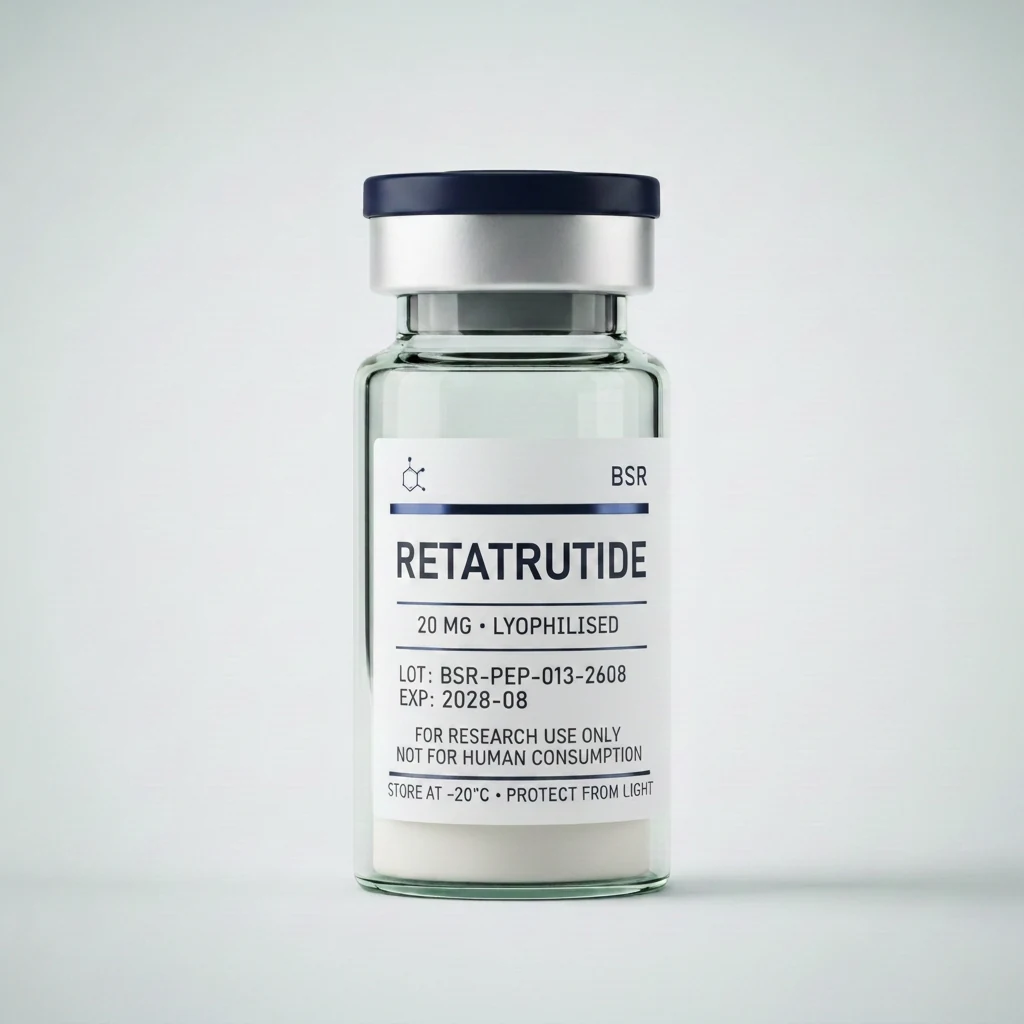
A synthetic triple agonist peptide with activity at the GIP, GLP-1 and glucagon receptors. Studied in receptor-binding and metabolic assay systems for its combined incretin and glucagon receptor signalling profile.
Add sterile bacteriostatic water to the vial to achieve your target working concentration.
Storage conditions: -20°C, dry
Form: Lyophilised
Solubility: Water, BAC water
Current batch: RT-260506-163
HPLC purity: 99.68%
MS verified: Yes
Expiry: May 2028
The certificate of analysis for this batch is issued with your order.
C₂₂₁H₃₄₂N₄₆O₆₈ · 4,731.4 Da
Retatrutide
out of stock
Free shipping on orders over £75
Working out volumes? Peptide calculator · Reconstitution guide
RT-260506-163 · HPLC 99.68%
The batch code matches the vial you will receive. Full analysis — purity, mass spectrometry, residual solvents and microbial limits — is issued with your order.
| Content | 20mg |
| Purity | 99.68% HPLC |
| Form | Lyophilised |
| Storage | -20°C, dry |
| Solubility | Water, BAC water |
Same-day dispatch — order within
Same-day dispatch before 3pm, Mon–Fri. Next dispatch .
via Royal Mail Tracked 24
Retatrutide
20mg · £79.99
Retatrutide is a synthetic triple-hormone-receptor agonist, acting at the GIP, GLP-1 and glucagon receptors. It is the newest of the incretin compounds in this catalogue and the subject of the most active research attention, with Phase 2 results published in the New England Journal of Medicine in 2023 and a Phase 2a trial in metabolic dysfunction-associated steatotic liver disease published in Nature Medicine in 2024.
It remains an investigational compound. Retatrutide is in clinical development and holds no marketing authorisation from the MHRA or the FDA; it is supplied here strictly as research material.
Mechanism in the literature
Retatrutide adds glucagon receptor agonism to the dual GIP and GLP-1 activity of earlier incretin compounds. The published trial literature describes this triple-receptor profile as the distinguishing feature of the molecule, and it is what the research interest turns on.
Published trials are clinical studies conducted under regulatory supervision by the developer. Nothing about that literature bears on material supplied for laboratory research, and none of it should be read as suggesting use in people.
Handling and reconstitution
Supplied lyophilised in vials from 20mg to 60mg. Bring the vial to room temperature before adding diluent, direct bacteriostatic water down the inner wall rather than onto the cake, and swirl rather than shake. The larger vials in this range hold a great deal of material, so the reconstitution volume needs working out before you start rather than after.
At 60mg the cost per milligram is materially lower than at 20mg, but the whole vial is reconstituted at once — that only makes sense where the solution will be used inside its stable window.
Storage and stability
Lyophilised material is held at -20°C and protected from light, with a two-year retest date on the certificate. Reconstituted solution is refrigerated and treated as a short-window preparation. Avoid repeated freeze-thaw cycling.
Common questions
What purity is BSR's Retatrutide?
The current batch tests at 99.68% by HPLC against a specification of not less than 98%, with identity confirmed by LC-MS. It is the highest purity figure in our current catalogue. The certificate also reports related impurities, residual solvents, heavy metals, endotoxins and microbial limits.
Which vial size works out cheapest?
Per milligram, the 60mg vial. The 20mg vial is £79.99 and the 60mg £149.99, so the larger vial is roughly £2.50 per milligram against £4.00. The trade-off is that the whole vial is reconstituted in one go.
Is Retatrutide approved as a medicine?
No. It is an investigational compound in clinical development with no marketing authorisation from the MHRA in the United Kingdom or the FDA in the United States. It is supplied for laboratory research use only and is not for human or animal consumption.
How does it differ from Tirzepatide?
Both are incretin receptor agonists. Tirzepatide acts at two receptors, GIP and GLP-1; Retatrutide adds a third, the glucagon receptor. That triple-receptor profile is the distinguishing feature in the published literature.
- Jastreboff A.M. et al. (2023) — Triple-Hormone-Receptor Agonist Retatrutide for Obesity: A Phase 2 Trial, New England Journal of Medicine
- Sanyal A.J. et al. (2024) — Retatrutide for metabolic dysfunction-associated steatotic liver disease: a randomized phase 2a trial, Nature Medicine
Cited as research context. BSR has no involvement in these studies and they do not constitute claims about this product.
No reviews of this compound yet. Reviews come only from customers who have bought it.
Sign in to review a compound you have bought.