Research Pipeline · 19 Jun 2026
BPC-157: What the 2026 Evidence Review, New Human Trial and Dual Regulatory Scrutiny Mean for Research Procurement
A March 2026 peer-reviewed review reinforces BPC-157's preclinical tissue-repair profile, yet human clinical data remain sparse and a newly registered controlled trial is the first to formally test the peptide in a musculoskeletal injury population. Meanwhile, the MHRA has opened investigations into UK clinics making unlicensed therapeutic claims, and the FDA is set to scrutinise the compound at its July 2026 PCAC meeting. Research-procurement teams need a clear picture of what is known, what…
12 sources cited
Key takeaways
- A March 2026 open-access review in Molecular Sciences (PMC) synthesises BPC-157's preclinical evidence across tissue repair, analgesia and gastrointestinal protection, confirming a consistent mechanistic signal while noting that human data remain very limited.
- As of March 2026, no actively recruiting clinical trials for BPC-157 appear on ClinicalTrials.gov; a newly registered study (NCT07437547) for acute hamstring strain represents the first formal randomised controlled trial in a musculoskeletal injury setting.
- In April 2026 the MHRA opened investigations into UK clinics making therapeutic claims about unlicensed peptides, with BPC-157 cited prominently; making medicinal claims for unlicensed products is a criminal offence under the Human Medicines Regulations 2012.
- BPC-157 is one of the seven peptides on the agenda for the FDA Pharmacy Compounding Advisory Committee (PCAC) meeting on 23–24 July 2026, which will consider whether the compound should be added to the 503A Bulks List.
- For UK research-procurement professionals, BPC-157 remains lawfully purchasable for laboratory and investigational research purposes only; no MHRA marketing authorisation exists and no NHS prescribing pathway is available.
What BPC-157 is
BPC-157 — Body Protective Compound 157 — is a synthetic pentadecapeptide of 15 amino acids derived from a protective protein first isolated from human gastric juice. It carries a molecular weight of approximately 1,419 Da and is most commonly supplied as the acetate salt in lyophilised powder form for reconstitution. The compound does not appear in the human genome; its amino acid sequence corresponds to a fragment of a larger gastric protein rather than to an endogenous peptide produced by routine gene expression.
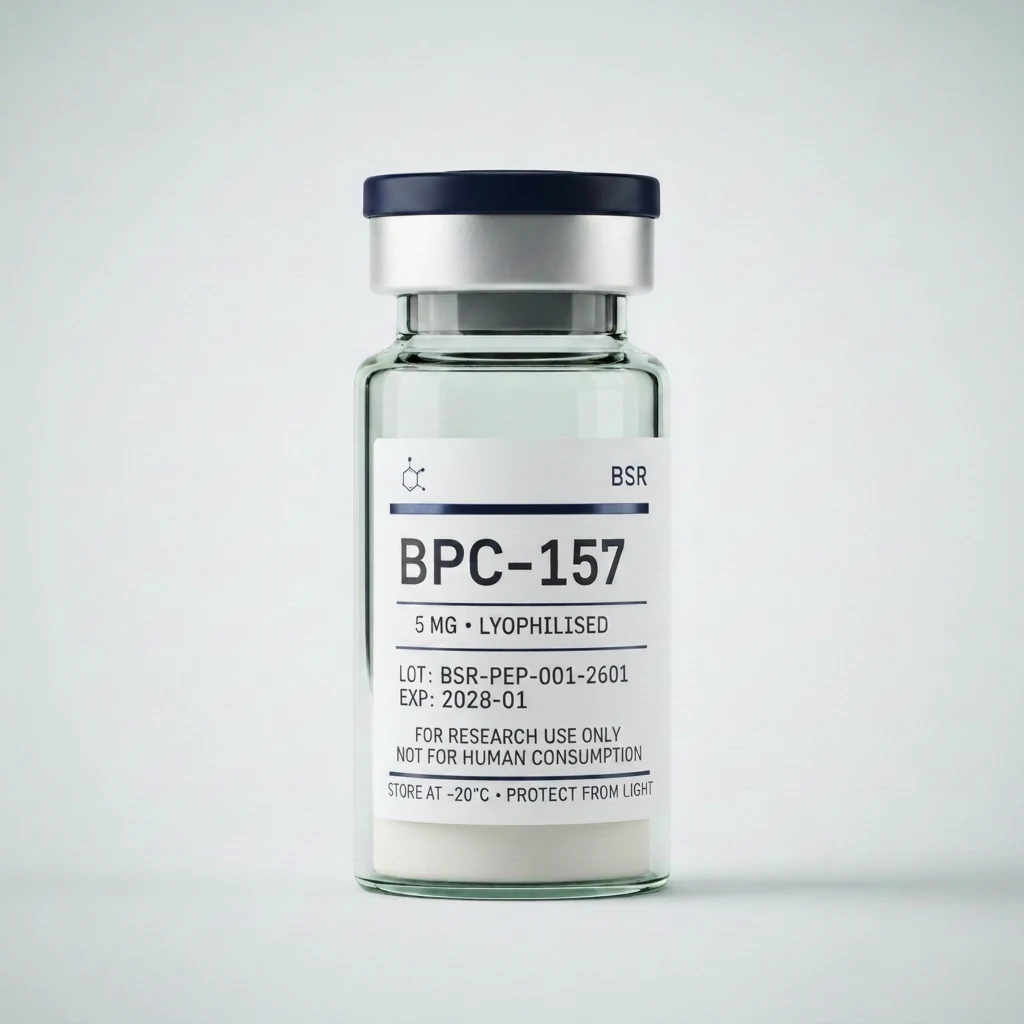
BPC-157 is not approved for human use by the MHRA, the EMA, or the FDA. It is not a controlled substance in the United Kingdom, and it is not a food supplement. Under UK law, it is legal to purchase and hold for legitimate laboratory and scientific research, provided suppliers use clear "for research use only / not for human consumption" labelling and make no medicinal claims.
The March 2026 evidence review: mechanism and preclinical signal
A March 2026 peer-reviewed review published in International Journal of Molecular Sciences and indexed on PubMed Central provides the most recent systematic synthesis of BPC-157's biology. The authors characterise the compound as having notable reparative and anti-inflammatory properties across diverse preclinical models. Mechanistically, the review records that BPC-157 supports angiogenesis, collagen synthesis, fibroblast activity, and modulation of nitric oxide pathways, contributing to enhanced healing of muscle, tendon, ligament, bone, and gastrointestinal tissue. It additionally reports reduced inflammatory cytokine activity, improved microvascular integrity, and beneficial effects on pain modulation through peripheral and dopaminergic mechanisms.
The review is careful to note significant methodological limits in the existing body of work. Much of the data suffers from small sample sizes, lack of appropriate and broad-ranging controls, and insufficient randomisation. A Phase I clinical trial conducted in 2015 on 42 patients examined pharmacokinetics and safety; the results were never published, for reasons that remain unknown. The review authors conclude that further studies are necessary to fully assess safety and efficacy in humans.
An independent literature review published in PMC in early 2025 reached a compatible conclusion: BPC-157 has not been approved for use in standard medicine by the FDA and other global regulatory authorities due to the absence of sufficient and comprehensive clinical studies confirming its health benefits in humans. The review also notes that the compound was temporarily banned by the World Anti-Doping Agency in 2022, though it is not currently on the WADA prohibited list.
The first randomised human trial: NCT07437547
A newly registered study on ClinicalTrials.gov (NCT07437547) represents the first formally registered randomised controlled trial of BPC-157 in a musculoskeletal injury population. The study is investigating subcutaneous BPC-157 versus matched placebo in participants with confirmed acute Grade II hamstring strain. The protocol randomises participants 1:1, administers the compound once daily for 14 days alongside a standard evidence-based rehabilitation programme, and includes clinical assessments at Days 3, 7, 14, 28 and 56, with a three-month return-to-play follow-up for recurrence monitoring.
Safety is assessed through adverse event monitoring, vital signs, and standard laboratory tests, and an independent Data and Safety Monitoring Committee will review unblinded safety data at predefined intervals. The trial rationale acknowledges that preclinical research suggests BPC-157 may influence pathways involved in tissue protection, angiogenesis, and repair, but that human clinical evidence remains limited, so a controlled trial is needed.
For procurement teams, this registration is meaningful: it signals that at least one investigator group considers the compound sufficiently credible to seek ethics approval and proceed with formal trial design. It does not, however, alter the current regulatory status or confer any indication of human safety or efficacy.
The MHRA investigation: UK regulatory risk for clinics
In April 2026, the MHRA opened an investigation into UK clinics and retailers making therapeutic claims about unregulated peptide products, with BPC-157 cited as the first compound named in the inquiry. The investigation followed a Guardian/BBC investigation that identified several UK clinics promoting experimental peptide treatments with claims linked to anti-ageing, injury recovery and cognitive enhancement, despite limited human clinical evidence.
The MHRA's position is clear. If clinics offering peptide injections make medicinal claims for those treatments, the products will be considered medicines and subject to regulation under the Human Medicines Regulations 2012, and the MHRA will take action against clinics which are identified as breaching the legal requirements. Some clinics advertised BPC-157 with stated benefits, pricing and treatment durations, even while labelling them as "research only"; the MHRA confirmed that this labelling does not shield a supplier from liability if medicinal claims are made.
Lynda Scammell, head of borderline products at the MHRA, stated that peptide products may be sold as cosmetics, supplements and medicines, and depending on their intended purpose, they fall under different regulatory frameworks. For UK research buyers, the practical implication is straightforward: making health or medicinal claims about unlicensed peptide products is a criminal offence under the Human Medicines Regulations 2012, and MHRA enforcement action can include product seizure and prosecution.
BPC-157 is not approved for human use by the MHRA, EMA, or FDA and has no marketing authorisation in the UK. No NHS prescribing pathway exists.
The FDA PCAC meeting: July 2026
In the United States, BPC-157 is scheduled for discussion at the FDA's Pharmacy Compounding Advisory Committee (PCAC) meeting on 23–24 July 2026. The meeting will consider seven peptides — including BPC-157 — that were removed from the Category 2 "significant safety risk" designation following the withdrawal of the original nominations in April 2026. The PCAC will advise on whether these substances should be formally added to the 503A Bulks List, which would authorise licensed US compounding pharmacies to prepare them against a valid prescription.
Critically, written comments submitted by 9 July 2026 will be provided directly to the Committee, and requests for oral presentations must be submitted by 30 June 2026. A second PCAC meeting is scheduled before the end of February 2027 to cover an additional five peptides. Stakeholders noting that companies have not studied BPC-157 for safety or efficacy and the FDA has not conducted a rigorous assessment of its use will find those themes likely to feature prominently in PCAC deliberations.
A favourable PCAC recommendation would not grant FDA approval. It would create a pathway for licensed US 503A pharmacies to compound BPC-157 against a prescription. Compounding eligibility is not the same as FDA approval — the compound would still lack formal clinical indication approval, Phase III trial data, and standardised dosing guidelines.
Procurement implications for UK labs
Research-procurement professionals sourcing BPC-157 for laboratory use should apply the following framework:
Regulatory status in the UK. BPC-157 is a research-use-only compound. It is not licensed by the MHRA for human or veterinary use, is not a food supplement, and must be held and used for laboratory and investigational research purposes only. Suppliers must not make medicinal claims; buyers should not repurpose procurement for clinical administration.
Evidence expectations. The preclinical mechanistic signal is consistent and documented in peer-reviewed literature. The human evidence base, however, consists of very few published studies and one unpublished Phase I dataset. The newly registered hamstring RCT (NCT07437547) will, if completed, represent the first adequately controlled safety and efficacy data in human subjects. Procurement teams should treat evidence claims with appropriate caution until trial readouts are available.
US regulatory watch. A favourable outcome at the July 2026 PCAC would represent a meaningful directional signal for the compound's long-term credibility. It would not, however, alter UK regulatory status or constitute MHRA authorisation. UK labs should monitor FDA and PCAC announcements as forward indicators of market trajectory and supply stability, rather than as direct licensing events.
Quality assurance. Standard good-practice requirements apply: third-party HPLC purity confirmation, mass spectrometry identity verification, supplier-issued Certificate of Analysis matched to the production lot, and cold-chain integrity documentation. Given the MHRA's current investigative posture towards the broader peptide sector, due diligence in supplier selection carries additional reputational weight.
Research-grade material, HPLC verified, certificate of analysis with every order.
The week's Intelligence in one email, every Friday morning.
Regulatory moves, trial readouts, supply-chain news. No product pitches. Unsubscribe in one click.
More in Research Pipeline
Thymosin Alpha-1: What 35 Countries of Clinical Use and a Lopsided PCAC Vote Mean for Research Access in 2026
07 Oct 2026
Viking Therapeutics Initiates Oral Maintenance Dosing Study for VK2735: What the GLP-1/GIP Dual Agonist's Two-Part Programme Tells Researchers About the Weight-Regain Problem
06 Oct 2026
GHK-Cu: What a Fresh Diabetic Wound Study and a Recruiting Phase 2 Trial Mean for the Copper Peptide's Research Standing
03 Oct 2026