Research Pipeline · 08 Aug 2026
BPC-157: What the Evidence Base Actually Shows — Mechanism, Human Data, and Post-PCAC Regulatory Position
BPC-157 is among the most discussed peptides in regenerative research, yet its human clinical evidence remains critically thin. Following the FDA PCAC's narrow 8-6 recommendation in July 2026, this spotlight examines what the peer-reviewed literature actually shows, what the rulemaking timeline means for procurement, and what UK research professionals need to understand about its current legal status.
12 sources cited
Key takeaways
- BPC-157 is a synthetic pentadecapeptide with an extensive preclinical record but a human evidence base that remains, by any objective measure, inadequate to support clinical recommendations.
- A 2026 PubMed narrative review confirmed that the compound's human pharmacokinetic profile is "critically undercharacterised," and a systematic review in orthopaedic sports medicine found only one human study meeting inclusion criteria out of 544 screened articles.
- The only published human safety data are from a two-person intravenous pilot — an IRB-approved study that found no adverse biomarker effects, but one that is insufficient, by the authors' own acknowledgement, to establish safety at scale.
- The FDA's Pharmacy Compounding Advisory Committee (PCAC) voted 8-6 on 23 July 2026 to recommend BPC-157 for the 503A Bulk Drug Substances List — overruling FDA staff scientists — but this recommendation is non-binding and triggers a formal rulemaking process estimated to take 12–24 months.
- In the United Kingdom, BPC-157 is not approved by the MHRA for any indication. It is also prohibited in competition by the World Anti-Doping Agency (WADA).
- For research procurement, the relevant practical questions are purity verification, stability characterisation, and supply chain provenance — not clinical availability, which remains a distant prospect in any jurisdiction.
What is BPC-157?
BPC-157 (Body Protection Compound 157) is a synthetic pentadecapeptide — a 15-amino-acid sequence — derived from a fragment of a gastric protein. It was first described in the scientific literature in 1992, with the earliest research originating from the laboratory of Predrag Sikiric at the University of Zagreb, Croatia. According to STAT News, the origins of the compound's research profile lie substantially in that single group, and independent replication by unaffiliated investigators has been limited.
The compound does not appear in the human genome. According to STAT News, a professor at Chang Gung University has noted that the peptide's amino acid sequence is absent from the human genome and may be produced by stomach microbes — a finding with significant implications for assumptions about endogenous activity.
Mechanism of action
Preclinical evidence characterises BPC-157 as a cytoprotective and regenerative agent acting through multiple pathways. According to a 2026 narrative review published in the International Journal of Molecular Sciences, experimental evidence indicates that BPC-157 supports angiogenesis, collagen synthesis, fibroblast activity, and modulation of nitric oxide pathways — contributing in animal models to enhanced healing of muscle, tendon, ligament, bone, and gastrointestinal tissue. The same review reports reduced inflammatory cytokine activity, improved microvascular integrity, and beneficial effects on pain modulation through peripheral and dopaminergic mechanisms.
In isolated tendon fibroblast studies, BPC-157 has been shown to promote cell migration and survival under stress. Researchers have linked this to activation of the FAK-paxillin signalling pathway and upregulation of growth hormone receptor expression in tendon fibroblasts. These are in-vitro findings and have not been replicated in controlled human trials.
A separate 2026 PubMed review on biopharmaceutical challenges and formulation strategies confirms that BPC-157 "exhibits unusual stability in gastric juice and demonstrates activity via oral, parenteral, and topical routes," but notes that its human pharmacokinetic profile "remains critically undercharacterised." A preclinical ADME study in two species confirmed a sub-30-minute plasma half-life and intramuscular bioavailability of 14–51% depending on species. Importantly, this short plasma half-life contrasts with prolonged biological effects lasting hours to days in animal models — a disconnect with significant implications for any future dosing strategy.
The evidence base: what peer review actually shows
The state of BPC-157 human research in 2026 can be summarised as: promising preclinical signals, a real but very small human foundation, and no randomised controlled trials for any indication.
Systematic reviews paint a consistent picture. A 2025 systematic review in the American Journal of Sports Medicine focused on orthopaedic sports medicine applications screened 544 articles. Of these, only one human clinical study met inclusion criteria — illustrating the thinness of the human evidence base. The preclinical findings were characterised as supportive: BPC-157 enhanced growth hormone receptor expression and pathways involved in cell growth and angiogenesis, while reducing inflammatory cytokines. In animal models, outcomes in muscle, tendon, ligament, and bone injury were improved.
A 2025 narrative review — "Regeneration or Risk?" (PubMed PMC12446177), cited by Irvine Health — searched six databases and concluded that despite extensive preclinical evidence, the human evidence base remains inadequate to support clinical recommendations, and that proper randomised controlled trials are required before BPC-157 can be considered evidence-based therapy.
Human safety data exist, but are limited to a single published pilot study. A PubMed-listed intravenous infusion safety study enrolled two participants — a 58-year-old male and a 68-year-old female — each of whom had previously received intravenous BPC-157. The infusions resulted in no measurable effects on cardiac, hepatic, renal, or thyroid biomarkers, and no side effects were reported. The study concluded that intravenous infusion of up to 20 mg was well-tolerated. As Irvine Health's analysis notes, this is an honest, IRB-approved study — and also, by the authors' own acknowledgement, a two-person pilot without a control group, which is not sufficient to establish safety at scale.
According to Irvine Health, all published human BPC-157 studies have been conducted by the same Florida-based research group, and independent replication has not yet occurred.
Regulatory status: US
BPC-157 is not an FDA-approved drug for any indication. In 2023, the FDA placed it on Category 2 of its bulk drug substances list for compounding pharmacies, citing insufficient safety data. In April 2026, it was removed from Category 2 after the original nominating parties withdrew their submission — but it was not simultaneously added to Category 1, nor to the 503A Bulks List that would authorise lawful compounding.
This placed BPC-157, along with several other peptides, in what regulatory lawyers at Sheppard Mullin described as "a regulatory gray zone" — no longer designated as posing a significant safety risk, but not affirmatively authorised for compounding under Section 503A. The firm cautioned that "compounders who interpret removal from Category 2 as implicit permission to compound do so at considerable enforcement risk."
At the FDA's PCAC meeting on 23–24 July 2026, the committee voted on seven peptides for potential 503A inclusion. According to TechTimes, the committee voted 8-6 (with one abstention) in favour of recommending BPC-157 for the 503A Bulk Drug Substances List, overruling FDA career scientists who had found no human injectable trial data.
However, as PharmExec reports, the vote was advisory only. A favourable PCAC recommendation initiates a formal rulemaking process in which the FDA must publish a proposed rule, accept public comment for 60–90 days, and issue a final determination. Legal experts cited by TechTimes estimate this process runs 12–24 months from a favourable vote, meaning "legally compounded BPC-157 could not be available from a licensed pharmacy before late 2027" under an optimistic timeline. The FDA is not bound to follow the committee's recommendation.
Olympia Pharmaceuticals notes that the FDA "has not announced a firm deadline for its final decision" on BPC-157 and that the next step "could take weeks or months, depending on the form of agency action." A historical parallel, cited by Peptides Insider, is instructive: glutathione cleared the same committee by a similar margin four years ago and remains off the 503A list.
FDA scientists highlighted a structural barrier to inclusion: absent universally accepted chemical definitions and formulas for BPC-157, basic identity, quality, and comparability remain unclear, undermining any safety and effectiveness assessment.
Regulatory status: UK and EU
In the United Kingdom, BPC-157 is not approved by the Medicines and Healthcare products Regulatory Agency (MHRA) for any indication. It is not licensed as a medicine and cannot be prescribed through standard NHS or private prescription channels. It has no equivalent European Medicines Agency (EMA) authorisation. Supply for legitimate in-vitro or ex-vivo research falls under the standard framework for research-use-only materials, with all the quality and documentation obligations that entails.
BPC-157 is also listed on the World Anti-Doping Agency (WADA) Prohibited List, a point relevant to any research involving competitive athletes or sport-adjacent populations.
Procurement considerations for UK research professionals
Given the above, UK laboratories procuring BPC-157 for legitimate research purposes should prioritise the following:
Purity documentation. The compound should be accompanied by a certificate of analysis from an accredited third-party laboratory, with HPLC purity confirmed at ≥98% and mass spectrometry confirmation of molecular identity. The 2026 PubMed formulation review highlights that BPC-157's structural characterisation can vary between suppliers, making identity confirmation particularly important.
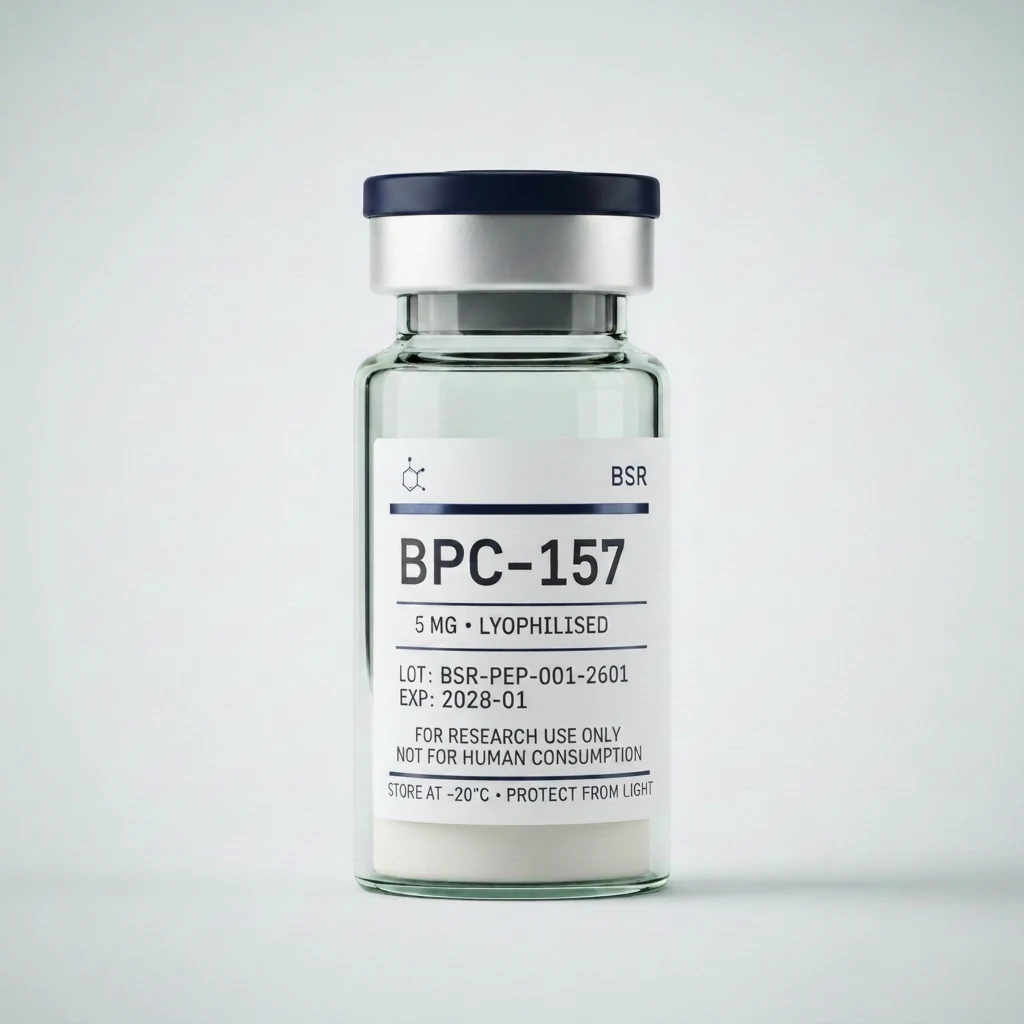
Stability and storage. The preclinical ADME data confirm a sub-30-minute plasma half-life, and the review notes that the disconnect between pharmacokinetic and pharmacodynamic profiles has significant formulation implications. Lyophilised powder should be stored at −20°C in the absence of reconstitution, with protection from repeated freeze-thaw cycles.
Supply chain provenance. Renew Youth notes that a substantial portion of the unregulated grey market consists of peptides sold by chemical manufacturers through unmonitored online channels entirely outside regulatory oversight. For research procurement, verifiable country of manufacture, GMP-equivalent synthesis conditions, and lot-to-lot consistency data are minimum due-diligence requirements.
Regulatory horizon monitoring. The July 2026 PCAC recommendation represents the most favourable US regulatory signal BPC-157 has received in years, but the rulemaking timeline means no change in legal compounding status is imminent. UK procurement professionals should treat the regulatory position as static for planning purposes through at least mid-2027, and monitor the FDA Federal Register for any notice of proposed rulemaking following the committee's recommendation.
Research-grade material, HPLC verified, certificate of analysis with every order.
The week's Intelligence in one email, every Friday morning.
Regulatory moves, trial readouts, supply-chain news. No product pitches. Unsubscribe in one click.
More in Research Pipeline
Thymosin Alpha-1: What 35 Countries of Clinical Use and a Lopsided PCAC Vote Mean for Research Access in 2026
07 Oct 2026
Viking Therapeutics Initiates Oral Maintenance Dosing Study for VK2735: What the GLP-1/GIP Dual Agonist's Two-Part Programme Tells Researchers About the Weight-Regain Problem
06 Oct 2026
GHK-Cu: What a Fresh Diabetic Wound Study and a Recruiting Phase 2 Trial Mean for the Copper Peptide's Research Standing
03 Oct 2026