Research Pipeline · 29 Jul 2026
CJC-1295 and Ipamorelin: The GHRH/GHRP Combination That Sits Outside the PCAC Process — What the Evidence Shows
While the FDA's Pharmacy Compounding Advisory Committee dominated peptide headlines this week, CJC-1295 and Ipamorelin occupy a distinct regulatory position: neither compound was among the twelve peptides removed from Category 2 in April 2026, nor is either scheduled for PCAC review. This briefing examines their mechanisms, the state of the clinical evidence, and what their current status means for UK research procurement.
8 sources cited
Key takeaways
- CJC-1295 (a GHRH analogue) and Ipamorelin (a selective GHRP) act on complementary receptors to amplify pulsatile growth hormone secretion; their combined use is a common preclinical protocol precisely because the two mechanisms are synergistic rather than redundant.
- Neither compound was among the twelve peptides removed from FDA Category 2 in April 2026, nor does either feature in the July 2026 PCAC vote outcomes or the forthcoming February 2027 PCAC tranche. Their US regulatory status is consequently different — and more complicated — than the six peptides recommended by the committee last week.
- The human clinical evidence base remains limited and predominantly involves short-duration, small-cohort studies in older adults or individuals with growth hormone deficiency; no large Phase 3 programme has been completed for either compound in isolation.
- In the United Kingdom, neither compound holds a marketing authorisation; research-grade supply is legal for bona fide in vitro and preclinical work under standard research-use-only conditions, but the MHRA's position on injectable research peptides warrants careful supplier due-diligence.
- The FDA's busy PCAC calendar — seven peptides reviewed in July 2026 and five more scheduled before February 2027 — may eventually draw CJC-1295 and Ipamorelin into a formal nomination process, but no timeline currently exists.
What are CJC-1295 and Ipamorelin?
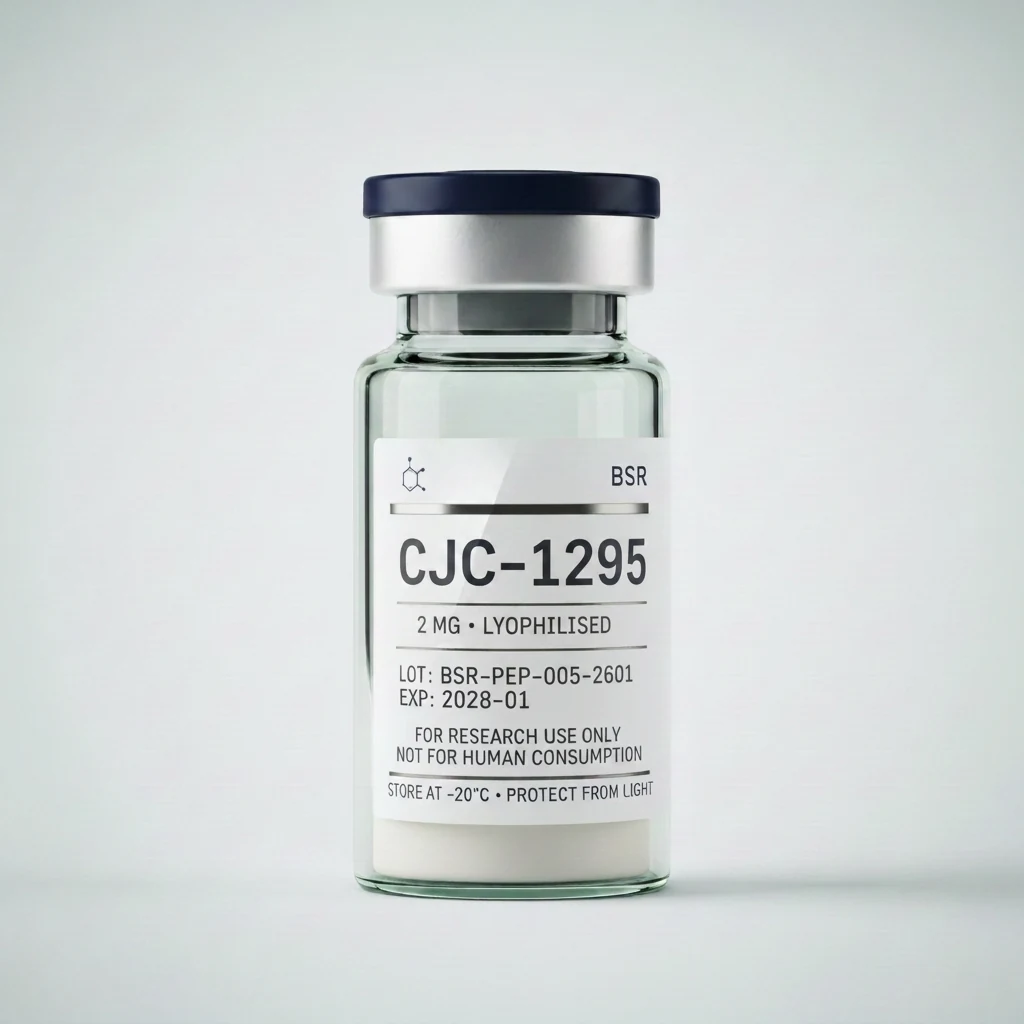
CJC-1295 is a synthetic analogue of growth hormone-releasing hormone (GHRH), the hypothalamic peptide that stimulates pituitary somatotrophs to release growth hormone (GH). The original molecule — sometimes called CJC-1293 in older literature — was modified by ConjuChem to extend half-life through a drug affinity complex (DAC) technology that covalently binds the peptide to endogenous albumin after injection. The DAC-bearing version, properly termed CJC-1295 with DAC, extends the plasma half-life from minutes (for native GHRH) to approximately six to eight days, according to published pharmacokinetic data. A modified GRF (1-29) preparation that lacks the DAC moiety is often sold under the same CJC-1295 label but has a substantially shorter half-life of approximately 30 minutes; procurement teams should confirm which form a supplier is providing, as the two are not interchangeable in experimental design.
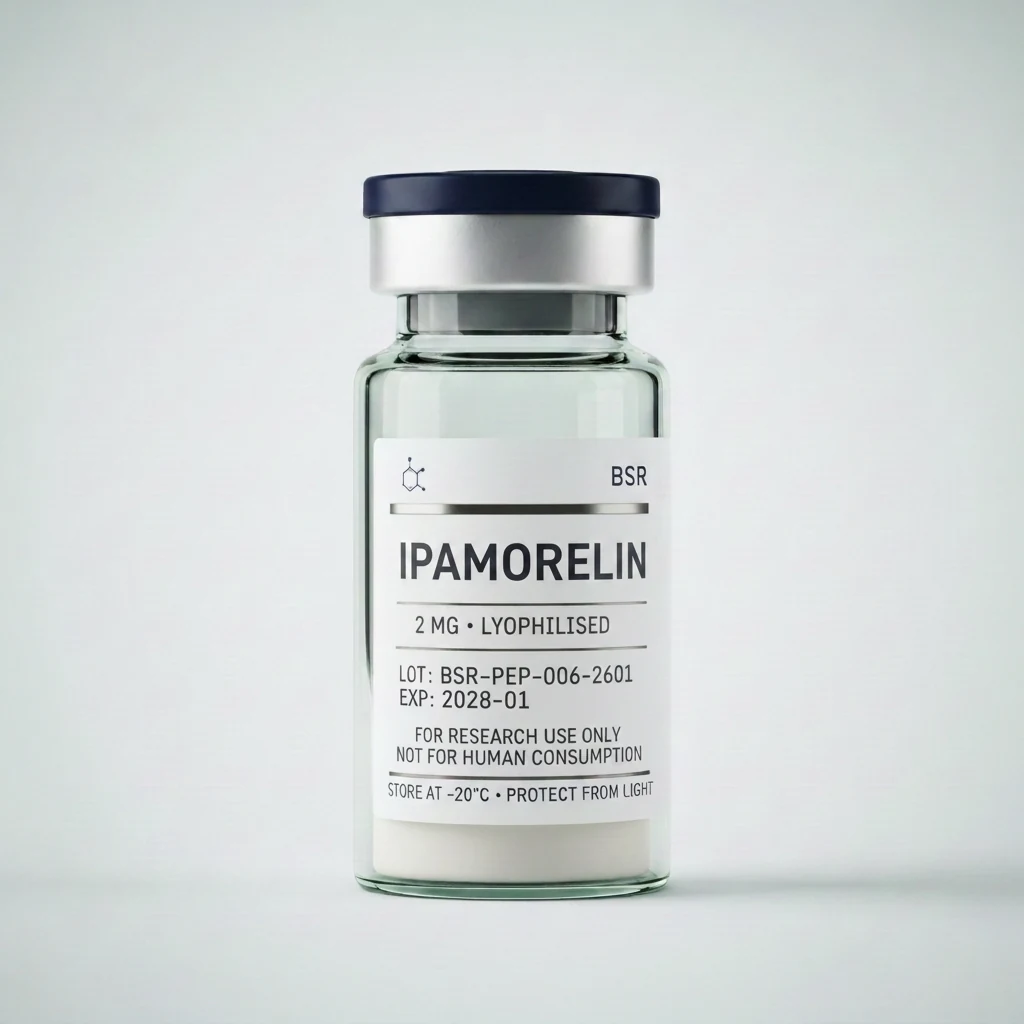
Ipamorelin is a pentapeptide (Aib-His-D-2-Nal-D-Phe-Lys-NH₂) and a selective agonist of the growth hormone secretagogue receptor (GHS-R1a), the same receptor activated by ghrelin. Unlike older GHRPs such as GHRP-6, Ipamorelin was specifically selected in structure–activity relationship programmes for its high selectivity: at standard research doses it does not appreciably stimulate ACTH, cortisol, or prolactin, and produces minimal effect on appetite-regulatory pathways, according to the original characterisation published by Raun et al. in the European Journal of Endocrinology.
Mechanism: why the combination is studied
GHRH (acting via CJC-1295) and GHRP (acting via Ipamorelin) stimulate GH release through distinct, complementary pathways. GHRH increases cAMP and activates adenylyl cyclase in somatotrophs, whereas GHS-R1a agonism operates partly through phospholipase C and intracellular calcium mobilisation. Crucially, somatostatin — the principal inhibitor of GH secretion — blunts GHRH-driven release but has comparatively less effect on GHRP-driven release. The combination therefore both increases the amplitude of GH pulses and partially overrides somatostatin-mediated suppression, producing a synergistic effect that preclinical data and small human studies suggest exceeds either compound administered alone.
This mechanistic rationale is why CJC-1295 and Ipamorelin are frequently co-administered in both research protocols and, in the United States, compounding pharmacy preparations — even though the two compounds were developed separately and have never been studied as a fixed-dose combination in a large-scale controlled trial.
State of the clinical evidence
CJC-1295
The pivotal human data for CJC-1295 (with DAC) were generated by Teichman et al. in a randomised, double-blind, placebo-controlled, dose-escalation study published in the Journal of Clinical Endocrinology & Metabolism in 2006. That study enrolled 65 healthy adults aged 21–61 and demonstrated dose-dependent, sustained increases in mean 24-hour GH concentrations and IGF-1 levels, with effects persisting for up to 28 days after a single injection. No serious adverse events were attributed to the compound. This remains the most-cited human pharmacology dataset for the molecule.
Since that study, no subsequent large controlled trial in any specific clinical population has been published, according to a review of available PubMed records. The compound has not entered FDA clinical development for a specific indication, and no New Drug Application or Investigational New Drug application is publicly listed on the FDA's database as of mid-2026. The clinical evidence therefore rests primarily on that single 2006 trial and a body of preclinical animal work in rodent and primate models.
Ipamorelin
Ipamorelin was originally developed by Novo Nordisk and extensively characterised in animal models during the late 1990s. Raun et al. (1998) demonstrated selective GH release in rats with no significant cortisol or prolactin stimulation at doses up to 500 µg/kg, establishing its selectivity profile. Human data are limited. A small Phase 1/2 programme conducted by Helsinn Healthcare for postoperative ileus — a GI indication where GH secretagogues have been explored for their prokinetic effects — reached clinical-stage work, but the programme did not produce published Phase 3 outcomes in that indication, and Helsinn's subsequent pipeline focus shifted to other areas.
No Ipamorelin-based product holds an FDA approval or an EMA marketing authorisation for any indication. In academic settings, the peptide is used as a research tool to probe GH axis physiology, with published in vitro and rodent data examining effects on bone density, body composition, and age-related GH decline.
Where these compounds sit in the US regulatory landscape
The PCAC process that generated headlines last week concerns the FDA's Section 503A Bulk Drug Substances List — specifically, which nominated peptides can be compounded by traditional (503A) pharmacies for individual patients with a valid prescription. The FDA removed twelve peptides from Category 2 in approximately April 2026, triggering the July PCAC meeting and a forthcoming second meeting before the end of February 2027 covering LL-37, GHK-Cu (injectable route), Dihexa, Melanotan II, and PEG-MGF, according to the FDA's own announcement and subsequently confirmed by the Orrick law firm's regulatory analysis.
CJC-1295 and Ipamorelin were not among those twelve compounds. Their Category 2 status — which designates substances that may not be compounded — has not changed as part of the April 2026 reclassification exercise. Accordingly, compounding either substance in the United States currently remains prohibited, and neither features in any publicly announced PCAC agenda. Research-grade supply for in vitro and preclinical laboratory use operates under a separate, research-use-only framework that does not constitute compounding.
The PCAC committee's advisory vote is not itself binding; even for the six peptides it recommended in July, formal notice-and-comment rulemaking is still required before any 503A pharmacy can legally compound them, a process that experts estimate will take additional months and could extend into 2027 or 2028. For CJC-1295 and Ipamorelin, even that process has not begun.
UK and MHRA considerations
In the United Kingdom, CJC-1295 and Ipamorelin are not licensed as medicinal products. The MHRA's enforcement posture on injectable research peptides has tightened since 2023 as part of broader action on unlicensed medicines sold online; procurement teams should confirm that any supplier operates under a legitimate research-use-only model, provides material with documented batch-level analytical testing (HPLC purity and mass spectrometry confirmation), and does not make therapeutic or clinical claims.
Importation of research chemicals for bona fide laboratory use by institutions is generally permissible, but individual importation of injectable peptides for personal use sits in a different legal category and has been the subject of MHRA advisory notices. Labs should review their institution's research governance policies before procurement and ensure purchasing records specify the intended research application.
What the evidence gap means for procurement decisions
For procurement professionals, the key asymmetry with CJC-1295 and Ipamorelin is that their mechanistic rationale is well-founded and their acute GH-stimulating effects in humans are documented, but their long-term safety and efficacy profiles in specific clinical populations have not been established in trials of sufficient scale or duration to support any therapeutic claim. The selectivity advantage of Ipamorelin over older GHRPs is mechanistically meaningful for research design, but it has not been formally validated in comparative human trials. The long half-life of CJC-1295-with-DAC is potentially valuable for sustained-release research paradigms, but the form without DAC — often confused with the former by suppliers — behaves pharmacokinetically very differently.
The FDA's PCAC process, however incomplete, has created a template for evaluating unapproved peptides against a four-factor framework covering safety, historical use, effectiveness evidence, and manufacturing concerns. When and if CJC-1295 or Ipamorelin are nominated for that review — which would require either a formal nomination submission or a regulatory decision to add them to an existing PCAC agenda — that framework will expose how thin the controlled human evidence currently is for both compounds. Researchers citing either peptide in grant applications or study designs should note that distinction clearly.
Summary
CJC-1295 and Ipamorelin occupy a mechanistically well-characterised but clinically under-evidenced position in the research peptide landscape. Their synergistic GH-axis effects are supported by plausible pharmacology and limited human data, but neither has a completed Phase 3 programme or an FDA or EMA approval. Their absence from the current PCAC process means their US regulatory status remains categorically different from the six peptides recommended for 503A compounding this week. For UK research laboratories, both compounds are procurable as research-grade material under appropriate institutional governance, but supply-chain diligence — including analytical certificate review — remains essential given the variable quality standards in the broader research peptide market.
Research-grade material, HPLC verified, certificate of analysis with every order.
The week's Intelligence in one email, every Friday morning.
Regulatory moves, trial readouts, supply-chain news. No product pitches. Unsubscribe in one click.
More in Research Pipeline
Thymosin Alpha-1: What 35 Countries of Clinical Use and a Lopsided PCAC Vote Mean for Research Access in 2026
07 Oct 2026
Viking Therapeutics Initiates Oral Maintenance Dosing Study for VK2735: What the GLP-1/GIP Dual Agonist's Two-Part Programme Tells Researchers About the Weight-Regain Problem
06 Oct 2026
GHK-Cu: What a Fresh Diabetic Wound Study and a Recruiting Phase 2 Trial Mean for the Copper Peptide's Research Standing
03 Oct 2026