Research Pipeline · 24 May 2026
GHK-Cu: The Copper Tripeptide Facing Its Second Regulatory Wave — What Research Labs Need to Know
GHK-Cu (copper tripeptide-1) has one of the stronger mechanistic evidence bases among research peptides, spanning wound healing, collagen remodelling, and genomic modulation of over a thousand genes. Following the FDA's April 2026 Federal Register notice, it now sits in the second wave of PCAC review, scheduled before February 2027. This briefing covers its biochemistry, the state of the clinical evidence, and what the split regulatory picture means for UK procurement teams.
16 sources cited
Key takeaways
- GHK-Cu (glycyl-L-histidyl-L-lysine copper complex) is a naturally occurring tripeptide-copper complex whose plasma concentrations decline markedly with age, providing a biological rationale for its study in wound healing and regenerative contexts.
- The peptide's genomic reach is unusually broad: studies attribute modulation of more than 1,000 genes to GHK-Cu, covering extracellular matrix remodelling, anti-inflammatory signalling, and cellular repair pathways.
- Topical GHK-Cu occupies a distinct regulatory position from injectable forms: it is lawfully incorporated into cosmetic and compounded dermatology preparations in both the US and UK without drug approval.
- Injectable GHK-Cu was placed on the FDA's Category 2 restricted list in 2023 and cannot currently be compounded by 503A or 503B pharmacies. However, the FDA's April 2026 Federal Register notice named GHK-Cu in a second PCAC advisory committee review, scheduled to conclude before February 2027.
- UK research-use-only supply remains unaffected by the US compounding timeline, provided standard RUO labelling and MHRA compliance obligations are met.
What GHK-Cu is
GHK-Cu is a tripeptide — three amino acids (glycine, histidine, lysine) — that binds a copper(II) ion to form a stable complex. It is a naturally occurring compound that declines sharply with age, correlating with reduced wound healing, skin thinning, and elevated inflammation. Quantitatively, GHK-Cu levels in young adults may reach around 200 ng/mL in plasma, but levels fall by more than half by age 60. That age-correlated decline provides the biological rationale that has driven decades of research interest.
The copper ion is not incidental to the molecule's activity. The copper component is essential for the peptide's biological activity; without the copper ion, the peptide does not exhibit the same regenerative and signalling properties. This is why GHK and GHK-Cu are referenced separately in the literature, even though it is the copper complex that carries demonstrated biological potency.
Mechanism of action
GHK-Cu operates across multiple cellular pathways rather than a single receptor target, which distinguishes it from most small-molecule drugs and makes its mechanism particularly relevant to tissue repair research.
Extracellular matrix modulation. At very low, non-toxic concentrations (1–10 nanomolar), GHK-Cu stimulates both synthesis and breakdown of collagen and glycosaminoglycans, and modulates the activity of metalloproteinases and their inhibitors (TIMP-1 and TIMP-2), acting as a regulator of wound healing and skin remodelling. It also stimulates collagen, dermatan sulphate, chondroitin sulphate, and decorin.
Angiogenesis and cellular recruitment. GHK was found to attract immune and endothelial cells to the site of an injury. Preclinical data show that GHK-Cu accelerated wound healing and increased blood vessel formation and the level of antioxidant enzymes in rabbits, with parallel findings replicated across rodent and porcine models.
Genomic reach. The most striking mechanistic claim in the GHK-Cu literature concerns gene regulation. Genomic analyses attribute to GHK-Cu the regulation of over 1,500 genes, including control of metalloproteinases and ECM breakdown, and enhancement of repair signalling — suggesting a systemic skin renewal effect. Studies indicate that GHK-Cu can reset the gene expression profile of aged skin cells to patterns more similar to younger cells, and this genomic reprogramming effect may explain the peptide's broad range of regenerative benefits beyond simple collagen stimulation.
MMP balance and the "copper uglies" caveat. GHK-Cu's influence on matrix metalloproteinases is a double-edged property. The peptide influences MMPs — enzymes that break down extracellular matrix components — helping balance their activity, promoting beneficial remodelling while preventing excessive tissue degradation. However, at higher concentrations or with suboptimal formulation, enhanced MMP-1 expression has been associated anecdotally with paradoxical accelerated collagen degradation, a phenomenon sometimes described in practitioner literature as "copper uglies." No controlled human data currently resolve the dose-response relationship for this risk.
State of the clinical evidence
The clinical evidence base for GHK-Cu is uneven across delivery routes and indications, a distinction that matters for procurement decisions.
Topical / dermatology. This is where the strongest human data exist. A 2024 multicentre study investigated 0.05% GHK-Cu gel after fractional laser resurfacing. Compared with standard care, the peptide group exhibited 25% faster epithelial recovery and reduced erythema within 72 hours; inflammatory markers IL-1β and TNF-α decreased by 30%, demonstrating measurable anti-inflammatory action. Earlier, a human trial comparing topical GHK-Cu to vitamin C and retinoic acid found GHK-Cu resulted in collagen increases in 70% of volunteers, outperforming both comparators. A 2025 review article published in BioImpacts examining GHK and its derivatives as anti-wrinkle peptide ingredients confirms the hydrophilic, oxidation-sensitive nature of the molecule, noting that permeation-enhancement methodologies can improve topical delivery, and that GHK has several properties spanning wound healing to wrinkle prevention or reduction, with GHK-Cu and Pal-GHK representing its principal therapeutic derivatives.
Wound healing (preclinical to limited clinical). GHK-Cu enhances collagen and elastin synthesis, angiogenesis, and fibroblast migration. A 2025 narrative review published on ResearchGate — covering studies from 2016 to 2025 — concluded that tripeptides including GHK-Cu can stimulate fibroblast migration, enhance collagen deposition, and support angiogenesis, while also exhibiting antimicrobial and anti-inflammatory properties, making them valuable candidates for both acute and chronic wound management.
Injectable / systemic. This is where the evidence gap is most pronounced. There are no completed randomised controlled trials evaluating systemic injectable GHK-Cu in humans. The preclinical data are substantial, but the FDA has issued a compounding safety communication calling out compounded injectables containing GHK-Cu as potentially risky, including immunogenicity concerns, and for systemic delivery that raises the bar for preclinical toxicology, pharmacology, and chemistry, manufacturing, and controls. Procurement teams sourcing injectable-grade material for in vitro mechanistic studies should note that the purity, copper-complex stability, and lot-to-lot consistency requirements are considerably more demanding than for topical-grade preparations.
Regulatory status: US
The US regulatory picture for GHK-Cu is bifurcated and currently in transition.
Topical and cosmetic. In topical form, GHK-Cu is regulated as a cosmetic active ingredient. The FDA does not require pre-approval for cosmetic ingredients; GHK-Cu (listed as copper tripeptide-1 on ingredient labels) can be legally included in over-the-counter skincare products and in physician-prescribed compounded topicals without drug approval.
Injectable compounding. Injectable GHK-Cu was placed in Category 2 by the FDA due to immunogenicity and impurity concerns; it cannot currently be legally compounded by any 503A or 503B pharmacy.
The PCAC second wave. The FDA's April 2026 Federal Register notice — which announced the July 23–24, 2026, Pharmacy Compounding Advisory Committee (PCAC) meeting for seven peptides including BPC-157 — also contained a separate announcement. The FDA announced that the PCAC will convene again before the end of February 2027 to review five additional peptides for the 503A Bulk Drug Substances List, including GHK-Cu, Melanotan II, Cathelicidin (LL-37), Dihexa acetate, and Mechano Growth Factor, Pegylated (PEG-MGF).
Critically, that PCAC review is a procedural step, not a reclassification itself. The PCAC recommendation is non-binding, and formal rulemaking is what comes next. Even if the PCAC recommends adding peptides to 503A's Category 1 list, notice-and-comment rulemaking is still required — a process that, under standard timelines, can take more than a year. Research procurement teams should not assume that Category 2 removal translates to immediate compounding access.
Regulatory status: UK
GHK-Cu's position in the UK is more straightforward. GHK-Cu is not FDA-approved as a drug, and the agency has never granted New Drug Application approval for GHK-Cu in any form or indication. By analogy in the UK, it holds no marketing authorisation as a finished medicinal product. However, the compound is legal to purchase for laboratory research. Self-administration is not legally sanctioned, though enforcement is minimal. UK suppliers operating under an MHRA-compliant research-use-only framework — with accurate labelling, published Certificates of Analysis, and no therapeutic claims — remain on solid legal ground, consistent with the broader framework described in MHRA guidance for unlicensed research substances.
In cosmetic formulations, copper peptides are permitted without concentration limits under both US and EU regulations provided they are non-therapeutic; brands must avoid claims implying wound healing, collagen regeneration, or medical efficacy.
Procurement considerations for UK research labs
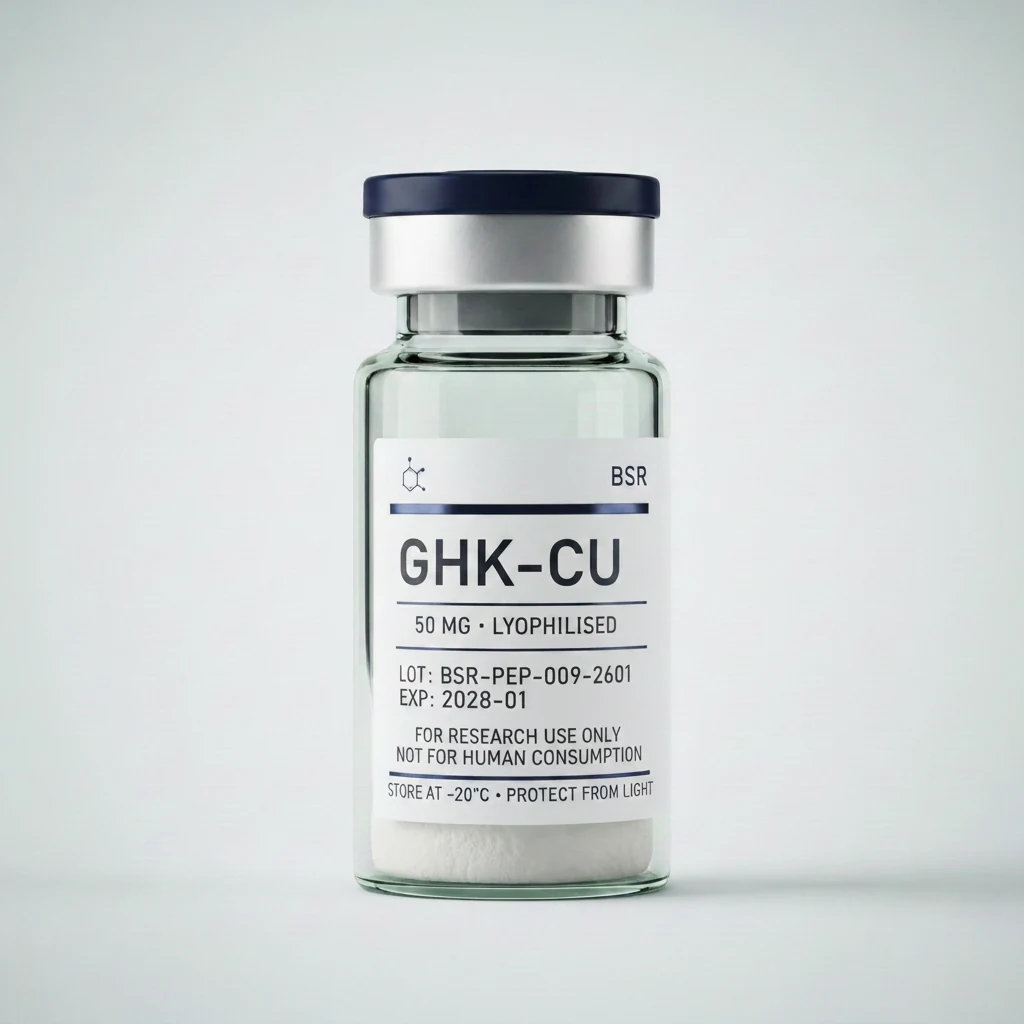
Several practical points follow from GHK-Cu's physicochemical profile. Because GHK-Cu is oxidation-sensitive, opaque or airless containers are preferred for storage. The copper complex is also water-soluble and relatively stable at neutral pH but degrades under oxidative conditions; cold chain management and protection from light are standard requirements. Research-grade injectable-format material should carry third-party HPLC confirmation of purity and a verified Certificate of Analysis — not a manufacturer's own-issued document — given known variability in copper-binding stoichiometry between lots. Regulatory experience suggests that copper complex stability across lots is a persistent analytical challenge, with questions about the active species in vivo remaining open.
For labs engaged in wound-healing or dermatology research, topical-grade GHK-Cu at pharmaceutical compounding quality (≥98% purity, endotoxin-tested) is the most defensible starting point given the existing clinical evidence base. Injectable-grade material is appropriate for specific mechanistic studies where the delivery route is intrinsic to the research question, but should be sourced with corresponding analytical rigour.
Outlook
GHK-Cu enters 2026 in an unusual position: it has arguably the most mature topical-form evidence base of any non-approved peptide in the dermatology and wound-healing space, yet its injectable form remains restricted and is at least eighteen months from potential US compounding approval following the pre-February 2027 PCAC review and any subsequent rulemaking. For UK research procurement, that distinction — not the compound in general, but the specific delivery route and its corresponding evidence and regulatory trajectory — should drive sourcing decisions.
The PCAC timeline provides a useful scheduling anchor. Labs planning research programmes that depend on compounded injectable-grade GHK-Cu via US-compliant channels should not expect regulatory clarity before late 2027 at the earliest. Topical and research-use-only supply chains are unaffected by that timeline.
Research-grade material, HPLC verified, certificate of analysis with every order.
The week's Intelligence in one email, every Friday morning.
Regulatory moves, trial readouts, supply-chain news. No product pitches. Unsubscribe in one click.
More in Research Pipeline
Thymosin Alpha-1: What 35 Countries of Clinical Use and a Lopsided PCAC Vote Mean for Research Access in 2026
07 Oct 2026
Viking Therapeutics Initiates Oral Maintenance Dosing Study for VK2735: What the GLP-1/GIP Dual Agonist's Two-Part Programme Tells Researchers About the Weight-Regain Problem
06 Oct 2026
GHK-Cu: What a Fresh Diabetic Wound Study and a Recruiting Phase 2 Trial Mean for the Copper Peptide's Research Standing
03 Oct 2026