Research Pipeline · 07 Aug 2026
Retatrutide's TRIUMPH Programme: Five Positive Phase 3 Readouts, a BLA Confirmed for Q1 2027 — What the Data Mean for Research Procurement
Eli Lilly has completed five positive Phase 3 studies for retatrutide, its first-in-class GIP/GLP-1/glucagon triple agonist, with topline TRIUMPH-2 and TRIUMPH-3 results released on 23 July 2026. The company has confirmed a Biologics Licence Application to the FDA in Q1 2027, marking the clearest regulatory timeline yet for the most efficacious agent in the GLP-1 class. For research procurement teams, the data package now available reframes how this investigational peptide should be sourced…
11 sources cited
Key takeaways
- Eli Lilly reported positive topline data from TRIUMPH-2 and TRIUMPH-3 on 23 July 2026, completing a five-trial positive Phase 3 package for retatrutide.
- TRIUMPH-2 (type 2 diabetes) showed up to 20.8% weight loss; TRIUMPH-3 (severe obesity with established cardiovascular disease) showed up to 22.6% at 80 weeks.
- The pivotal general-obesity trial, TRIUMPH-1, had already reported up to 30.3% mean weight loss at 104 weeks in May 2026.
- Lilly confirmed it will submit a Biologics Licence Application (BLA) to the FDA in Q1 2027, with approval projected under standard review in late 2027 or early 2028.
- Retatrutide remains investigational; it is not approved by the FDA, MHRA, or any other regulator. Research-use procurement must reflect that status.
What retatrutide is
Retatrutide (LY3437943) is a synthetic peptide developed by Eli Lilly that simultaneously activates three hormone receptors: GLP-1, GIP, and glucagon. It is administered as a once-weekly subcutaneous injection. The triple-agonist design distinguishes it from semaglutide (single GLP-1 agonist) and tirzepatide (dual GIP/GLP-1 agonist): Drug Discovery News summarises the mechanism hierarchy as semaglutide near 15% weight loss, tirzepatide near 21%, and retatrutide above 28%, with each added receptor target lifting the efficacy ceiling.
The glucagon receptor component is retatrutide's most distinctive feature: retaweightloss.com notes that glucagon activation increases energy expenditure and fat oxidation, contributing to weight reduction beyond what dual agonism alone achieves. This mechanism also creates a distinct pharmacological profile for metabolism and cardiovascular research compared to the earlier GLP-1 class agents.
The TRIUMPH programme: five positive studies
Eli Lilly's investor release of 23 July 2026 confirmed that retatrutide has now succeeded across five Phase 3 studies. The TRIUMPH programme comprises eight pivotal trials, enrolling more than 5,800 participants, plus a separate cardiovascular outcomes study of approximately 10,000 patients, according to parahealth.com's programme overview.
TRIUMPH-4 (December 2025): The first Phase 3 readout. Parahealth reports a mean body-weight reduction of 28.7% at 68 weeks on the 12 mg weekly dose in adults with obesity and knee osteoarthritis — the largest weight-loss signal ever reported in a randomised Phase 3 trial of any GLP-1-class agent. Secondary data included a 75.8% reduction in osteoarthritis pain scores on the WOMAC scale.
TRIUMPH-1 (May 2026): The pivotal general-obesity trial. AJMC reported 28.3% mean weight loss at 80 weeks and 30.3% at 104 weeks, in a 2,339-patient population with obesity or overweight without type 2 diabetes. A nested sleep apnoea substudy, presented at the American Diabetes Association meeting in June 2026, showed a 60.6% reduction in the apnoea-hypopnoea index from a severe-OSA baseline, according to retaweightloss.com.
TRANSCEND-T2D-1 (March/June 2026): A dedicated Phase 3 diabetes programme, separate from the TRIUMPH umbrella. Retaweightloss.com reports a -2.0% HbA1c reduction and 16.8% weight loss in 537 type 2 diabetes patients.
TRIUMPH-2 and TRIUMPH-3 (23 July 2026): The two most recently disclosed readouts. Eli Lilly's press release confirmed that in TRIUMPH-3 — adults with severe obesity (BMI ≥35) and established cardiovascular disease — participants lost up to an average of 22.6% body weight at 80 weeks. The Cardiology Advisor reports that TRIUMPH-2 showed up to 20.8% weight loss in adults with type 2 diabetes and obesity. Both studies met their primary endpoints. The lower efficacy in these more complex populations, relative to the non-diabetic TRIUMPH-1 cohort, is consistent with established patterns in the GLP-1 class, reflecting the metabolic burden of comorbidities rather than any inconsistency in the compound's pharmacology.
Filing timeline and regulatory pathway
Following the TRIUMPH-2 and TRIUMPH-3 readouts, Lilly confirmed a BLA submission to the FDA in Q1 2027, according to Pharmaceutical Executive. This is a Biologics Licence Application rather than a standard New Drug Application because retatrutide, as a peptide above the regulatory threshold, is classified as a biological product.
Retaweightloss.com's August 2026 update models the forward timeline as: BLA submission Q1 2027; FDA review 10–12 months under standard review, or approximately four months shorter under priority review designation; projected approval late 2027 under priority review or Q1 2028 under standard review.
For the United Kingdom, Lola Health's programme overview estimates MHRA approval in 2027–2028 (typically six to twelve months after an FDA decision), with a NICE technology appraisal and potential NHS coverage in 2028–2029 under that scenario. These are analyst projections; no formal MHRA submission has been announced.
Safety signals to note in the research context
The TRIUMPH trials have identified several adverse-event signals relevant to procurement and handling decisions. Retaweightloss.com reports dysesthesia (abnormal skin sensation) at up to 12.5% on the 12 mg dose in TRIUMPH-1, a signal not observed with semaglutide or tirzepatide and attributable to the glucagon receptor component. Discontinuation due to adverse events in TRIUMPH-2 ranged from 3.8% to 11.6% across doses, compared with 4.9% for placebo, according to retaweightloss.com's clinical results summary. Gastrointestinal adverse events remain the predominant class, consistent with the GLP-1 mechanism. A urinary tract infection signal was noted in TRIUMPH-1. Full safety datasets from TRIUMPH-2 and TRIUMPH-3 are to be published in peer-reviewed journals following presentation at a future medical conference, per Lilly's investor release.
Implications for research procurement
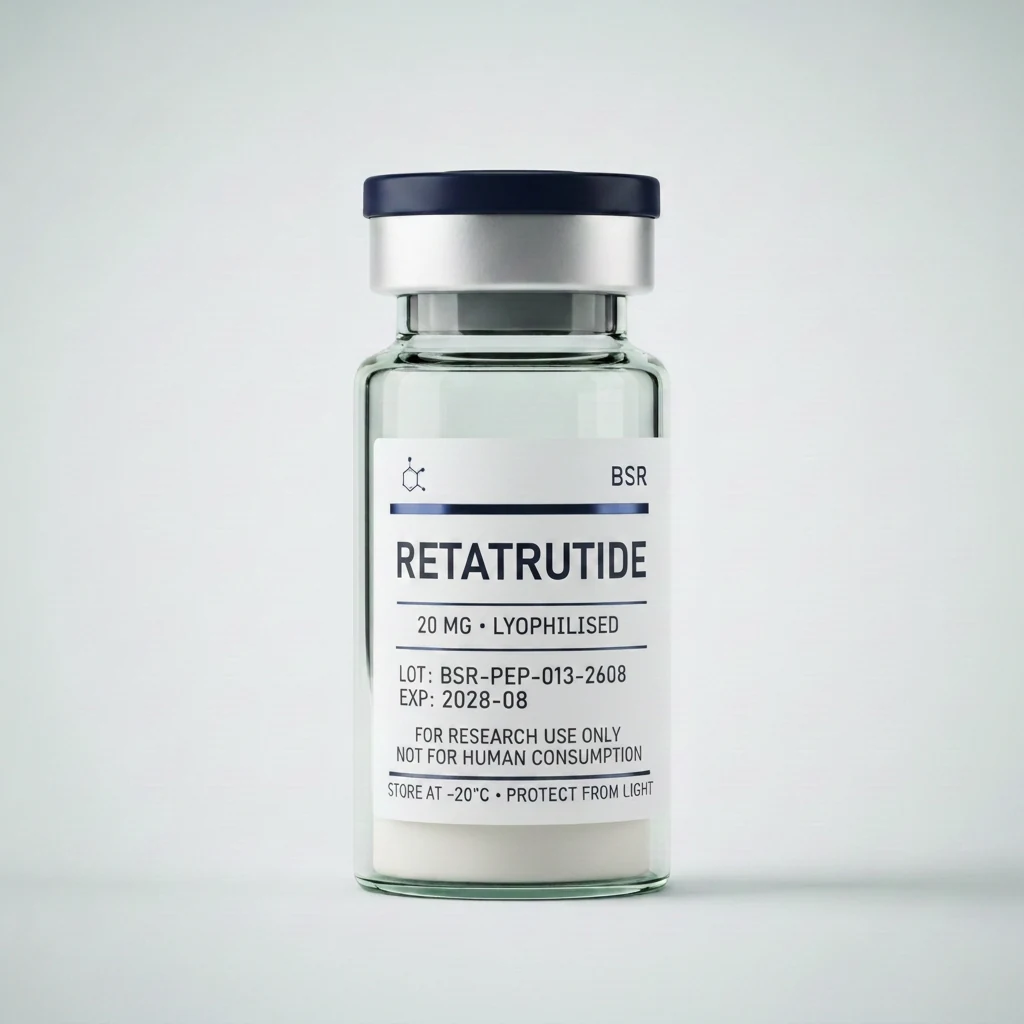
Retatrutide is currently classified as an investigational compound. Retaweightloss.com is explicit: "Retatrutide remains investigational and is not available by prescription." Any material supplied to research laboratories must be procured as a research-use-only (RUO) peptide, with full documentation of synthesis route, analytical confirmation (ideally mass spectrometry alongside HPLC purity data), and lot-specific CoA. The appearance of vendors offering "retatrutide" online has been noted; findhonestcare.com explicitly warns that such products are not legitimate and may be hazardous, as the compound remains outside any approved manufacturing framework.
The BLA filing confirmation also carries a secondary implication for research supply chains: once a BLA is accepted for review, the FDA will formally examine Lilly's proprietary manufacturing processes, making third-party synthesis of the identical sequence for commercial therapeutic use legally complex. For basic science and preclinical pharmacology research, RUO GIP/GLP-1/glucagon triple-agonist analogues with confirmed sequence identity will remain in demand through and beyond the regulatory review period. Procurement teams should verify that any research-grade material specifies the confirmed amino acid sequence, molecular weight, and counter-ion (acetate or trifluoroacetate salt form), and that cold-chain integrity is documented from manufacture to delivery.
Wider context: where retatrutide sits in the GLP-1 class
Drug Discovery News characterises the GLP-1 pipeline as "the most competitive pipeline in metabolic medicine," with each new mechanism pushing weight reduction higher. Retatrutide's TRIUMPH-1 figure of up to 30.3% at 104 weeks approaches the weight-loss outcomes associated with metabolic-bariatric surgery, a comparison that Lilly has deliberately avoided quantifying in its press releases but which independent analysts have noted. Whether the dysesthesia signal and the degree of discontinuation in higher-risk populations translate into label restrictions that narrow the therapeutic addressable market will be central to both regulatory and commercial decisions over the next 18 months. For research teams studying the glucagon receptor axis, MASLD mechanisms, or osteoarthritis-related metabolic pathways, the TRIUMPH dataset now in the public domain provides a substantially richer evidence base than was available even six months ago.
Research-grade material, HPLC verified, certificate of analysis with every order.
The week's Intelligence in one email, every Friday morning.
Regulatory moves, trial readouts, supply-chain news. No product pitches. Unsubscribe in one click.
More in Research Pipeline
Thymosin Alpha-1: What 35 Countries of Clinical Use and a Lopsided PCAC Vote Mean for Research Access in 2026
07 Oct 2026
Viking Therapeutics Initiates Oral Maintenance Dosing Study for VK2735: What the GLP-1/GIP Dual Agonist's Two-Part Programme Tells Researchers About the Weight-Regain Problem
06 Oct 2026
GHK-Cu: What a Fresh Diabetic Wound Study and a Recruiting Phase 2 Trial Mean for the Copper Peptide's Research Standing
03 Oct 2026