Research Pipeline · 24 Aug 2026
Epitalon: The Pineal Tetrapeptide With a PCAC Vote, Four Decades of Russian Research, and No Western Clinical Trials
Epitalon, a synthetic tetrapeptide derived from a pineal-gland extract, received a favourable PCAC recommendation on 24 July 2026 — cleared 7-5 against FDA staff advice. Its evidence base spans four decades of Russian research, compelling in vitro and animal data, and a near-complete absence of independent Western clinical trials. This profile examines the mechanism, the literature, and what the regulatory development means for UK research procurement.
11 sources cited
Key takeaways
- Epitalon (Ala-Glu-Asp-Gly) is a synthetic tetrapeptide derived from epithalamin, a natural pineal-gland extract, and was developed over four decades by Vladimir Khavinson's group at the St Petersburg Institute of Bioregulation and Gerontology.
- Its proposed primary mechanism is activation of telomerase reverse transcriptase (hTERT), with secondary effects on pineal melatonin secretion and circadian regulation.
- The FDA's Pharmacy Compounding Advisory Committee (PCAC) cleared Epitalon 7-5 on 24 July 2026, against the written recommendation of FDA scientific staff, who cited an absence of registered clinical trials.
- The PCAC vote is advisory only. Formal rulemaking — a Notice of Proposed Rulemaking, public comment period, and Final Rule — is required before any pharmacy may lawfully compound Epitalon under Section 503A.
- In the United Kingdom, Epitalon has no MHRA-approved product and no licensed compounding route; it remains a research-use-only compound subject to standard import and supply controls.
What is Epitalon?
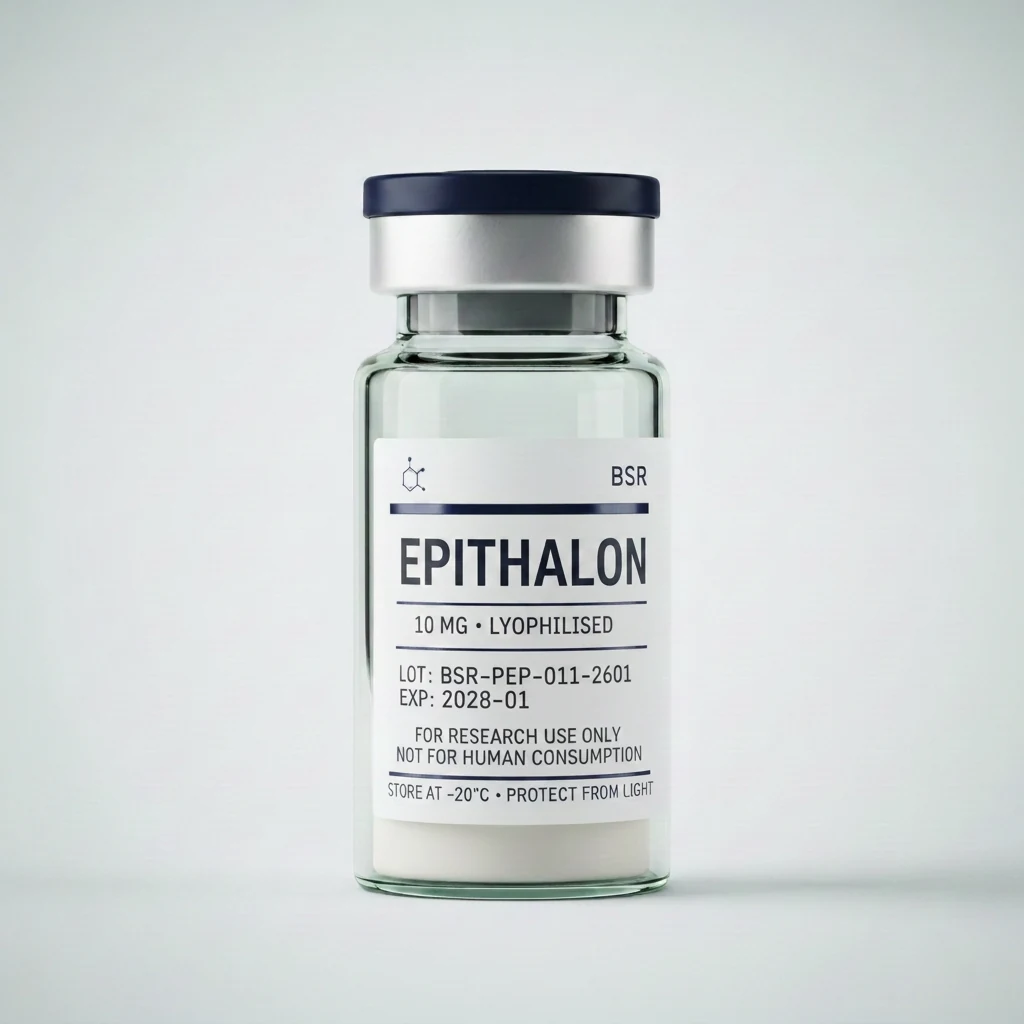
Epitalon is a synthetic tetrapeptide (Ala-Glu-Asp-Gly) developed by Russian scientist Vladimir Khavinson at the St Petersburg Institute of Bioregulation and Gerontology. It is based on epithalamin, a peptide extract from the pineal gland. The compound is also rendered in English-language literature as "Epithalon," reflecting different transliterations of the original Russian; in commercial and research contexts internationally, "epithalon" has become the more common spelling, though "epitalon" still appears widely in translated Russian-origin publications.
In the 1980s, Soviet gerontologists at the St Petersburg Institute began investigating a central question: could the ageing process be modulated at the peptide level? Their hypothesis was that the pineal gland produced regulatory peptides that declined with age, and that restoring these peptides might slow the hallmarks of ageing.
The FDA's July 2026 PCAC agenda listed both the free base and acetate forms together as Epitalon-related bulk drug substances.
Mechanism of action
Epitalon's research interest rests on three partially overlapping mechanisms.
Telomerase activation. Epitalon is proposed to activate telomerase reverse transcriptase (hTERT) expression, enabling telomere elongation. Secondary mechanisms include stimulation of pineal gland melatonin production and modulation of cell cycle regulators. The molecular mechanism by which a four-amino-acid peptide reaches the nucleus and activates telomerase gene expression is not well-characterised.
Circadian and melatonin restoration. The pineal gland synthesises melatonin and regulates circadian rhythm. Pineal function declines with age, contributing to sleep fragmentation and disrupted seasonal hormonal cycles in older adults. Epitalon, derived as it was from a pineal extract, appears to restore melatonin secretion in aged monkeys and humans in several published trials. The restoration is partial rather than complete, but measurable.
Epigenetic and inflammatory modulation. Epitalon appears to suppress expression of CCL11 and HMGB1 — genes linked to systemic inflammation and accelerated ageing. It also influences epigenetic methylation patterns in animal ageing models. If verified in humans, this would position Epitalon not merely as a telomere compound but as something operating at the level of epigenetic clocks.
The evidence base
In vitro
The foundational Epitalon study was published in 2003 by Khavinson and colleagues in the Bulletin of Experimental Biology and Medicine. It reported that Epitalon induced telomerase activity and produced measurable telomere elongation in human somatic cells, including fetal fibroblasts pushed beyond the Hayflick limit. A 2004 follow-up confirmed the fibroblast data and added observations on cell division capacity.
Cell-line studies — most notably by the Khavinson group — show Epitalon increases telomerase activity in cultured human fibroblasts and extends telomere length through either telomerase upregulation or the alternative lengthening of telomeres (ALT) pathway. These findings have been reproduced enough times in vitro to be taken seriously; what remains unclear is whether these in vitro effects translate to meaningful telomere extension in vivo at practical dosing.
Animal studies
The most striking data in the Epitalon literature comes from rodent longevity studies conducted by Khavinson's group. These experiments demonstrated lifespan extensions in the range of 15–30% in treated versus control animals, alongside reduced tumour incidence rates. Extended median and maximum lifespan in rodent models is a demanding experimental endpoint — one that requires carefully controlled housing, nutrition, and environmental conditions to be interpretable.
Fruit fly (Drosophila) models reported lifespan extensions of approximately 11–16% across multiple experiments by Khavinson's group. Russian studies across rats, mice, and rhesus monkeys have shown Epitalon extends median and maximum lifespan modestly, reduces tumour incidence in some tumour-prone rodent strains, and restores age-related melatonin decline in aged primates. Effect sizes are small to moderate, and the trials are old by modern methodological standards.
These studies were significant, but they came from a single research group, conducted in a single country, with limited independent replication — a well-documented limitation in this literature.
Human data
Does Epitalon actually lengthen telomeres in humans? The honest answer is: we do not know from current evidence. Cell culture studies demonstrate telomerase activation in human fibroblasts, and animal models show telomere-related outcomes consistent with the proposed mechanism. However, there are no peer-reviewed, independently replicated, controlled trials in healthy human subjects demonstrating that systemic Epitalon administration meaningfully lengthens leucocyte telomeres over time.
Human in vivo RCT data does not yet exist in the public literature. Epitalon is a research compound with no FDA approval and no published in vivo human clinical trial data. The cell and animal evidence is genuinely impressive, but the translation to living humans has not been formally established.
One area of partial exception is melatonin restoration. One human observational study reported improved health outcomes in elderly subjects. No Western peer-reviewed RCTs exist.
A potential safety concern specific to the mechanism warrants mention: the theoretical cancer risk associated with telomerase activation is a topic of ongoing scientific debate — current animal data suggests Epitalon may actually inhibit certain cancers, but more research is needed.
Regulatory position
United States
In 2023, the FDA added Epitalon and six other peptides to a list of products it deemed too risky for compounding pharmacies to produce. In April 2026, the FDA withdrew Epitalon and several others from the high-risk list in a move Kennedy said would "immediately begin shifting demand away from the black market."
At the July 23–24, 2026 meeting of the Pharmacy Compounding Advisory Committee, the PCAC voted to recommend adding certain peptides — including Epitalon — to the 503A compounding bulk substance list, a step toward making them eligible for lawful compounding.
Epitalon passed 7-5 with one abstention. This outcome is particularly striking given that FDA staff observed Epitalon has no registered clinical trials and a notably thin evidence base supporting its proposed use. The overall pattern is unmistakable: the committee's votes ran contrary to FDA staff's briefing recommendations against inclusion for all seven substances.
The PCAC votes did not immediately make Epitalon lawful for compounding under Section 503A. PCAC serves an advisory role, and the FDA retains the authority to ultimately decide whether a substance is placed on the 503A Bulks List. Accordingly, pharmacies should not interpret the favourable votes as authorisation to begin compounding Epitalon.
The FDA will review the committee's recommendation and decide whether to initiate formal rulemaking. If it does, it publishes a Notice of Proposed Rulemaking in the Federal Register, opens a public comment period, reviews those comments, and publishes a Final Rule adding the substances to the 503A Bulks List. This process typically takes 12 months or more after the committee recommendation.
A second PCAC meeting is also relevant to the broader pipeline: the FDA has announced a further PCAC meeting before the end of February 2027 to review five additional peptides for possible inclusion on the 503A Bulks List — GHK-Cu, LL-37, Dihexa acetate, Melanotan II, and PEG-MGF — all previously in a withdrawn or no-active-review state.
United Kingdom
Epitalon holds no MHRA marketing authorisation and there is no licensed compounding pathway equivalent to the US 503A framework that would permit routine clinical dispensing. Under MHRA guidance, unlicensed medicines may be supplied by a Specials manufacturer holding an MS licence, or imported as a named-patient product, but both routes require a documented clinical need and a prescribing practitioner's oversight. For research institutions, Epitalon supplied as a research-use-only (RUO) compound sits outside these routes and must not be administered to humans. Standard import documentation, cold-chain handling, and independent certificate-of-analysis verification apply.
What this means for research procurement
For UK laboratories procuring Epitalon as a research compound, several practical points follow from the evidence review.
-
Provenance matters. Given that the published literature originates almost entirely from a single Russian research group, independent verification of purity is especially important. HPLC purity of ≥98% and mass spectrometry confirmation of the correct molecular weight (Ala-Glu-Asp-Gly; MW 432.38 Da) should be standard requirements on any certificate of analysis.
-
The PCAC outcome does not change UK status. The US advisory vote has no direct effect on MHRA enforcement. Epitalon remains an unlicensed substance in the UK, and the RUO designation must be maintained rigorously.
-
Evidence limitations are real. FDA staff's characterisation — that Epitalon has no registered clinical trials and a notably thin evidence base — is accurate. The committee's vote reflected the broader political environment in which Secretary Kennedy has publicly advocated for expanded patient access to peptides as part of the Administration's health freedom platform, rather than a revised scientific consensus on the compound's human safety and efficacy profile.
-
Monitor the rulemaking. The PCAC vote does not automatically change which peptides can be compounded. Before deciding whether to add any peptides to the 503A Bulks List, the FDA will continue reviewing comments and documentation submitted to the public docket, then publish a proposed rule, followed by a further public comment period, before issuing a final rule. This process will be the meaningful regulatory milestone for those tracking US market access.
Research-grade material, HPLC verified, certificate of analysis with every order.
The week's Intelligence in one email, every Friday morning.
Regulatory moves, trial readouts, supply-chain news. No product pitches. Unsubscribe in one click.
More in Research Pipeline
Thymosin Alpha-1: What 35 Countries of Clinical Use and a Lopsided PCAC Vote Mean for Research Access in 2026
07 Oct 2026
Viking Therapeutics Initiates Oral Maintenance Dosing Study for VK2735: What the GLP-1/GIP Dual Agonist's Two-Part Programme Tells Researchers About the Weight-Regain Problem
06 Oct 2026
GHK-Cu: What a Fresh Diabetic Wound Study and a Recruiting Phase 2 Trial Mean for the Copper Peptide's Research Standing
03 Oct 2026