Research Pipeline · 25 Jul 2026
Epitalon: The Telomere Tetrapeptide Heading Into Its First FDA Compounding Vote Tomorrow
Epitalon — a synthetic four-amino-acid peptide derived from pineal gland extract — faces its first formal FDA compounding review on 24 July 2026, the second day of the PCAC meeting at White Oak. With fresh independent evidence from a 2025 Biogerontology study, a negative FDA staff recommendation, and reported conflicts of interest on the panel itself, the regulatory moment is more contested than the peptide's three decades of largely preclinical research would suggest.
16 sources cited
Key takeaways
- The FDA's Pharmacy Compounding Advisory Committee (PCAC) convenes on 23–24 July 2026 to review seven peptides for potential inclusion on the 503A Bulk Drug Substances List; Epitalon is scheduled for Day 2 (24 July).
- FDA career scientists have recommended against listing all seven peptides, citing insufficient characterisation, limited human clinical data, and unassessed immunogenicity risk.
- An independent 2025 study published in Biogerontology by researchers at Brunel University London confirmed telomere lengthening in human cell lines — the most significant external replication of Epitalon's core mechanism to date.
- A PCAC vote in favour of a peptide is not an authorisation to compound; it triggers a separate notice-and-comment rulemaking process that typically takes six to eighteen months.
- Reported conflicts of interest among newly appointed PCAC members have attracted media scrutiny, with the Associated Press, STAT News, and the Washington Post all covering the committee's composition ahead of the meeting.
What is Epitalon?
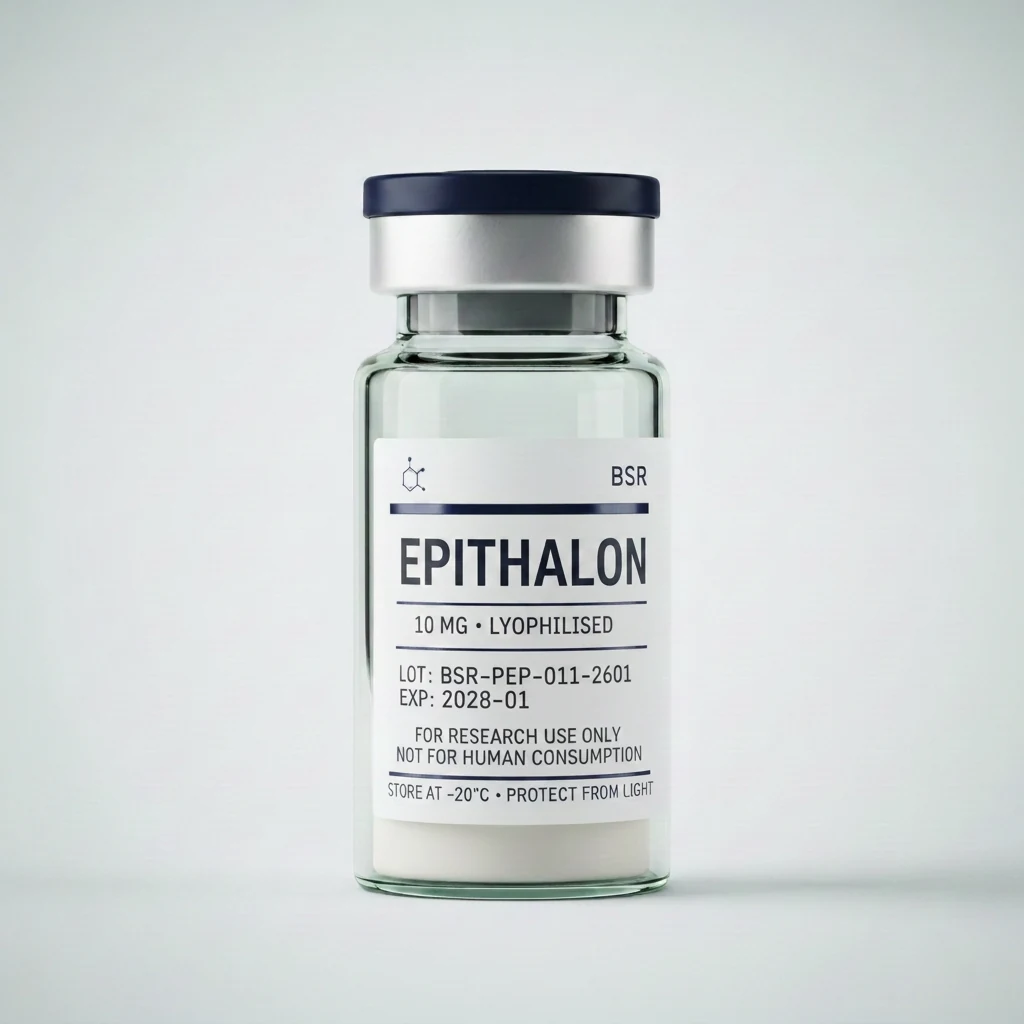
The tetrapeptide (AEDG) — Ala-Glu-Asp-Gly — known as Epitalon (or Epithalon) was first identified in a pineal gland extract and is based on the polypeptide Epithalamin. The body naturally produces very small amounts of this peptide; it is available as a synthetic compound for research use only.
Of all the peptides associated with longevity research, Epitalon has the most compact molecular structure and arguably the most ambitious proposed mechanism: that a four-amino-acid peptide can activate telomerase, lengthen telomeres, and restore pineal melatonin production in ageing adults. Unlike many longevity claims, this one is tethered to real, if limited, Russian and international research spanning three decades.
A critical distinction for interpreting the evidence: Epitalon is the synthetic tetrapeptide Ala-Glu-Asp-Gly — molecularly defined and reproducible — whereas Epithalamin is a polypeptide complex extracted from bovine pineal glands with variable composition and no molecular standardisation. Many of the human observational studies — including cohort data reporting lower mortality and improved melatonin rhythms in elderly subjects — used Epithalamin, not synthetic Epitalon. Those outcomes cannot be directly extrapolated to the synthetic compound.
Proposed mechanisms
Research interest in Epitalon centres on three principal biological pathways.
Telomerase activation and telomere biology. Epitalon is understood to exert anti-ageing effects on mammalian cells through the induction of telomerase enzyme activity, resulting in the extension of telomere length. A strong link exists between telomere length and ageing-related diseases; telomeres are considered a biomarker of ageing, and increasing or maintaining their length may contribute to healthy ageing and longevity.
Pineal and melatonin regulation. Research in elderly humans and senescent monkeys shows Epitalon restores nighttime melatonin peaks and normalises the circadian rhythm of melatonin secretion.
Antioxidant and cytoprotective activity. The primary research-backed activities attributed to Epitalon include telomerase activation, telomere elongation, pineal gland and melatonin regulation, improved circadian rhythm, antioxidant activity, retinal protection, and neuroendocrine normalisation.
State of the evidence
In vitro. The foundational in vitro work dates to 2003, when Khavinson and colleagues reported that Epitalon induced telomerase activity in human fibroblasts and extended replicative capacity. A 2025 Biogerontology study from Brunel University London demonstrated dose-dependent telomere length extension in normal cells through hTERT and telomerase upregulation. In cancer cells, significant telomere length extension also occurred through alternative lengthening of telomeres (ALT) activation. Only a minor increase in ALT activity was observed in normal cells, indicating specificity. The authors concluded that Epitalon can extend telomere length in normal healthy mammalian cells through upregulation of hTERT mRNA expression and telomerase enzyme activity.
This 2025 Brunel study is noteworthy because, as sources note, it came from outside Khavinson's original laboratory — providing the most significant independent replication of the core telomere mechanism to date.
Animal data. Animal models show a 12–24% increase in median and maximum lifespan. Anisimov and colleagues reported longer lifespan and fewer spontaneous tumours in mice, though these remain animal findings.
Human evidence. Human data remains limited to observational work and cohort studies using the parent extract Epithalamin. No large-scale randomised controlled trial in humans has been completed. This absence of controlled human trial data is the central point on which FDA staff have based their negative recommendation.
FDA's position ahead of the PCAC vote
Inclusion on the 503A Bulks List means FDA has formally determined, through rulemaking, that a bulk drug substance may be used in compounding under Section 503A of the Federal Food, Drug, and Cosmetic Act.
In briefing documents posted ahead of the meeting, FDA reviewers concluded that none of the seven substances — including Epitalon — should be added to the 503A Bulks List. Across all seven, FDA cited that the substances are not well-characterised, that there is little or no human evidence of effectiveness for the proposed (mostly injectable) routes, and that there is insufficient human safety data — including unassessed immunogenicity risk.
The procedural removal of these peptides from Category 2 should not be read as a go-ahead to compound them. Under FDA's current policy, removal of a bulk drug substance from Category 2 does not, on its own, authorise use of that substance in compounding or bring it within FDA's interim enforcement discretion policy for substances in Category 1.
Contested committee composition
The meeting has attracted attention well beyond the scientific questions. At least three members of the FDA panel deciding whether these peptides get a legal compounding pathway have financial ties to the peptide industry — including two who currently sell peptides to patients, according to reporting by the Associated Press. The AP reported the conflicts on 29 June 2026, less than a month before the panel's vote. The story, carried by PBS NewsHour, ABC News, NBC News, and other outlets, landed in the middle of an already tense review: FDA's own career scientists had released briefing documents on 30 June recommending against all seven peptides, while HHS Secretary Robert F. Kennedy Jr. has publicly pushed to widen access.
Per STAT News reporting of 29 June 2026, the FDA named eight new panelists to the PCAC. A majority are involved with businesses that promote or prescribe peptides, and the composition is seen as likely to make the committee more favourably disposed toward compounding.
Concerns about potential committee member bias, stemming from reported ties to the peptide industry, have also been raised in commentary published in Forbes ahead of the meeting.
The Washington Post separately reported that the FDA itself raised conflict-of-interest concerns ahead of the reconstituted peptide panel.
What a vote means — and does not mean
Research procurement professionals and laboratory managers should be clear on the procedural mechanics before drawing procurement conclusions.
The PCAC meeting is an advisory committee review, not a legalisation event. A positive vote starts a separate rulemaking process that typically takes six to eighteen months. Nothing changes at compounding pharmacies immediately after 24 July.
The committee's analysis considers four factors: physical and chemical characterisation of the substance; any safety issues raised by compounding; available evidence of effectiveness for the proposed use; and historical use in compounding. Recommendations are non-binding — the FDA ultimately decides whether to add a substance to the list — but PCAC recommendations carry significant weight.
Advisory committee recommendations carry significant weight, and the FDA follows them most of the time, but there is no mechanism that converts a PCAC vote into immediate legal change. The rulemaking process that follows a positive recommendation is a separate, formal regulatory procedure with its own timeline and public comment periods.
UK and international regulatory context
Epitalon has no approved therapeutic indication in the United Kingdom, the European Union, or the United States. In the UK, the MHRA classifies unlicensed peptides supplied for human use as prescription-only medicines requiring a valid prescription and a licensed supply chain. Epitalon sold or supplied as a "research chemical" or "not for human use" remains in a legally ambiguous position; enforcement has historically focused on supply-chain actors rather than end-user researchers, but this posture can change.
For legitimate UK research institutions, Epitalon may be sourced as a research-use-only compound from reputable suppliers providing a Certificate of Analysis, with purity confirmation by HPLC and mass spectrometry. The absence of a recognised pharmacopoeial monograph means lot-to-lot characterisation falls entirely on the supplier's quality assurance documentation.
Outlook for research procurement
The PCAC vote on 24 July 2026 will be the first formal regulatory verdict on Epitalon's suitability for compounded human-use formulations. Given FDA staff's negative recommendation and the evidentiary gaps in human clinical data, a committee vote against listing remains the more likely near-term outcome — though the reconstituted panel's composition makes the result genuinely uncertain.
For the research community, the more durable signal will come from the 2025 Brunel University telomere data and from whatever further independent replication it attracts. There is now evidence that this synthetic tetrapeptide can influence telomerase-related biology in cell systems, and there is a longer tradition of pineal peptide research suggesting possible geroprotective effects, circadian modulation, and survival benefits in some animal and human-adjacent clinical settings. Whether that evidence base can support the transition to controlled human trials — the step that would genuinely resolve the regulatory debate — is the question the advisory committee vote alone cannot answer.
Research-grade material, HPLC verified, certificate of analysis with every order.
The week's Intelligence in one email, every Friday morning.
Regulatory moves, trial readouts, supply-chain news. No product pitches. Unsubscribe in one click.
More in Research Pipeline
Beyond the GLP-1 Duopoly: Three October Developments That Signal a Broadening Obesity Pipeline
22 Oct 2026
Thymosin Alpha-1: What 35 Countries of Clinical Use and a Lopsided PCAC Vote Mean for Research Access in 2026
07 Oct 2026
Viking Therapeutics Initiates Oral Maintenance Dosing Study for VK2735: What the GLP-1/GIP Dual Agonist's Two-Part Programme Tells Researchers About the Weight-Regain Problem
06 Oct 2026