Research Pipeline · 06 Jul 2026
Semax: The ACTH-Derived Neuropeptide With 30 Years of Russian Clinical Use Now Facing Its First FDA Compounding Review
Semax is a synthetic heptapeptide derived from ACTH(4-10) with over three decades of approved clinical use in Russia for stroke recovery and cerebral ischaemia. The FDA's Pharmacy Compounding Advisory Committee is scheduled to review it on 24 July 2026 — and the agency's own briefing documents, published last week, propose against listing it on the 503A Bulks List, citing insufficient human safety and efficacy data for injectable routes. Here is what the evidence record and regulatory outlook…
15 sources cited
Key takeaways
- Semax is a synthetic analogue of ACTH(4-10), engineered for metabolic stability, and has been approved in Russia for cerebral ischaemia and stroke recovery since the mid-1990s.
- The FDA's Pharmacy Compounding Advisory Committee (PCAC) will review Semax on 24 July 2026 for potential inclusion on the Section 503A Bulk Drug Substances List, covering proposed indications of cerebral ischaemia, migraine, and trigeminal neuralgia.
- FDA briefing documents published ahead of the meeting propose against listing Semax — citing inadequate characterisation, limited human data for injectable routes, and unassessed immunogenicity risk.
- In the UK, Semax holds no MHRA marketing authorisation and is not a controlled substance; it may be supplied for research purposes under a research-use-only framework.
- Recent 2025 preclinical studies demonstrate multi-mechanism neuroprotective activity, including BDNF upregulation and amyloid-beta aggregation inhibition — but Western-standard RCTs remain absent.
What Semax is and where it came from
Semax is a synthetic heptapeptide with the amino acid sequence Met-Glu-His-Phe-Pro-Gly-Pro (MEHFPGP). It is a structural analogue of the ACTH(4–10) fragment of adrenocorticotropic hormone, engineered with a modified C-terminal Pro-Gly-Pro tail that substantially increases resistance to enzymatic degradation — a key limitation of the parent hormone fragment in vivo.
Semax was developed at the Institute of Molecular Genetics of the Russian Academy of Sciences, where research began in the 1980s. It has been approved in Russia as a prescription nootropic since the late 1990s and is used clinically for neuroprotection, stroke recovery, and cerebrovascular conditions. Semax is the only compound among the seven peptides under July 2026 PCAC review that holds any form of governmental approval for clinical use — albeit exclusively within Russia and outside Western regulatory frameworks.
Mechanism of action
Semax engages several neurological pathways simultaneously. It modulates brain-derived neurotrophic factor (BDNF), nerve growth factor (NGF), and other neurotrophins, and affects the expression of genes involved in neuronal plasticity, memory formation, and immune response. Research suggests it also modulates serotonergic and dopaminergic systems and affects enkephalin degradation.
Crucially, Semax crosses the blood-brain barrier and affects central nervous system function directly. This characteristic — rare among larger peptides — underlies its research interest for neurological indications and makes it distinct from peripherally acting peptides such as BPC-157 or TB-500.
State of the evidence base
Preclinical
Over 100 peer-reviewed publications document Semax's effects on BDNF expression, monoaminergic neurotransmission, cognitive function, and neuroprotection following ischaemic injury. Robust research demonstrates protection against neural damage from multiple insults including ischaemia, oxidative stress, neurotoxin exposure, and traumatic brain injury.
Two 2025 preclinical studies are of particular note:
-
A study published in Acta Naturae tested Semax in transgenic Alzheimer's disease mouse models (APPswe/PS1dE9). Researchers found measurable improvements in cognitive function across open field, novel object recognition, and Barnes maze tests. Microscopic examination of brain tissue revealed that both Semax and a peptide derivative reduced the number of amyloid plaque deposits in the cortex and hippocampus.
-
A separate 2025 study in Bioinorganic Chemistry and Applications demonstrated that Semax reduced reactive oxygen species (ROS) production associated with amyloid-beta/copper interactions — a mechanistically distinct neuroprotective pathway unrelated to BDNF activity. Investigators note these findings do not establish efficacy in human Alzheimer's disease, but indicate the mechanistic rationale for neuroprotection is multilayered.
A 2025 qualitative literature review from UTRGV evaluated whether Semax could have relevance as a therapy for Parkinson's disease by reviewing evidence on its effects on dopamine release, locomotor behaviour, and non-motor symptoms in rodent models — reflecting the growing interest in applying Semax beyond ischaemia.
Clinical (Russian)
Russian researchers developed Semax specifically for clinical use, and it has been used in Russian hospitals for stroke recovery, cognitive disorders, and a range of neurological conditions. Clinical studies in Russia have documented improved outcomes in stroke patients receiving Semax. Semax is also approved in Russia for certain optic nerve pathologies, with the mechanism hypothesised to be neuroprotective via BDNF on retinal ganglion cells.
The critical limitation for Western regulatory review is that most of the clinical evidence base is in Russian-language literature. How PCAC handles non-English clinical data will be a significant factor in the outcome of the July review — a problem shared by no other peptide on the July agenda to the same degree.
The July 2026 PCAC review: what is at stake
The PCAC will discuss Semax-related bulk drug substances (free base and acetate salt) on 24 July 2026 for potential inclusion on the Section 503A Bulk Drug Substances List, specifically for the indications of cerebral ischaemia, migraine, and trigeminal neuralgia.
The 503A pathway is significant: under Section 503A of the Federal Food, Drug, and Cosmetic Act, licensed compounding pharmacies can prepare individualised prescriptions using bulk drug substances — but only if those substances appear on the FDA's approved bulks list. There is no USP monograph and no FDA-approved drug containing Semax, making this the sole legal US compounding route.
FDA's preliminary position
Briefing documents published by the FDA ahead of the meeting propose that Semax — in common with all seven peptides under review — should not be added to the 503A Bulks List. Across all seven compounds, the FDA cited that the substances are not well-characterised, that there is little or no human evidence of effectiveness for the proposed (mostly injectable) routes, and that there is insufficient human safety data — including unassessed immunogenicity risk.
For Semax specifically, the FDA's concern about injectable routes is directly relevant: the agency's review focuses on injectable administration, whereas Semax's established Russian clinical profile is predominantly intranasal. The mismatch between the nominated delivery route and the available evidence base is likely to be a central point of contention during the hearing.
Critically, these are advisory-committee proposals, not final determinations, and no final rule had been issued as of the briefing documents. The PCAC's recommendation is non-binding; formal rulemaking is what comes next. Even a positive PCAC vote would initiate a notice-and-comment rulemaking process typically requiring 12 to 24 months before any substance is formally added to the 503A list.
The regulatory timeline
Semax's regulatory path in the US prior to this review is important context. It was placed on FDA's 503A Category 2 list of bulk substances flagged for compounding safety risks in September 2023, effectively prohibiting its use in compounding. It was removed from Category 2 on 23 April 2026 after the underlying nominations were withdrawn — a procedural step that cleared the path for the PCAC review but did not, on its own, authorise compounding. Removal from Category 2 is a step, not a clearance.
UK and EU regulatory position
In the UK, Semax is not licensed as a pharmaceutical product by the MHRA. It is not classified as a controlled substance under UK drug legislation, and common research peptides including Semax are not listed on any schedule of the Misuse of Drugs Act 1971. Semax may be legally supplied for research and laboratory purposes, provided regulatory compliance is maintained.
The governing frameworks are: the Human Medicines Regulations 2012 — permitting unlicensed compound supply for research — and the Medicines Act 1968. Any UK supplier making medical or therapeutic claims about Semax is operating outside compliance and risks MHRA enforcement action. UK researchers considering clinical translation must navigate standard regulatory pathways including an Investigational Medicinal Product Dossier and MHRA consultation.
The Psychoactive Substances Act 2016 is a relevant consideration given Semax's CNS-active profile: while most research peptides are not psychoactive, any peptide with CNS effects could theoretically fall under this Act if marketed for human consumption — but when sold for research purposes only, this Act does not apply.
At the EU level, the European Medicines Agency's first-ever dedicated "Guideline on the Development and Manufacture of Synthetic Peptides" entered into force on 1 June 2026, setting new characterisation and impurity-profiling standards that will raise the analytical bar for any peptide seeking a regulatory pathway in Europe.
What this means for research procurement
Semax occupies a distinctive position in the current peptide landscape. Of the seven peptides before the July 2026 PCAC, it has the strongest existing regulatory precedent in the form of Russian approval, the largest published clinical evidence base (however inaccessible in linguistic terms to Western regulators), and arguably the most coherent mechanism of action for its proposed neurological indications.
Yet the FDA's preliminary briefing documents indicate the agency considers that evidence insufficient for 503A listing under injectable administration — the route nominated by US compounders, rather than the intranasal route underpinning the Russian clinical record.
For UK procurement professionals, the practical position is unchanged: Semax remains a research-use-only compound with no licensed therapeutic pathway, procurable from compliant UK suppliers with appropriate certificates of analysis and research-use labelling. The July PCAC outcome will have no direct effect on UK law. Its indirect significance lies in what it signals about the evidentiary standards regulators will apply when any formal licensing pathway is eventually sought, and in the precedent it may set for how Western agencies handle non-English clinical datasets from Russian-tradition compounds.
Procurement teams should ensure any Semax used in research originates from suppliers operating under Good Manufacturing Practice, with third-party mass spectrometry confirmation of identity and HPLC purity verification to at least 98% — the minimum standard consistent with rigorous research protocols.
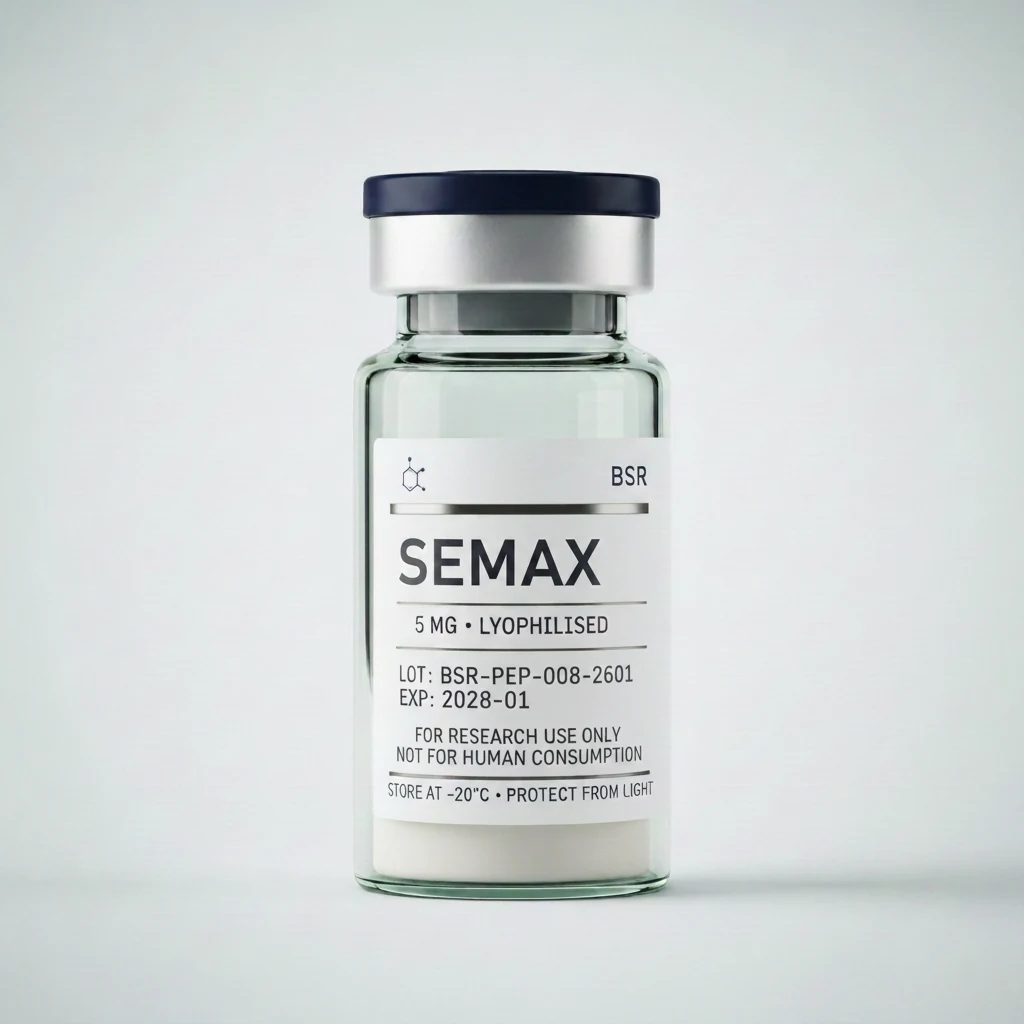
Research-grade material, HPLC verified, certificate of analysis with every order.
The week's Intelligence in one email, every Friday morning.
Regulatory moves, trial readouts, supply-chain news. No product pitches. Unsubscribe in one click.
More in Research Pipeline
Thymosin Alpha-1: What 35 Countries of Clinical Use and a Lopsided PCAC Vote Mean for Research Access in 2026
07 Oct 2026
Viking Therapeutics Initiates Oral Maintenance Dosing Study for VK2735: What the GLP-1/GIP Dual Agonist's Two-Part Programme Tells Researchers About the Weight-Regain Problem
06 Oct 2026
GHK-Cu: What a Fresh Diabetic Wound Study and a Recruiting Phase 2 Trial Mean for the Copper Peptide's Research Standing
03 Oct 2026