Research Pipeline · 13 Jun 2026
TB-500: What the First Human RCT and 2026 Regulatory Reclassification Mean for Research Procurement
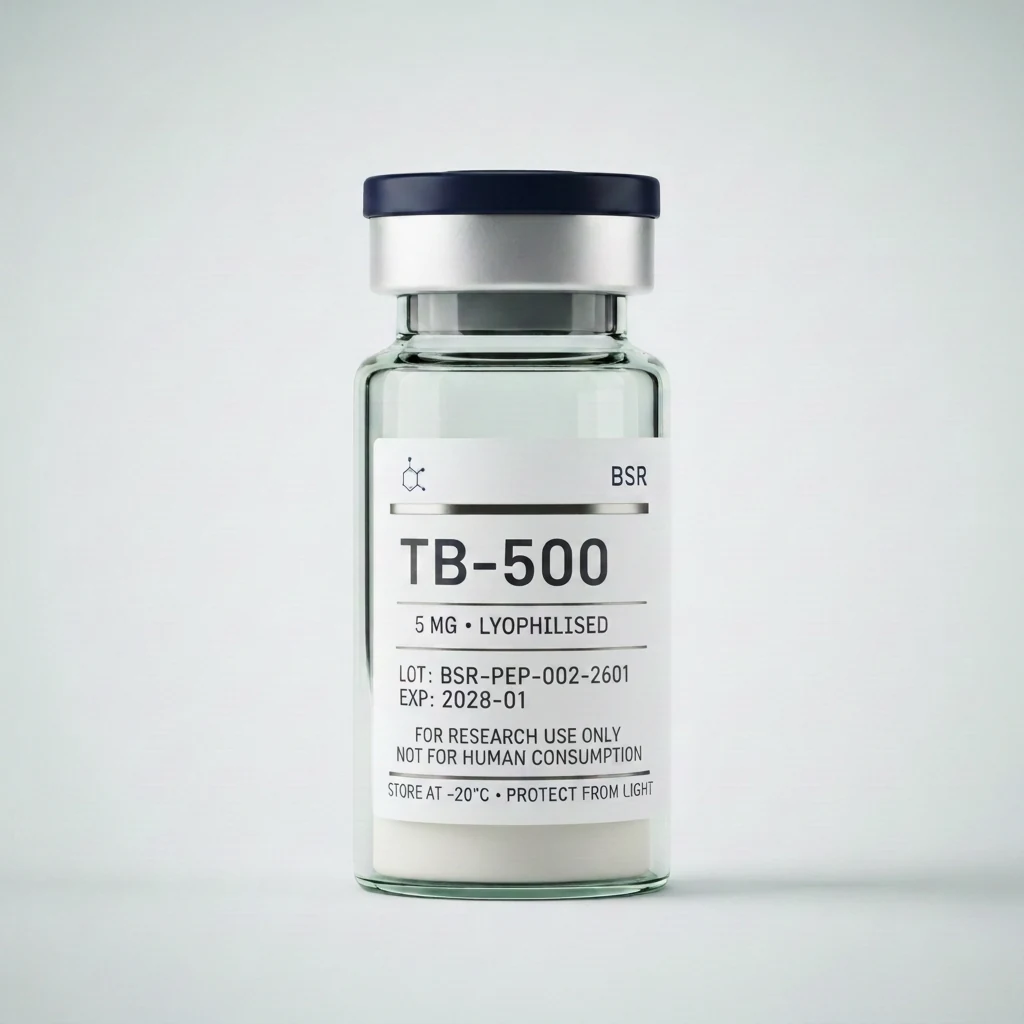
A Phase 1/2 randomised controlled trial of TB-500 in adults with stable cardiovascular disease — the first interventional human study of the 17-amino acid fragment specifically — began enrolment in early 2026. Simultaneously, the February 2026 FDA reclassification placed TB-500 in the 503A Category 2 prohibited list, reshaping how UK and US research labs can legitimately source the compound.
7 sources cited
Key takeaways
- A Phase 1/2 randomised, double-blind, placebo-controlled dose-escalation trial of TB-500 in adults with stable atherosclerotic cardiovascular disease (ASCVD) began in February 2026 — the first interventional human study of the 17-amino acid fragment specifically.
- The February 2026 FDA reclassification confirmed TB-500 as a 503A Category 2 bulk drug substance, prohibiting its preparation by US compounding pharmacies.
- No completed human efficacy trials had been published for TB-500 as of April 2026; all therapeutic evidence prior to the new trial derives from preclinical models and from studies of full-length thymosin beta-4 (Tβ4), which is a distinct molecule.
- WADA has prohibited thymosin beta-4 and its synthetic fragments — including TB-500 — at all times since 2012 under Section S2 of the Prohibited List.
- In the UK, TB-500 remains unscheduled under the Misuse of Drugs Act 1971 and is lawful to supply for research-use-only purposes, provided no therapeutic claims are made; however, MHRA enforcement of mis-marketed peptide products is increasing.
What TB-500 is — and what it is not
TB-500 (also known by its INN fequesetide, and sometimes by its amino acid sequence Ac-LKKTETQ) is a synthetic, N-terminally acetylated 17-amino acid fragment of thymosin beta-4 (Tβ4), the naturally occurring 43-amino acid protein originally isolated from the thymus. Innerbody Research notes that TB-500 specifically covers the actin-binding domain of the parent protein, and that clinical data from full-length Tβ4 studies do not transfer directly to the fragment.
This distinction matters for research procurement. TrimRX's 2026 evidence review records that systemic injectable TB-500 has not been submitted through any IND pathway that has reached approval, and that no Phase 2 or Phase 3 trials of systemic injectable TB-500 for musculoskeletal indications have been published. What exists in the published literature is a body of preclinical work, primarily in rodent models, studying the parent protein's effects on actin polymerisation, cell migration, angiogenesis, and wound healing, plus a separate ophthalmic pharmaceutical development programme (RGN-259, a topical Tβ4 formulation) that has reached Phase 3 trials but has not produced a marketed product as of 2026.
The 2026 cardiovascular trial: what is known
ClinicalTrials.gov record NCT07487363 describes a Phase 1/2, randomised, double-blind, placebo-controlled, sequential dose-escalation study of TB-500 (Thymosin Beta 4 17-23 Fragment) in adults with stable atherosclerotic cardiovascular disease. The trial is evaluating safety, tolerability, pharmacokinetics, and exploratory cardiovascular biomarkers — including markers of endothelial function — in an estimated enrolment of 80 participants. The study start date is recorded as 5 February 2026, with primary completion estimated in February 2027 and full study completion in February 2028. The sponsor is listed as Hudson Biotech.
This is a meaningful development. The trial is explicitly studying the isolated 17-amino acid fragment rather than full-length Tβ4, which closes a long-standing evidential gap. The cardiovascular focus aligns with preclinical findings: GlobalRPH's November 2025 pharmacology briefing summarises preclinical evidence suggesting TB-500 may attenuate scar tissue formation following myocardial infarction and promote neovascularisation in ischaemic cardiac tissue, noting also that the peptide's capacity to promote endothelial cell migration and angiogenesis may contribute to improved cardiac perfusion and functional recovery following injury.
Researchers reviewing NCT07487363 should note several caveats that are standard for early-phase dose-escalation studies. Safety and tolerability are primary endpoints — the trial is not powered to demonstrate efficacy, and exploratory biomarker data will require cautious interpretation. The GlobalRPH briefing raises a relevant concern for angiogenesis-promoting peptides: promoting angiogenesis carries potential risks in patients with undiagnosed malignancies or other conditions where increased vascularisation could be detrimental. Primary completion is not expected until early 2027.
Mechanism: what the preclinical literature supports
The biology of Tβ4 is well-characterised at the molecular level. TrimRX summarises the endogenous protein's functions as including actin regulation, cell migration, angiogenesis, and inflammation control. Preclinical evidence for tissue-healing effects spans multiple indications and research groups.
In rodent models of traumatic brain injury, Tβ4 treatment has been associated with reduced neuronal death and enhanced angiogenesis in the injury zone, according to Irvine Health's 2026 research review. The same review cites a landmark 2004 Nature study by Bock-Marquette et al. demonstrating that Tβ4 could activate cardiac progenitor cells and promote cardiomyocyte survival in a mouse model of myocardial infarction — the mechanistic precursor to the new cardiovascular trial.
Research interest in both full-length Tβ4 and the TB-500 fragment has grown over the past two decades, supported in part by NIAID- and NIH-funded investigations into wound healing and cardiac repair, according to Irvine Health.
Regulatory status: US and UK
United States. Following the February 2026 FDA reclassification, TB-500 is classified as a 503A Category 2 bulk drug substance, prohibited in compounding, according to Superpower Health's April 2026 compound reference. It is also prohibited under the 2026 WADA Prohibited List at all times under Section S2, and cannot be legally obtained through any licensed US pharmacy, per the same source. TrimRX confirms that no completed Phase 2 or Phase 3 trials of systemic injectable TB-500 have been published, and that the research-chemical sale of TB-500 remains in a regulatory grey zone.
United Kingdom. TB-500 is not a controlled drug under the Misuse of Drugs Act 1971 and is not licensed by the MHRA for any therapeutic indication. Supply for legitimate research purposes with accurate research-use-only labelling is not prohibited under current UK law. However, the MHRA's enforcement posture towards mis-marketed peptide products is increasing, and accurate labelling, published Certificates of Analysis, and the absence of therapeutic claims are material compliance requirements for UK research suppliers. Procurement teams should request batch-specific COA documentation and confirm supplier identity verification processes.
The WADA prohibition, in force since January 2012 for thymosin beta-4 and its synthetic fragments, means that any institution supplying TB-500 to athletes or sports research contexts faces additional compliance obligations regardless of UK scheduling status.
What the first human trial means for research procurement
The registration of NCT07487363 represents a structural shift in the evidentiary landscape for TB-500. Prior to February 2026, the compound had no published human interventional data specific to the 17-amino acid fragment; researchers were working from preclinical models and extrapolating cautiously from Tβ4 full-length clinical work.
From a procurement standpoint, the cardiovascular trial introduces several practical implications:
-
Demand signal. Clinical-stage interest in TB-500 typically increases demand for research-grade material across academic and pharmaceutical research groups seeking to conduct complementary mechanistic or biomarker work. Procurement leads at UK labs should monitor lot availability and purity specifications from established suppliers ahead of anticipated demand pressure.
-
Purity requirements. Early-phase clinical studies require well-characterised, high-purity peptide material. For research labs running parallel in vitro or animal studies that may ultimately inform or complement clinical data, the specification bar is effectively raised. A minimum 98% purity by HPLC, mass spectrometry confirmation of molecular weight, endotoxin testing, and sterility certificates are appropriate for injectable-grade research use.
-
Regulatory trajectory. The February 2026 reclassification has closed the US compounding route for TB-500. If NCT07487363 produces a positive safety and biomarker signal at Phase 1/2, a formal IND and eventually NDA pathway becomes plausible — which would progressively formalise supply chains around pharmaceutical-grade material rather than research-chemical vendors.
-
Evidence gap awareness. Despite the new trial, TB-500 remains a compound with no completed human efficacy data. Research teams should continue to characterise it accordingly in grant applications, ethics submissions, and internal risk assessments. The BPC-157 scrutiny of early 2026 has demonstrated that claims outrunning evidence attract regulatory and media attention.
Sources cited
- ClinicalTrials.gov NCT07487363 — Phase 1/2 TB-500 cardiovascular trial record
- Superpower Health — TB-500 Compound Reference, April 2026 — FDA 503A Category 2 status, WADA status
- TrimRX — TB-500 Evidence Review 2026 — regulatory status, clinical evidence gaps
- Irvine Health — TB-500 Research Review 2026 — preclinical evidence summary, actin biology
- GlobalRPH — BPC-157 and TB-500 Background, November 2025 — cardiovascular preclinical findings, angiogenesis caveats
- Innerbody Research — TB4 and TB-500, updated June 2026 — structural distinction between TB-500 and Tβ4
- Peptide Stack — MOTS-c Clinical Trials Status 2026 — comparative regulatory context for research peptides
Research-grade material, HPLC verified, certificate of analysis with every order.
The week's Intelligence in one email, every Friday morning.
Regulatory moves, trial readouts, supply-chain news. No product pitches. Unsubscribe in one click.
More in Research Pipeline
Thymosin Alpha-1: What 35 Countries of Clinical Use and a Lopsided PCAC Vote Mean for Research Access in 2026
07 Oct 2026
Viking Therapeutics Initiates Oral Maintenance Dosing Study for VK2735: What the GLP-1/GIP Dual Agonist's Two-Part Programme Tells Researchers About the Weight-Regain Problem
06 Oct 2026
GHK-Cu: What a Fresh Diabetic Wound Study and a Recruiting Phase 2 Trial Mean for the Copper Peptide's Research Standing
03 Oct 2026