Research Pipeline · 03 Nov 2026
Thymosin Alpha-1: Mechanism, Clinical Evidence, and Regulatory Status for UK Research Procurement
Thymosin alpha-1 (Tα1) is a 28-amino-acid immunomodulatory peptide approved as Zadaxin in more than 35 countries — but not by the FDA, MHRA, or EMA. A 2026 scoping review, a 2025 phase 3 sepsis trial, and active vaccine-adjuvant research make it one of the better-evidenced non-approved peptides in circulation. This briefing maps the mechanism, evidence base, regulatory standing, and procurement considerations for UK laboratories.
13 sources cited
Key takeaways
- Thymosin alpha-1 (Tα1) is a naturally occurring 28-amino-acid peptide produced by the thymus; the synthetic form, thymalfasin, is marketed as Zadaxin.
- Zadaxin carries regulatory approval in more than 35 countries — including China, Italy, the Philippines, and Brazil — principally for chronic hepatitis B and C and as an immune adjunct in certain oncology settings.
- Neither the MHRA nor the FDA has granted a marketing authorisation. The compound holds no MHRA licence and does not appear on the MHRA Products Register, verified as recently as August 2026.
- Tα1 was briefly placed on the FDA's Category 2 restricted list before being removed; it does not feature in the current round of PCAC review proceedings.
- A 2026 scoping review in Pharmaceuticals and a 2025 phase 3 randomised controlled trial in the BMJ represent the most recent landmarks in the clinical literature.
- For UK laboratories, the compound is classified as an unlicensed substance; supply for legitimate research use falls under standard research-use-only frameworks.
What is thymosin alpha-1?
Thymosin alpha-1 is a 28-amino-acid peptide produced by the thymus gland, first isolated from bovine thymus fraction in the 1970s. The commercial pharmaceutical form, thymalfasin, is a fully synthetic version that is chemically identical to the endogenous peptide. It is sold under the brand name Zadaxin by SciClone Pharmaceuticals in jurisdictions where it is licensed.
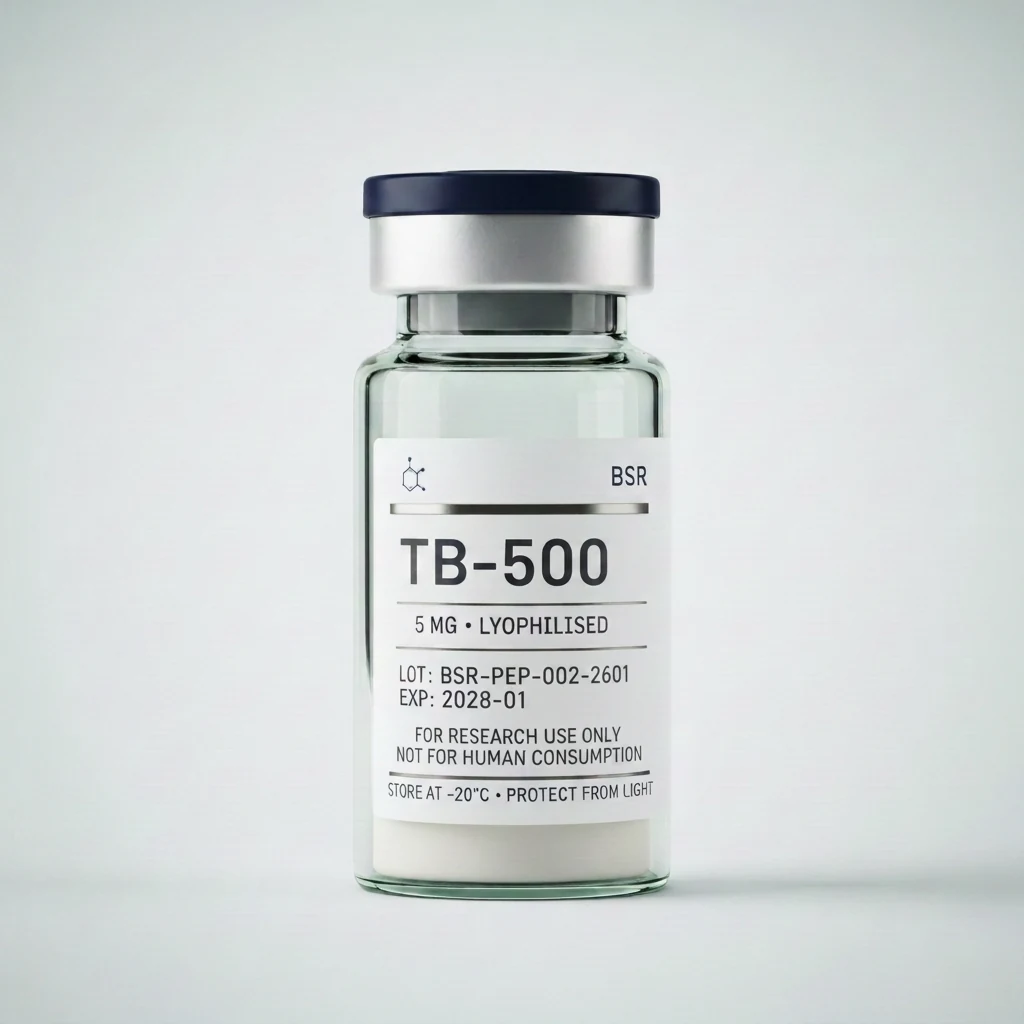
Tα1 should not be confused with Thymosin Beta-4 (TB-500), a structurally unrelated peptide with a different mechanism of action and a very different regulatory history. Thymosin alpha-1 is an approved medicine in many countries and is not named on the WADA prohibited list, whereas TB-500 has been on the WADA banned list since 2022.
Mechanism of action
Tα1 exerts its principal effects through the regulation of T-cell maturation and activity. Biological research has demonstrated that thymosin alpha-1 can stimulate the proliferation, differentiation, and maturation of T cells in the thymus. At the cytokine level, T alpha-1 can influence immunoregulatory T-cell function, promote interferon-alpha, interferon-gamma, and IL-2 and IL-3 production by normal human lymphocytes, and increase lymphocyte IL-2 receptor expression.
Crucially, T alpha-1 also leads to an increase in IL-10-producing regulatory T cells, which create feedback inhibition of cytokine production, hence dampening immune response and preventing a pro-inflammatory cytokine storm. This bidirectional effect — stimulating adaptive immunity while suppressing pathological inflammation — is the property that has driven interest across hepatitis, sepsis, oncology, and vaccine research.
Clinical evidence: what does the 2025–26 literature show?
Sepsis: the definitive phase 3 trial
The highest-quality single study in the Tα1 literature is the TESTS trial — a multicentre, double-blinded, randomised, placebo-controlled phase 3 study published in the BMJ in 2025. The efficacy and safety of thymosin alpha-1 for sepsis (TESTS) trial was a multicentre, double-blinded, randomised, placebo-controlled, phase 3 trial. This represents a more rigorous design than the majority of earlier Tα1 studies, which were predominantly single-centre or open-label.
Severe acute pancreatitis: 2025 meta-analysis
A systematic review and meta-analysis published in Frontiers in Immunology in 2025 examined Tα1's role in severe acute pancreatitis (SAP). Thymosin alpha-1 is an important immunomodulatory agent in clinical practice; this review assessed its effectiveness in improving the condition of SAP patients. Previous clinical studies have found that Tα1 has a beneficial immunomodulatory effect in patients with a variety of diseases, including malignant tumours, sepsis-induced lung injury, and COVID-19.
Oncology: 2026 scoping review
A 2026 scoping review by Kim and colleagues — published in Pharmaceuticals (PMID: 42797537, DOI: 10.3390/ph19091492) — searched PubMed, Embase, and CENTRAL for clinical studies published between January 2016 and March 2026. Researchers found that Tα1 has been studied across a range of malignancies and treatment contexts, with several studies reporting favourable immune-related and clinical signals — but they are equally clear that the evidence base requires strengthening through rigorous, prospective, controlled research. The review explicitly characterised the current evidence as preliminary and not yet sufficient to support definitive treatment recommendations.
A separate randomised phase 2 trial of thymosin alpha-1 in triple-negative breast cancer from Fudan University (NCT07884201) was first posted on ClinicalTrials.gov in October 2026 and is not yet recruiting, according to research tracking by remyresearch.com.
Also in October 2026, a Cochrane review of Tα1 in chronic hepatitis B was registered, alongside a 2026 colorectal-cancer meta-analysis of thymosin preparations and a gastric-cancer meta-analysis, per the same tracking source.
Neoadjuvant gastric cancer: 2026 prospective trial
A 2026 prospective clinical trial, published in BMC Medicine (PMID: 41749205), examined neoadjuvant immunochemotherapy plus thymalfasin in locally advanced gastric cancer, adding to the growing body of evidence for Tα1 as an oncology adjunct.
Vaccine enhancement: active trial in older adults
A current trial (NCT06821100) sponsored by The Methodist Hospital Research Institute is assessing Zadaxin (thymalfasin/Ta1) as an enhancer of vaccine response among older adults receiving booster doses of COVID-19 vaccine, with a primary completion date of December 2026. The trial tests a 4.8 mg dose of Ta1 administered prior to vaccination, following earlier evidence that Ta1 has also demonstrated improvement in response to vaccines in the elderly and in patients immunocompromised by renal disease.
Evidence quality caveat
Notwithstanding the breadth of literature, caution is warranted. A Cochrane-style evaluation rated the certainty of evidence for thymosin preparations in cancer as low or very low and concluded that the evidence is insufficient to support routine clinical use. The volume of PubMed records (~890 as of October 2026) exceeds that of most peptides in the BSR catalogue, but the evidence skews heavily towards Chinese single-centre studies and short-duration endpoints.
Regulatory status: a jurisdiction-by-jurisdiction summary
| Jurisdiction | Status |
|---|---|
| China, Italy, Philippines, Brazil (35+ countries) | Approved as Zadaxin (chronic hepatitis B/C; some oncology adjunct) |
| United States (FDA) | Not approved; not on 503A Category 1 list; not in current PCAC batch |
| United Kingdom (MHRA) | No marketing authorisation; not on MHRA Products Register (verified August 2026) |
| European Union (EMA) | EMA orphan designation granted in 2002 (Germany); not approved in most EU member states |
| Australia (TGA) | Not approved; not named in the Poisons Standard |
| WADA | Not explicitly prohibited |
Thymosin alpha-1 has no MHRA marketing authorisation and no FDA approval; it cannot lawfully be supplied for human use in the UK. Despite being approved as Zadaxin in 35+ countries and having extensive Phase II/III human clinical data, thymosin alpha-1 never received FDA approval in the United States. Two Phase 3 hepatitis C trials failed, and no NDA was ever submitted.
Tα1's regulatory trajectory illustrates a pattern familiar in peptide pharmacology: broad adoption in markets with different evidentiary thresholds, without the head-to-head, large-sample, placebo-controlled trials in FDA/MHRA-regulated populations that Western agencies require. While Tα1 has extensive data and is approved in over 35 countries, it has not completed the FDA or MHRA approval processes.
Importantly, Tα1 is not among the twelve peptides removed from FDA Category 2 in April 2026, nor among the seven reviewed at the July 2026 PCAC meeting, nor in the five scheduled for the February 2027 PCAC convening. Its US compounding status is therefore distinct from the main current PCAC pathway: despite holding no FDA approval, thymosin alpha-1 is generally described as compoundable with a prescription under current US enforcement posture, a position that can change without notice.
Safety profile
Ta1 is one of only a few immunomodulatory agents that have been approved for human use, but it does not appear to induce most of the side effects and toxicities commonly associated with other biological response modifiers such as interferon and interleukin-2. Common side effects are mild injection-site reactions; systemic adverse events across the available trial populations have been infrequent. No pattern of serious adverse effects has been reported across hepatitis, COVID-19, sepsis, and HIV clinical trials.
The relative safety record — accrued across 8,075 patients in safety trials across hepatitis, COVID-19, sepsis, and HIV studies — is notable given the decades of international use.
Procurement considerations for UK laboratories
For UK research procurement professionals, the following points govern responsible sourcing.
Legal category. Thymosin alpha-1 cannot lawfully be supplied for human use in the UK. Supply for preclinical or analytical research purposes must comply with applicable research-use-only frameworks and should be accompanied by a clear statement of intended use.
Structural distinguishability from TB-500. Despite sharing the "thymosin" prefix, Tα1 and TB-500 are chemically and pharmacologically distinct. Research applications, CoA requirements, and storage conditions differ materially. Procurement teams should verify that supplier documentation clearly specifies the compound and that mass-spectrometry confirmation of identity is available.
API sourcing geography. The commercial Zadaxin formulation is produced in jurisdictions where the molecule is licensed; research-use API typically originates from peptide synthesis houses in China and Europe. Standard due diligence on HPLC purity (target ≥98%), endotoxin testing, and lot-to-lot consistency documentation applies.
WADA relevance. Tα1 does not appear on the current WADA Prohibited List, unlike TB-500. Institutions supplying to research programmes that may intersect with sport science should confirm current WADA status independently and at the point of each procurement cycle.
Regulatory watch. The molecule is not in the active US PCAC review pipeline; however, any FDA rulemaking on the broader 503A bulks framework, or a future MHRA review of unlicensed medicines in research settings, could affect the status of supply. Procurement teams should maintain awareness of MHRA enforcement communications.
Research-grade material, HPLC verified, certificate of analysis with every order.
The week's Intelligence in one email, every Friday morning.
Regulatory moves, trial readouts, supply-chain news. No product pitches. Unsubscribe in one click.
More in Research Pipeline
GHK-Cu: Evidence Base, Regulatory Status, and Procurement Considerations for UK Research Laboratories
01 Nov 2026
Retatrutide Beats Semaglutide 2 mg on Every Primary Endpoint in First Phase 3 Head-to-Head Trial: What the TRANSCEND-T2D-2 Results Mean for Research Procurement
30 Oct 2026
MOTS-c: What the July 2026 PCAC Vote and the October Interim Policy Mean for Research Procurement
28 Oct 2026