Research Pipeline · 01 Nov 2026
GHK-Cu: Evidence Base, Regulatory Status, and Procurement Considerations for UK Research Laboratories
GHK-Cu, the naturally occurring copper tripeptide, sits at a regulatory inflection point: removed from FDA Category 2 in April 2026, scheduled for a second PCAC review before the end of February 2027, and under active Phase 2 clinical investigation for wound healing. A comprehensive 2026 review in Pharmaceutics confirms robust preclinical signal but sparse clinical evidence — a distinction that matters for procurement and compliance decisions at UK research labs.
10 sources cited
Key takeaways
- GHK-Cu (glycyl-L-histidyl-L-lysine copper complex) was removed from FDA Category 2 in April 2026 and is scheduled for a second Pharmacy Compounding Advisory Committee (PCAC) review before the end of February 2027, specifically for injectable routes.
- A comprehensive August 2026 critical review published in Pharmaceutics finds consistent preclinical signal across wound repair, matrix remodelling, and angiogenesis, but characterises the clinical evidence as "sparse" and not meeting "contemporary active-entity quality standards."
- A new study appearing today in Biomaterials Advances examines GHK-Cu within poly(γ-benzyl-L-glutamate) microsphere structures in the context of osteogenic-angiogenic coupling, extending the preclinical biomaterials literature.
- An industry-sponsored Phase 2 trial (NCT07437586, CuHeal) is actively recruiting participants to evaluate topical GHK-Cu gel for acute skin wound re-epithelialisation, with primary completion expected in February 2027.
- In the UK, GHK-Cu has no authorised medicinal use and no MHRA-approved product; research procurement continues under research-use-only (RUO) designation, subject to standard chain-of-custody and documentation obligations.
What GHK-Cu is and how it acts
GHK-Cu is a copper(II) complex of the tripeptide glycyl-L-histidyl-L-lysine, a sequence first isolated from human plasma in the early 1970s. The peptide component (GHK) occurs naturally in plasma, urine, and saliva, and the sequence is present in collagen, where it is proposed to be released following tissue injury as part of a localised repair signal.
The compound's hypothesised mechanism involves copper ion modulation at the cellular level: it is proposed that GHK-Cu modulates copper intake into cells, which in turn influences gene expression pathways associated with collagen synthesis, matrix metalloproteinase regulation, and inflammatory signalling. An important distinction in the experimental literature is that an in vivo study comparing GHK with GHK-Cu in rat experimental wounds found that GHK had no effect and only GHK-Cu produced a statistically significant increase in collagen accumulation — suggesting the copper-chelated form is pharmacologically active and the apo-peptide is not equivalent. This distinction is material to procurement: specifications for research applications should confirm the chelated complex, not the free peptide.
Preclinical evidence: what the 2026 literature shows
The preclinical literature for GHK-Cu is notably dense relative to most peptides in the compounding space. Preclinical data consistently support effects on matrix remodelling, epithelial repair, inflammatory/redox regulation, and angiogenesis, according to a systematic critical review published in Pharmaceutics in August 2026. The same review notes that quantitative pooling of results was not performed because active-entity definitions, formulations, doses, models, comparators, and endpoints were not quantitatively commensurable — a common limitation when a compound has been studied across heterogeneous experimental systems over several decades.
In rodent wound healing models, GHK-Cu treated wound tissue shows statistically significant improvements in healed tissue tensile strength compared to controls, consistent with the compound's documented role in organised collagen fibril assembly rather than simply increased collagen quantity. The compound has also been found to induce a systemic enhancement of healing in rats, mice, and pigs — that is, GHK-Cu injected in one area of the body improved healing at distant body areas, an observation that remains mechanistically unexplained at the clinical level.
The osteogenic application is a more recent area of investigation. GHK-Cu shows promise for bone repair in laboratory studies, with copper-based scaffolds demonstrating pro-osteogenic properties in preclinical biomaterials research. The study published today in Biomaterials Advances extends this line of inquiry into poly(γ-benzyl-L-glutamate) microsphere delivery systems, examining osteogenic-angiogenic coupling — a structurally relevant combination given GHK-Cu's dual proposed roles in both tissue vascularisation and mineral matrix support. Procurement teams sourcing material for bone biomaterials research should be aware that the formal FDA PCAC review of injectable GHK-Cu before February 2027 will include consideration of this evidence base.
Regarding gene expression, preclinical fibroblast model data have reportedly identified modulation of over 31% of ageing-related genes, though the broader anti-aging, neurological, and anti-inflammatory applications remain primarily preclinical in 2026, with cell model and rodent data that has not yet advanced to large-scale human trials.
Clinical evidence: the honest assessment
The gap between preclinical promise and clinical confirmation is the defining feature of GHK-Cu's evidence profile. The August 2026 Pharmaceutics review is unambiguous: the clinical evidence remains sparse and does not meet contemporary active-entity quality standards. Historical cosmetic reports are described as small or incompletely characterised; a 13-participant post-CO₂-laser study was negative on objective endpoints; and a more recent 18-participant split-face eyebrow study reported positive cosmetic hair outcomes but did not define GHK-Cu speciation or local exposure — a methodological limitation that prevents mechanistic interpretation.
The clinically actionable development is the Phase 2 CuHeal trial (NCT07437586), sponsored by Hudson Biotech. This is a randomised, double-blind, vehicle-controlled, split-wound study of topical GHK-Cu gel to accelerate re-epithelialisation of standardised acute skin wounds in healthy adults, with a recruitment start date of February 2026 and an estimated primary completion date of February 2027. The split-wound design is methodologically rigorous — each participant acts as their own control — which should improve signal detection relative to earlier cosmetic studies. Results, if publicly disclosed, will be a meaningful data point for researchers evaluating whether GHK-Cu's wound-healing preclinical literature is translating into humans.
GHK-Cu does not have FDA approval for osteoporosis, fracture healing, or any other bone or musculoskeletal condition, and remains an investigational compound in this specific area of research. The same applies in the UK.
Regulatory status: US and UK
The US regulatory position for GHK-Cu has shifted materially in 2026. Twelve peptides were removed from FDA Category 2 as of April 2026; GHK-Cu was among them. However, injectable GHK-Cu was not among the seven peptides reviewed at the July 2026 PCAC meeting. The FDA has scheduled a second PCAC meeting before the end of February 2027 to evaluate five additional 503A bulk substances: GHK-Cu (injectable routes), Melanotan II, Cathelicidin (LL-37), Dihexa acetate, and Pegylated Mechano Growth Factor (PEG-MGF). Critically, being placed on a PCAC agenda is an evaluation step, not an approval — removal from Category 2 does not authorise compounding.
GHK-Cu is also not among the six peptides covered by the HHS enforcement discretion policy announced on 28 October 2026 (which applies to BPC-157, TB-500, KPV, Epitalon, Semax, and MOTS-c under specific conditions). Compounding pharmacies cannot rely on that policy to justify GHK-Cu preparation; formal rulemaking must follow a favourable PCAC vote before legal compounding could begin, and based on typical FDA rulemaking timelines, legal compounding of PCAC-recommended peptides is unlikely before mid-to-late 2027 at the earliest.
In the UK, GHK-Cu has no MHRA-authorised product. There is no parallel mechanism to the US 503A framework in Great Britain. The 503A compounding framework is a US-specific statutory mechanism and has no direct parallel in UK or EU regulation. UK laboratories procuring GHK-Cu for in vitro or preclinical research must ensure product is labelled, invoiced, and documented as research-use only (RUO), with clear chain-of-custody records and no human administration claims attached. The compound's cosmetic-grade availability (in topical serums) is a separate category entirely and should not be conflated with GMP-standard research-grade material for laboratory use.
Delivery and formulation considerations
One practical complexity for GHK-Cu research procurement is that topical GHK-Cu preparations face vastly different regulatory and formulation considerations compared to subcutaneous injectables. The dermal penetration data are, at present, unflattering: one study in Pharmaceutical Research reportedly found near-zero permeation of GHK-Cu through intact human skin, with meaningful dermal delivery only observed when microneedle channels were created. This is a critical constraint for any research programme that involves topical application to intact skin; it does not affect injectable or cell-culture applications.
For cell-culture and in vitro work — the most common research context — procurement teams should prioritise suppliers who provide confirmed GHK-Cu speciation on the certificate of analysis (CoA), including the copper-to-peptide ratio and confirmation of the chelated complex rather than a physical mixture. Purity by HPLC and identity confirmation by mass spectrometry remain the baseline quality markers. Lot-to-lot consistency is particularly important given the known sensitivity of copper chelation to pH and ionic environment during synthesis.
What to watch
The February 2027 PCAC meeting for injectable GHK-Cu will be a decision-relevant event for research procurement managers assessing long-range supplier strategy. A favourable PCAC vote would not immediately change UK procurement obligations, but it would signal improving clinical acceptance, likely accelerating manufacturer quality investment and potentially reducing certificate-of-analysis variability. The primary completion of the CuHeal Phase 2 trial, also expected around February 2027, could provide the first controlled human wound-healing data from a registered trial — a meaningful marker for assessing whether the extensive preclinical literature represents translatable biology.
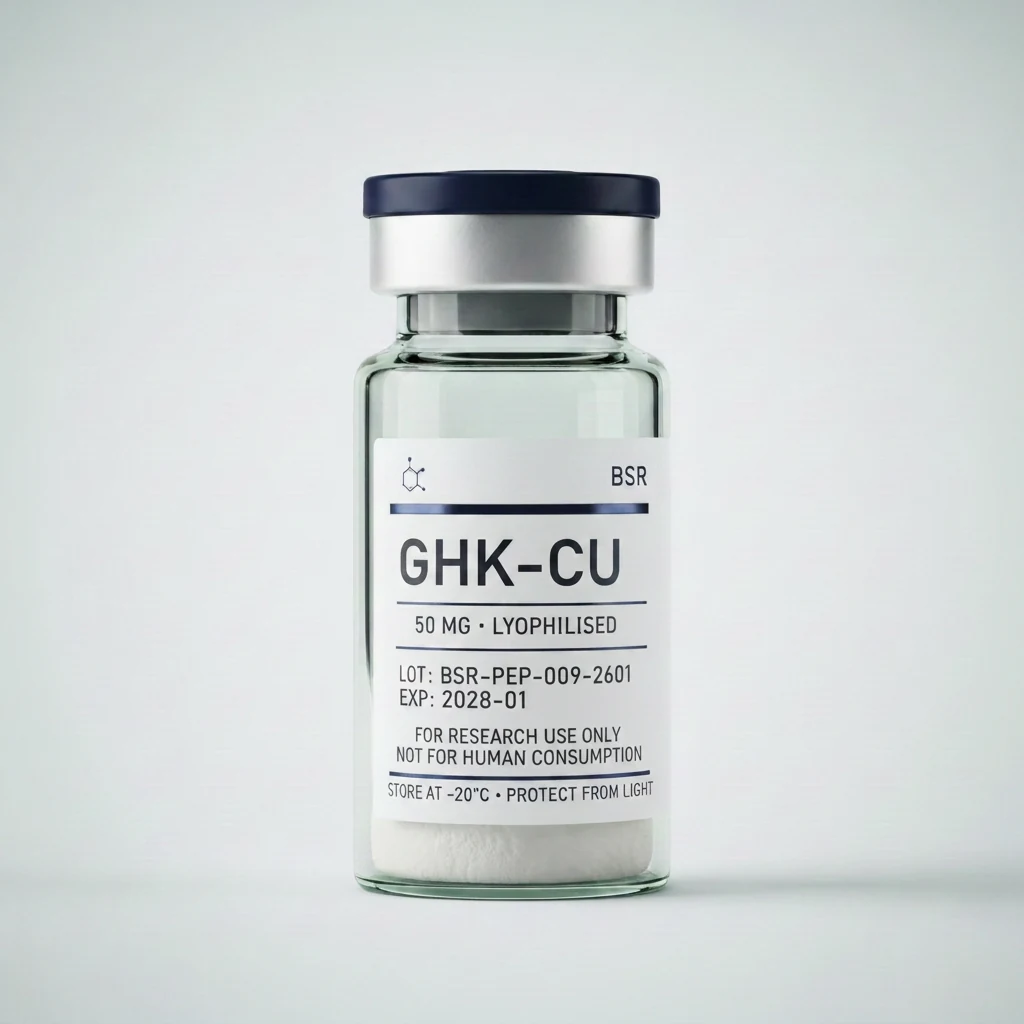
Research-grade material, HPLC verified, certificate of analysis with every order.
The week's Intelligence in one email, every Friday morning.
Regulatory moves, trial readouts, supply-chain news. No product pitches. Unsubscribe in one click.
More in Research Pipeline
Retatrutide Beats Semaglutide 2 mg on Every Primary Endpoint in First Phase 3 Head-to-Head Trial: What the TRANSCEND-T2D-2 Results Mean for Research Procurement
30 Oct 2026
MOTS-c: What the July 2026 PCAC Vote and the October Interim Policy Mean for Research Procurement
28 Oct 2026
Beyond the GLP-1 Duopoly: Three October Developments That Signal a Broadening Obesity Pipeline
22 Oct 2026