Research Pipeline · 11 Jul 2026
Epitalon: The Pineal Tetrapeptide With Four Decades of Russian Research Now Facing Its First FDA Compounding Review
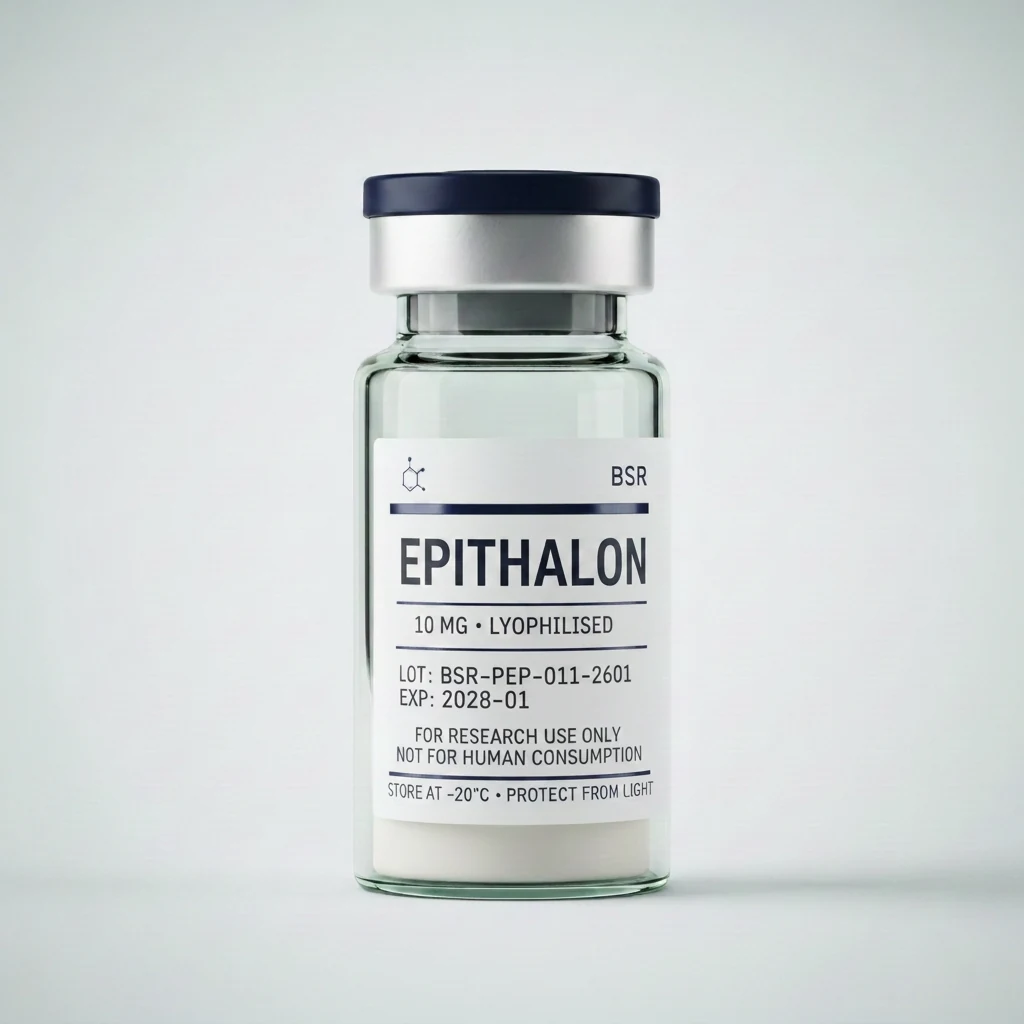
Epitalon — a four-amino-acid synthetic peptide derived from pineal gland extracts — is scheduled for review by the FDA's Pharmacy Compounding Advisory Committee on 24 July 2026. With a research base spanning 40 years, proposed mechanisms ranging from telomerase activation to melatonin restoration, and an unresolved carcinogenicity question, it presents one of the most scientifically nuanced cases on the PCAC's agenda.
12 sources cited
Key takeaways
- Epitalon (Ala-Glu-Asp-Gly), a synthetic tetrapeptide derived from a pineal gland polypeptide, is scheduled for review by the FDA's Pharmacy Compounding Advisory Committee (PCAC) on 24 July 2026 — the compound's first formal US regulatory evaluation.
- Its principal proposed mechanisms are telomerase activation in somatic cells and restoration of melatonin secretion in ageing pineal tissue; animal data show lifespan extension and reduced spontaneous tumour incidence, while independent human replication remains limited.
- FDA staff briefing documents have flagged the telomerase activation claim itself as a potential safety concern, noting uncertain carcinogenicity — a signal that is likely to dominate committee discussion.
- Even a positive PCAC recommendation does not constitute FDA approval; subsequent notice-and-comment rulemaking typically takes more than a year before any substance reaches the 503A Bulks List.
- Epitalon is not approved by the FDA, MHRA, or EMA for any indication. In the UK it is classified as an unlicensed medicine; its supply for human administration without a prescription is not lawful.
What is Epitalon?
Epitalon (also written Epithalon) is a synthetic tetrapeptide with the amino acid sequence Ala-Glu-Asp-Gly. It was isolated from epithalamin — a polypeptide complex extracted from the pineal gland — by Vladimir Khavinson and colleagues at the St. Petersburg Institute of Bioregulation and Gerontology, beginning in the 1980s. The team synthesised the simplified four-residue analogue and spent the subsequent four decades studying its effects on ageing, longevity, and biological regulation in both animal models and humans.
The peptide is reviewed by the PCAC on Day 2 of the two-day July hearing. On 24 July 2026, the committee will discuss Epitalon-related bulk drug substances — both the free base and acetate salt forms — alongside Emideltide (DSIP) and Semax. The nominated use under FDA review is insomnia, reflecting one of Epitalon's proposed effects on melatonin regulation and sleep architecture.
Regulatory journey to date
Epitalon was among the 12 peptides removed from FDA Category 2 following the withdrawal of original nominations. On 15 April 2026, HHS Secretary Robert F. Kennedy Jr. confirmed removal of 12 peptides from Category 2, including Epitalon, effective 23 April 2026. That action, however, did not confer Category 1 status or authorise compounding. Removal from Category 2 is separate from the FDA's review of which peptides may be compounded under Section 503A; the PCAC meeting on 23–24 July 2026 is the required next step in that process.
The procedural mechanics matter for research procurement professionals. The PCAC's recommendation is non-binding, and formal rulemaking is required before any substance can be added to the 503A Bulks List — a process that, under standard timelines, can take more than a year. The docket for public comment (FDA-2025-N-6895) closed for committee-visible submissions on 9 July 2026, and will close entirely on 22 July 2026.
In the UK, Epitalon holds no MHRA marketing authorisation and is not listed in any British Pharmacopoeia or NHS formulary. It is available from research-use-only suppliers under the convention that it is sold for in-vitro or preclinical study rather than human administration.
Proposed mechanisms
Telomerase activation
The most cited mechanism — and the one most carefully scrutinised by regulators — is telomerase activation. In human somatic cell cultures, Epitalon treatment induces expression of the telomerase catalytic subunit (hTERT), increases enzymatic activity, and produces measurable telomere elongation sufficient to extend cellular lifespan beyond the Hayflick limit, according to work by Khavinson and colleagues (2003) and a 2025 replication study by Araj and colleagues. The 2025 paper by Al-Dulaimi and colleagues, published in Biogerontology, is described as the first major independent replication of telomerase upregulation in human cell lines outside Khavinson's own laboratory.
The mechanism is biologically coherent: telomere shortening is a recognised hallmark of cellular ageing, and each round of somatic cell division erodes telomeric caps. Slowing that process has been a long-standing target in geroscience. Epitalon appears to influence hTERT gene expression, the catalytic component of the telomerase enzyme complex, potentially leading to increased telomerase activity in cells that normally show limited enzyme function.
The same mechanism, however, introduces a safety concern that the PCAC is expected to examine closely. Constitutive telomerase upregulation is a feature of most human cancers; uncontrolled activation of hTERT in somatic tissue could, in principle, promote malignant transformation. FDA staff briefing materials have flagged this explicitly: Epitalon's telomerase activation raises uncertain carcinogenicity concerns. No published clinical studies have reported tumour incidence as a primary endpoint, and the long-term observational studies from Russia have not been conducted with the methodological rigour sufficient to rule out this risk.
Pineal regulation and circadian biology
The second principal mechanism is modulation of the pineal gland and its melatonin output — the basis of the nominated use of insomnia. Epitalon enhances pineal gland function and melatonin secretion, which decline markedly with age and contribute to circadian disruption, sleep disturbances, and increased oxidative stress. In aged Rhesus monkeys, Epitalon treatment stimulated melatonin production and restored youthful secretion patterns, whilst also normalising cortisol rhythms. In aged human pinealocytes studied in vitro, Epitalon selectively safeguarded cells from degenerative changes, suggesting a tissue-specific effect on the gland responsible for circadian control.
The sleep indication nominated to the FDA is arguably the most clinically tractable of Epitalon's proposed effects; unlike the anti-ageing claims, it maps to a defined, measurable endpoint that randomised controlled trials could test. To date, no adequately powered, independently conducted RCT has been published for this indication.
Antioxidant and lifespan effects in animal models
Animal studies suggest that Epitalon increases activity of antioxidant enzymes, including superoxide dismutase and glutathione peroxidase, and extends median and maximum lifespan by 12–24% in rodent longevity studies. A 2003 study by Anisimov and colleagues showed that Epitalon extended lifespan and reduced spontaneous tumour incidence in SHR mice — though the same data set that showed reduced spontaneous tumours in mice does not resolve the theoretical carcinogenicity risk in humans, given the different mechanisms by which hTERT operates across species.
State of human clinical evidence
The body of human research on Epitalon is predominantly observational, open-label, or conducted within Khavinson's own group without independent replication until recently. Long-term human studies have been associated with improved physiological markers and reduced all-cause mortality in older populations over twelve-year follow-up cohorts, though these results carry significant methodological caveats: absence of blinding, no placebo control, and publication primarily in Russian-language journals with limited international peer review.
Cell-line studies confirm Epitalon increases telomere length and telomerase activity, but human replication is limited to case reports and small open-label studies. There are no Phase II or Phase III randomised controlled trials registered with ClinicalTrials.gov for any Epitalon indication. This evidence gap is the central problem the PCAC must navigate: the preclinical signal is genuine and well-characterised, but the translation to humans remains largely unverified under Western evidentiary standards.
What the PCAC will evaluate
The committee's analysis is structured around four criteria: the physical and chemical characterisation of the substance; any safety issues arising from its use in compounding; the available evidence of effectiveness for the nominated use; and the historical use of the substance in compounding, including the medical condition and relevant medical literature. The PCAC will hear short presentations from nominators and evaluate the background materials posted by FDA two business days before the meeting, before voting on a recommendation. Recommendations are non-binding; the FDA ultimately decides whether to act on them.
For Epitalon specifically, the committee will need to reconcile a substantial preclinical evidence base — including the 2025 independent Biogerontology replication — against the unresolved carcinogenicity signal, the absence of controlled human trials, and questions about the physical and analytical characterisation of the tetrapeptide in compounded formulations. Peptide purity, stability in injectable formulations, and batch-to-batch consistency are all factors the PCAC considers when assessing compounding suitability.
Procurement considerations for UK research laboratories
For UK laboratories sourcing Epitalon for legitimate in-vitro or preclinical research, the current regulatory position is straightforward: the compound remains an unlicensed substance available from research-use-only suppliers, with no MHRA-approved pathway for clinical supply. Its removal from FDA Category 2 has no direct legal effect in the UK. Procurement professionals should verify that any supplier provides a Certificate of Analysis demonstrating HPLC purity (typically ≥98% for research-grade material), mass spectrometry confirmation of the correct sequence (Ala-Glu-Asp-Gly, molecular weight 432.4 Da), and documentation of endotoxin testing for any injectable-research-grade preparation.
The outcome of the 24 July PCAC vote — and the FDA's subsequent determination — will inform whether a formal compounding route becomes available in the US, which in turn may influence how international CROs and reference material suppliers position the compound. Regardless of that outcome, Epitalon will not acquire an approved indication in Western markets without a full regulatory submission and the controlled human trial data that currently do not exist.
Research-grade material, HPLC verified, certificate of analysis with every order.
The week's Intelligence in one email, every Friday morning.
Regulatory moves, trial readouts, supply-chain news. No product pitches. Unsubscribe in one click.
More in Research Pipeline
Thymosin Alpha-1: What 35 Countries of Clinical Use and a Lopsided PCAC Vote Mean for Research Access in 2026
07 Oct 2026
Viking Therapeutics Initiates Oral Maintenance Dosing Study for VK2735: What the GLP-1/GIP Dual Agonist's Two-Part Programme Tells Researchers About the Weight-Regain Problem
06 Oct 2026
GHK-Cu: What a Fresh Diabetic Wound Study and a Recruiting Phase 2 Trial Mean for the Copper Peptide's Research Standing
03 Oct 2026