Research Pipeline · 25 Jul 2026
MOTS-c: The Mitochondria-Encoded Peptide With a Decade of Preclinical Evidence and a Critical FDA Compounding Vote Eleven Days Away
MOTS-c, a 16-amino acid peptide encoded within mitochondrial DNA, is set for formal FDA advisory review on 23 July 2026 as part of the PCAC's evaluation of seven peptides for the 503A Bulk Drug Substances List. FDA briefing documents propose that it should not be listed, citing insufficient human data and characterisation gaps — yet a Phase 2a trial in prediabetes is now registered, adding new urgency to procurement decisions for UK research labs.
12 sources cited
Key takeaways
- MOTS-c is a 16-amino acid peptide encoded in mitochondrial DNA — one of a small class of mitochondria-derived peptides (MDPs) with confirmed systemic signalling activity.
- Its primary mechanism involves AMPK activation via folate-cycle inhibition, which in preclinical models improves glucose homeostasis, insulin sensitivity, and fat oxidation.
- On 23 July 2026, the FDA's Pharmacy Compounding Advisory Committee (PCAC) is scheduled to evaluate MOTS-c for potential inclusion on the Section 503A Bulk Drug Substances List — covering both the free-base and acetate salt forms.
- The FDA's briefing documents propose that MOTS-c should not be added, citing insufficient human efficacy and safety data, uncharacterised immunogenicity risk, and analytical standardisation gaps.
- Despite the adverse pre-meeting posture, a Phase 2a clinical trial (NCT07505745) testing MOTS-c against placebo in adults with prediabetes and overweight is now registered, indicating active investigational interest.
- In the UK, MOTS-c carries no MHRA marketing authorisation and is legally procured only for non-clinical research under a research-use-only framework.
What is MOTS-c?
MOTS-c — an acronym for Mitochondrial Open Reading Frame of the 12S rRNA Type-C — is a 16-amino acid peptide with the sequence MRWQEMGYIFYPRKLR. Its discovery in 2015 reframed mitochondria not solely as cellular energy factories but as active signalling hubs, a conceptual shift that has driven considerable downstream research interest.
What makes MOTS-c unusual within the peptide landscape is its genetic origin. It is encoded not within nuclear DNA but within the mitochondrial genome — specifically within the 12S ribosomal RNA gene, making it one of a small number of mitochondria-derived peptides (MDPs) known to exert systemic effects. MOTS-c acts as a retrograde mitochondrial signal, travelling from the mitochondria to the nucleus and into systemic circulation, where it regulates gene expression and metabolic homeostasis.
Circulating MOTS-c levels have been measured in human plasma, and those levels decline measurably with age — a finding that underpins its relevance to longevity and metabolic ageing research. In exercise physiology it has been characterised as a metabolic "exercise mimetic," meaning it appears to replicate elements of the physiological response to physical activity through downstream metabolic pathway activation.
Mechanism of action
The central mechanism attributed to MOTS-c in the published literature is activation of AMP-activated protein kinase (AMPK), which it achieves via inhibition of the folate cycle. Emerging data suggest that MOTS-c regulates cellular metabolism through AMPK-dependent pathways, enhancing glucose utilisation and stress responses, according to a 2025 peer-reviewed study published in Frontiers in Physiology examining its effects on the type-2-diabetic heart.
AMPK activation promotes catabolic metabolic processes while suppressing anabolic ones. This leads to increased fat oxidation, improved glucose metabolism, and overall energy balance, which explains why MOTS-c research has concentrated on insulin resistance, obesity, and mitochondrial dysfunction models.
Mitochondria are involved in calcium signalling, apoptosis, heme synthesis, and immune response — contexts in which MOTS-c's systemic activity becomes relevant beyond straightforward metabolic endpoints. This multi-pathway engagement distinguishes MOTS-c from more narrowly targeted peptides in the research catalogue.
State of the preclinical evidence
The preclinical record for MOTS-c is substantive by the standards of the mitochondrial peptide class, though it remains predominantly rodent-derived. Across multiple preclinical studies, findings cluster around glucose homeostasis — where exogenous MOTS-c improved fasting glucose and glucose tolerance in diet-induced obese mouse models — alongside insulin sensitivity, fat metabolism, and exercise capacity.
A 2025 Frontiers in Physiology paper examined MOTS-c's effects on mitochondrial respiration in the type-2-diabetic heart, contributing to a growing body of cardiac-metabolic research. Type 2 diabetes is a global epidemic, and heart failure is the primary cause of premature death among T2D patients, with mitochondrial dysfunction linked to decreased contractile performance in the diabetic heart — a context in which MOTS-c's ability to restore mitochondrial respiration is of particular interest to investigators.
In human data terms, the evidence base is limited but not entirely absent. According to one review of the compounding regulatory landscape, MOTS-c has a Phase 1a/1b trial record for its analogue CB4211 and a 7-day intravenous trial of native MOTS-c. That combination of a well-characterised mechanism and modest but real early human data places MOTS-c ahead of some peptides in the July PCAC cohort, even if the overall clinical record remains preliminary.
The Phase 2a prediabetes trial
The most significant clinical development in MOTS-c research is the registration of a Phase 2a trial (NCT07505745), which is testing whether 12 weeks of MOTS-c improves oral-glucose-tolerance-test-derived insulin sensitivity versus placebo in adults with prediabetes and overweight or obesity. This is the first controlled human study targeting a clinically meaningful metabolic endpoint, and it represents a step-change from the 7-day IV study that constitutes the bulk of prior human exposure data.
UK-based research procurement teams should note that the existence of a registered Phase 2a study does not, on its own, change the current regulatory position. The PCAC review will evaluate the evidence as it stands, and trial registration establishes investigational intent rather than demonstrated clinical benefit.
FDA regulatory position ahead of the 23 July PCAC hearing
From Category 2 to grey zone
In September 2023, the FDA moved over a dozen peptides into Category 2 of the 503A bulks list, a designation that effectively prohibited their use in compounding. MOTS-c was among those affected. In April 2026, the FDA removed 12 peptides — including MOTS-c — from Category 2 after the original nominations were withdrawn, effective 23 April 2026.
Removal from Category 2 is meaningful in that it signals the FDA no longer considers these compounds to present significant safety risks at the compounding level. But it does not authorise compounding. MOTS-c therefore sits in a regulatory grey zone: off the prohibited list, but not yet on the authorised list.
What the PCAC briefing documents say
The FDA's Pharmacy Compounding Advisory Committee is scheduled to meet on 23–24 July 2026 at the agency's White Oak Campus in Silver Spring, Maryland. MOTS-c falls on Day 1, 23 July, alongside BPC-157, KPV, and TB-500. Both free-base and acetate salt forms are under evaluation.
The proposed use nominated for MOTS-c covers obesity and osteoporosis. The FDA's pre-meeting briefing documents, however, take a sceptical position. At the July 23 PCAC meeting, the FDA proposed that MOTS-c — free base and acetate — not be added to the 503A Bulks List, finding insufficient effectiveness and safety evidence.
Across all seven peptides, FDA cited that the substances are not well-characterised, that there is little or no human evidence of effectiveness for the proposed (mostly injectable) routes, and that there is insufficient human safety data — including unassessed immunogenicity risk. For MOTS-c specifically, the available regulatory commentary indicates it suffers from a lack of standardised nomenclature recognised in pharmacopoeias, and critical data regarding impurities, aggregates, and endotoxins are missing from most commercial offerings. The FDA also noted that without robust formulation details, it is difficult to assess how MOTS-c's physicochemical properties — including solubility — would affect injectable products.
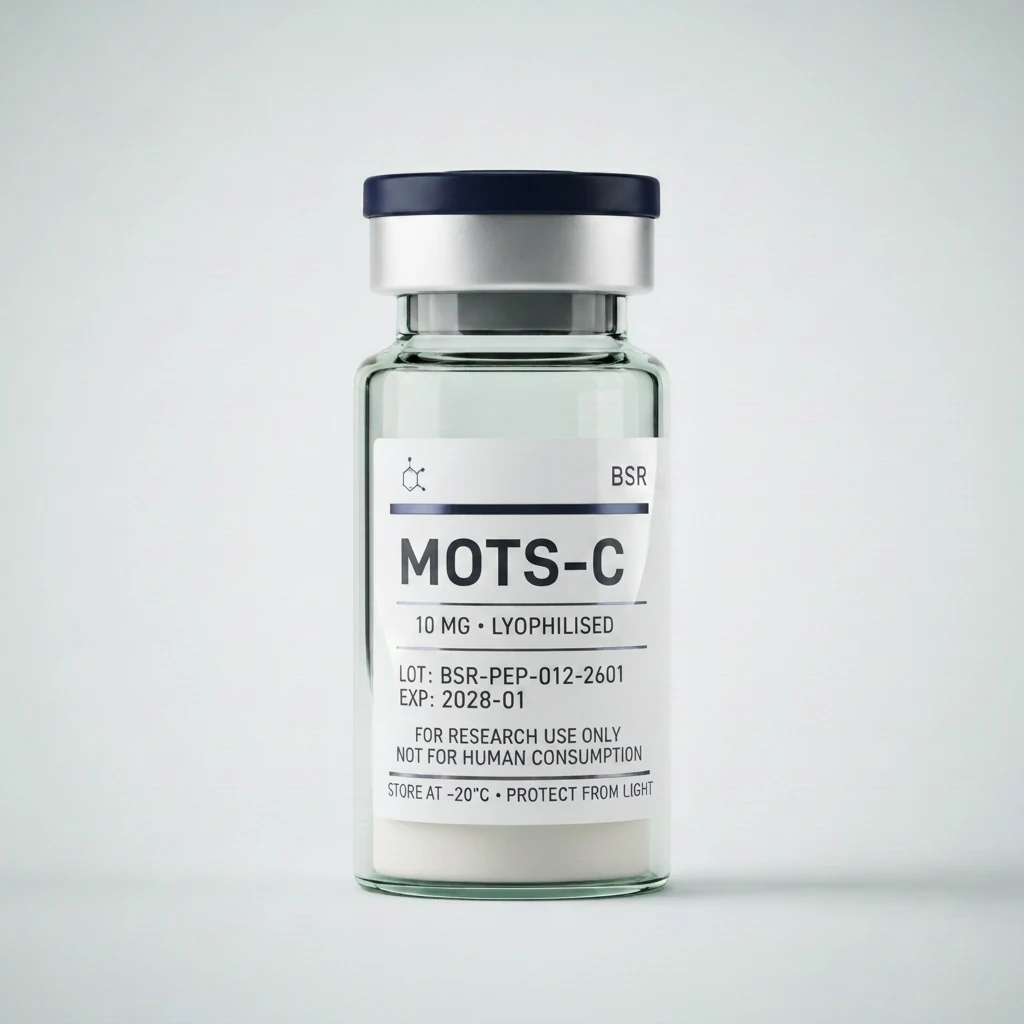
On stability, FDA reported that lyophilised MOTS-c free base is stable below −20°C when desiccated and protected from light. This is a relevant data point for research-use-only procurement, confirming that storage conditions typical of peptide research infrastructure are appropriate.
External commentary
The Partnership for Safe Medicines has formally submitted comments to the PCAC strongly opposing the addition of all seven peptides to the Section 503A Bulk Drug Substances List, citing a critical deficit in human safety data, widespread consumer confusion, and systemic supply chain vulnerabilities. Its submission argues that permitting these unapproved peptides to enter the compounding market would allow the public to be exposed without adequate clinical trial protections.
What happens after the hearing
PCAC recommendations are non-binding. Even a unanimous positive vote would not immediately authorise compounding — the FDA must then initiate formal rulemaking, publish a proposed rule, accept public comment, and issue a final rule. That process typically takes 12 to 24 months after the hearing. Given that the FDA's own briefing position is to propose non-listing, a positive outcome would be an against-the-grain recommendation.
UK procurement and MHRA status
MOTS-c has no MHRA marketing authorisation and is not licensed as a medicinal product in the United Kingdom. It is procured in UK research settings under a research-use-only framework, meaning it may be legitimately acquired for non-clinical laboratory work provided it is not administered to humans and is not sold with therapeutic claims. Researchers should source MOTS-c from suppliers who provide a Certificate of Analysis confirming sequence identity by mass spectrometry, HPLC purity (typically ≥98%), endotoxin testing results, and sterility data where injectable-adjacent use is intended.
The FDA's characterisation concerns are directly relevant to UK procurement: the absence of standardised analytical benchmarks across commercial suppliers means that lot-to-lot variability is a genuine quality risk. Procurement teams are advised to request batch-specific CoA documentation and to audit supplier quality management systems before placing orders.
Summary for research procurement
MOTS-c occupies an interesting position in the peptide research landscape: it has a mechanistically coherent basis, a decade of accumulating preclinical evidence, and early human data, yet it faces the same characterisation and clinical evidence shortfalls that the FDA has cited across the entire July PCAC cohort. The pre-meeting briefing documents signal an unfavourable outcome on 23 July, but the PCAC recommendation — whatever it is — will not immediately alter the substance's legal status in either direction. UK laboratories procuring MOTS-c for non-clinical research are not directly affected by the US 503A pathway, but the analytical standards and safety scrutiny the FDA is applying offer a useful framework for evaluating supplier quality and research protocols.
Research-grade material, HPLC verified, certificate of analysis with every order.

The week's Intelligence in one email, every Friday morning.
Regulatory moves, trial readouts, supply-chain news. No product pitches. Unsubscribe in one click.
More in Research Pipeline
Beyond the GLP-1 Duopoly: Three October Developments That Signal a Broadening Obesity Pipeline
22 Oct 2026
Thymosin Alpha-1: What 35 Countries of Clinical Use and a Lopsided PCAC Vote Mean for Research Access in 2026
07 Oct 2026
Viking Therapeutics Initiates Oral Maintenance Dosing Study for VK2735: What the GLP-1/GIP Dual Agonist's Two-Part Programme Tells Researchers About the Weight-Regain Problem
06 Oct 2026