Research Pipeline · 14 Sep 2026
BPC-157: The Gastric Pentadecapeptide With Three Decades of Animal Data, a 2026 MDPI Formulation Review, and No Completed Phase II Trial
BPC-157 has accumulated more than a hundred preclinical publications over thirty years, yet as of mid-2026 it has no completed Phase II human trial on record, no approved formulation, and no validated dosing regimen. A May 2026 review in Pharmaceutics catalogues the biopharmaceutical barriers that have stalled clinical translation, while the MHRA's April 2026 investigation into peptide clinics making health claims about the compound underscores the regulatory distance between animal evidence…
8 sources cited
Key takeaways
- BPC-157 is a synthetic 15-amino-acid pentadecapeptide derived from a gastric protein fragment, with a published preclinical corpus of more than a hundred studies spanning three decades.
- A May 2026 narrative review in Pharmaceutics (MDPI) concludes that despite consistent biological activity in animal models, BPC-157 has no approved formulation, no validated dosing regimen, and no completed Phase II clinical trial.
- The MHRA opened an investigation in April 2026 into peptide clinics making health claims about BPC-157, stating that there is little credible scientific evidence behind those claims and that the products are unlicensed.
- BPC-157 was not among the twelve peptides identified for reclassification under HHS Secretary Robert F. Kennedy Jr.'s February 2026 announcement; its compounding status in the United States remains constrained.
- For UK research procurement, the compound is classified as an unlicensed substance; supply for in vitro and preclinical laboratory use under research-use-only conditions is the only lawful channel.
What BPC-157 is
BPC-157 — Body Protection Compound 157 — is a synthetic pentadecapeptide derived from a protective protein found in human gastric juice. The compound consists of 15 amino acids (sequence GEPPPGKPADDAGLV) and was first characterised in the laboratory of Predrag Sikirić at the University of Zagreb in Croatia, where the bulk of the early preclinical programme was conducted. It is produced by solid-phase peptide synthesis, not extracted from biological sources.
The compound exists in two salt forms — acetate and arginine — which differ in solubility and stability but share the same amino acid sequence. This nomenclature distinction is relevant for procurement and certificate-of-analysis verification: lot documentation should specify the salt form and confirm peptide content by HPLC alongside purity by mass spectrometry.
Mechanism of action
The proposed mechanisms are multiple and partly overlapping, which is both scientifically interesting and a source of difficulty for formal drug development. BPC-157's proposed mechanisms involve modulation of growth factor expression, promotion of angiogenesis, and interaction with the nitric oxide pathway. Separately, preclinical data indicate modulation of dopaminergic and serotonergic pathways, which has prompted research interest in gastrointestinal motility and neurological models.
Animal studies have reported accelerated wound healing across tissue types — skin, muscle, tendon, bone, and ligament — together with protection against experimentally induced gastric ulcers, inflammatory bowel conditions, and certain models of traumatic brain injury. The May 2026 MDPI review notes that despite over three decades of preclinical research demonstrating consistent biological activity, BPC-157's pharmaceutical development remains rudimentary. Mechanistic diversity is one reason: a compound that appears to act on multiple systems simultaneously is more difficult to model pharmacokinetically and to target with a single clinical indication.
The review, a narrative survey of PubMed/MEDLINE, Embase, and Cochrane Library from database inception to April 2026, examines BPC-157's physicochemical and pharmacokinetic properties, formulation challenges across routes of administration, and the pharmacokinetic–pharmacodynamic disconnect that characterises its preclinical profile. The disconnect the authors identify — that animal data show robust effects yet human-relevant PK/PD parameters remain poorly characterised — is a central barrier to regulatory-grade development.
State of clinical evidence
The critical shortfall is the absence of completed controlled human trials. As of 2026, no large-scale, peer-reviewed Phase I–III clinical trials of BPC-157 in humans have been published in major medical journals. The May 2026 MDPI review confirms this directly: the compound has no approved formulation, no validated dosing regimen, and no completed Phase II clinical trial on record.
There are reports of clinical trial activity in jurisdictions outside the United States and Western Europe — including research in Croatia — but peer-reviewed publications of those results in major international journals are not yet available in mainstream literature. The most cited human reference is a Phase 2 trial for inflammatory bowel disease that showed dose-dependent improvement in ulcerative colitis symptoms, but this trial has not been published in full peer-reviewed form in an indexed journal in a manner that allows independent appraisal of methodology, randomisation, blinding, or statistical analysis.
The gap between preclinical volume and clinical evidence is unusual even by research-peptide standards. BPC-157 has extensive animal evidence across more than a hundred studies but very limited published human clinical trial data as of 2026. Reviewers attribute this partly to the compound's multi-system profile, partly to a lack of an industrial sponsor willing to fund the IND-enabling package, and partly to formulation challenges — the peptide is relatively small and undergoes rapid proteolytic clearance in vivo, complicating route-of-administration decisions for systemic indications.
Regulatory status: United States
BPC-157 was placed on the FDA's Category 2 bulk drug substance list in September 2023, a designation that prohibited compounding pharmacies from preparing it. The designation identified the compound as presenting potential significant safety risks.
The February 2026 announcement by HHS Secretary Robert F. Kennedy Jr. identified approximately 14 of the 19 peptides previously on the Category 2 list as candidates for return to Category 1. However, BPC-157 was among the cohort selected for Pharmacy Compounding Advisory Committee (PCAC) review rather than direct reclassification. The FDA convened a two-day PCAC meeting in late July 2026 to deliberate whether compounding pharmacies should retain the ability to produce seven specific peptides, with a further panel to address five more peptides by February 2027.
BPC-157 was included in the July 2026 PCAC cohort. The committee's votes on that cohort — including BPC-157 — form part of the reclassification process, but a PCAC vote is advisory rather than determinative; it triggers further FDA rulemaking before any legal compounding pathway opens. As of 2026, most peptides discussed in wellness contexts, including BPC-157, remain unapproved by the FDA as drugs; these unapproved peptides are not lawful dietary supplement ingredients and are not legal for compounding pharmacies to produce. The final regulatory determination has not been published.
Regulatory status: United Kingdom and EU
In the United Kingdom, BPC-157 holds no marketing authorisation from the MHRA. In April 2026 the MHRA opened an investigation into peptide clinics making health claims about compounds they cannot legally sell as medicines, and BPC-157 was named first. The MHRA's stated position is that there is little credible scientific evidence behind the claims being made, that the products are unlicensed, and that marketing has substantially outrun the available data. Supplying BPC-157 for human use without a marketing authorisation is unlawful under the Human Medicines Regulations 2012.
At the EU level, neither the EMA nor any national competent authority has authorised a BPC-157 drug product. The compound is not listed on the WADA Prohibited List as a named substance, but supply-chain contamination from peptide vendors selling other prohibited compounds through shared channels is a documented risk in the sport-testing context.
For UK research procurement, supply of BPC-157 for legitimate in vitro and preclinical studies under research-use-only conditions remains lawful, provided that products are correctly labelled, lot-level certificate-of-analysis documentation confirms sequence, purity, and salt form, and no human-use representations are made.
What to verify at procurement
Given the MHRA's active attention to BPC-157 claims and the FDA's ongoing rulemaking, UK laboratory buyers should apply standard research-peptide due diligence with particular care:
- Sequence confirmation: Mass spectrometry confirmation of GEPPPGKPADDAGLV sequence; salt form (acetate vs arginine) specified.
- Purity: HPLC purity of ≥98% for research-grade material; impurity profile documented.
- Endotoxin: Limulus amoebocyte lysate (LAL) test result for any material intended for cell-based assays.
- Labelling: Research-use-only declaration on product and documentation; no therapeutic or health claims.
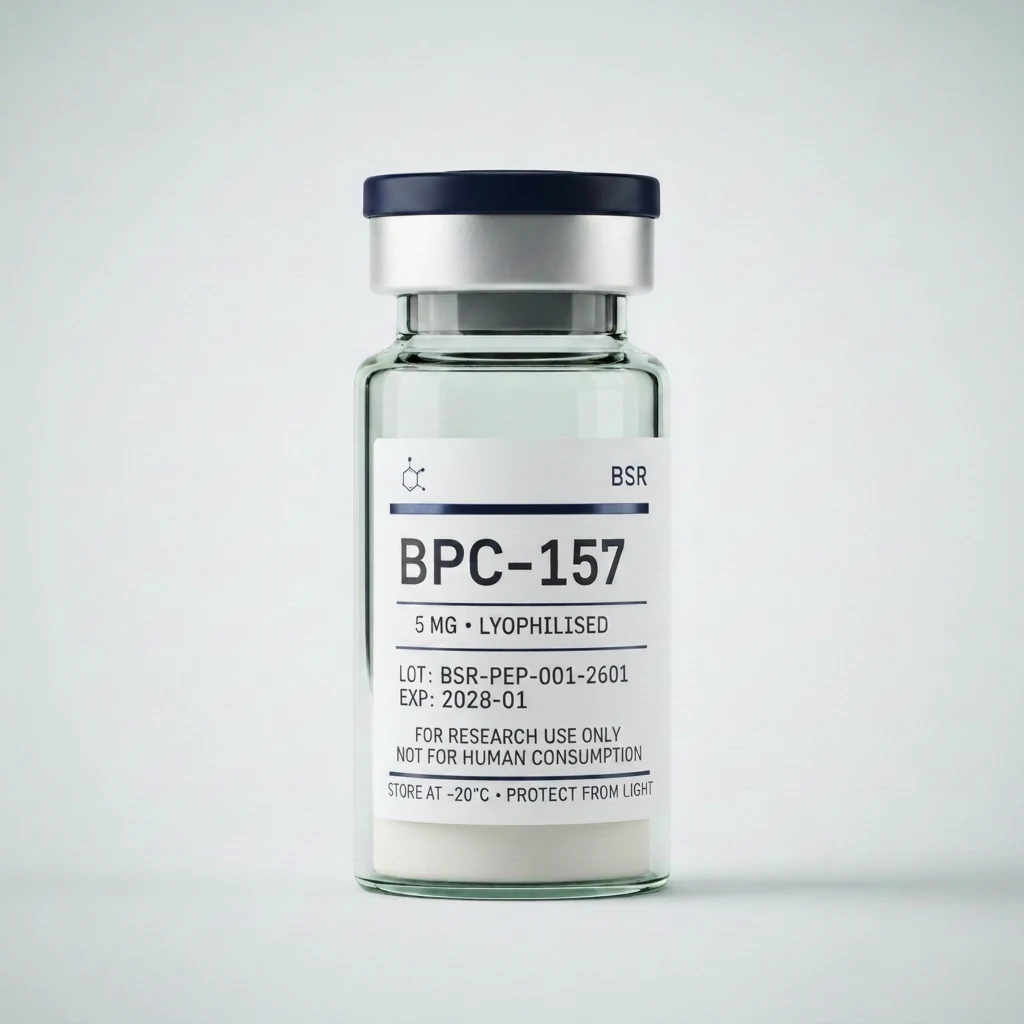
- Storage: BPC-157 peptide powder is stable at −20 °C when lyophilised; reconstituted solutions should be prepared fresh or stored at 4 °C for short periods with bacteriostatic water if extended use is intended.
Outlook
The May 2026 MDPI review is the most thorough published appraisal of BPC-157's biopharmaceutical development barriers to date, and its conclusions are cautious: the compound's multi-system preclinical profile is scientifically interesting but makes the route to a single approvable indication and a GMP-grade, validated formulation longer and more expensive than for more narrowly targeted peptides. The 2026 reclassification process, if it results in BPC-157 moving to Category 1 in the US, may accelerate academic clinical research by improving access — but the timeline for rigorous, peer-reviewed human trial data remains uncertain regardless of compounding status.
For procurement professionals at UK research institutions, the operative position is unchanged: BPC-157 is a well-characterised research compound with a large and largely consistent preclinical literature, an unlicensed status in the UK and EU, and an evidence base that does not yet meet the bar required for clinical use or regulatory approval in any major jurisdiction.
Research-grade material, HPLC verified, certificate of analysis with every order.
The week's Intelligence in one email, every Friday morning.
Regulatory moves, trial readouts, supply-chain news. No product pitches. Unsubscribe in one click.
More in Research Pipeline
MOTS-c: The Mitochondria-Encoded Peptide With a 7-5 PCAC Vote, a Metabolic Evidence Base Built Largely in Rodents, and No Human Drug-Product Data on Record
13 Sep 2026
KPV: The Alpha-MSH Tripeptide With a Favourable PCAC Vote, an Intracellular NF-κB Mechanism, and No Completed Human Trial
12 Sep 2026
Semax: The ACTH-Derived Heptapeptide With an 8-5 PCAC Vote, Russian Clinical Approval, and a Research-Use-Only Status in the UK
09 Sep 2026