Research Pipeline · 12 Sep 2026
KPV: The Alpha-MSH Tripeptide With a Favourable PCAC Vote, an Intracellular NF-κB Mechanism, and No Completed Human Trial
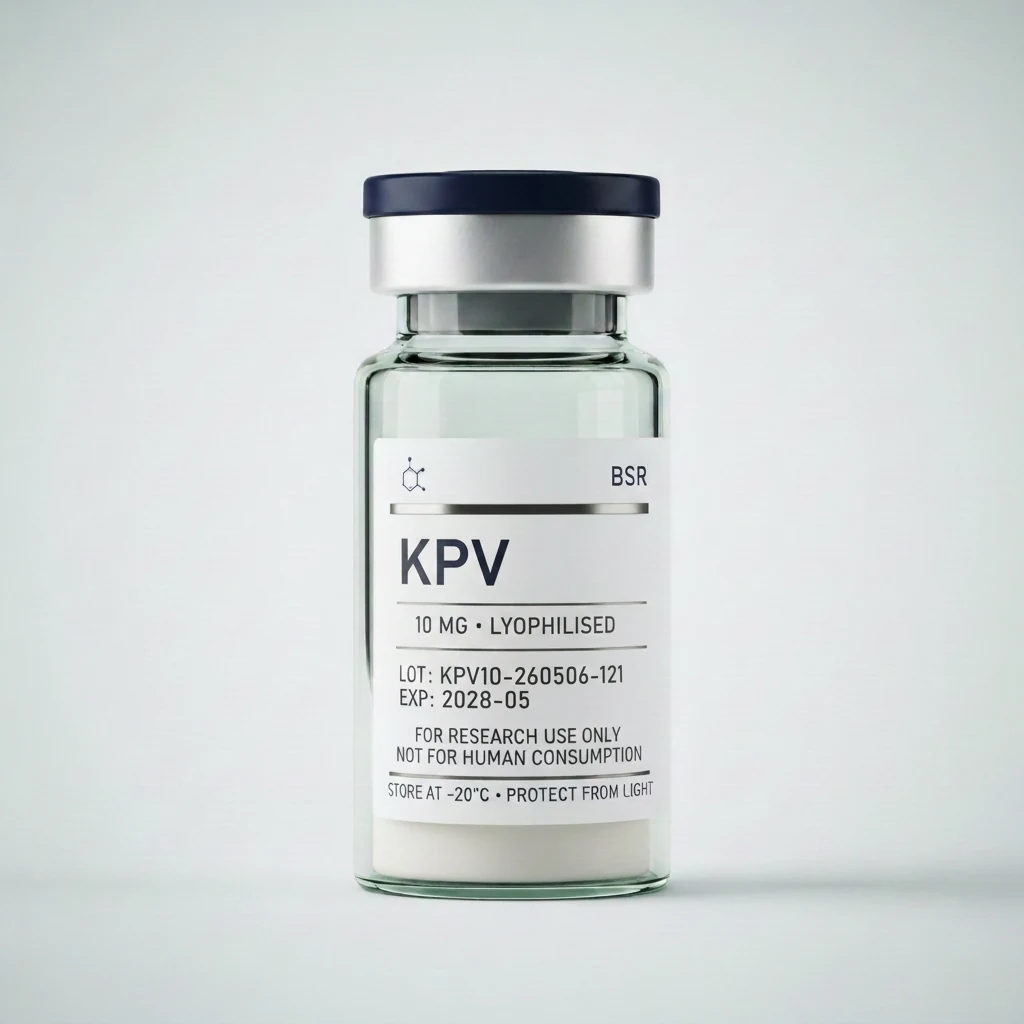
KPV is a synthetic tripeptide derived from the C-terminal end of alpha-melanocyte-stimulating hormone that has attracted research interest for its anti-inflammatory properties in gut and skin models. Following its removal from the FDA's Category 2 list in April 2026 and a favourable advisory committee vote in July, its regulatory trajectory is moving — but its human evidence base remains effectively absent.
7 sources cited
Key takeaways
- KPV is a synthetic tripeptide (Lys-Pro-Val) derived from the C-terminal sequence of alpha-melanocyte-stimulating hormone (α-MSH), engineered to isolate the hormone's anti-inflammatory activity from its pigmentation effects.
- Its primary proposed mechanism is intracellular: KPV is transported into inflamed epithelial cells via the PepT1 di/tripeptide transporter, where it inhibits NF-κB activation by competitively blocking nuclear import of the p65 RelA subunit.
- The FDA removed KPV from its Section 503A Category 2 list in April 2026, and the Pharmacy Compounding Advisory Committee (PCAC) issued a favourable advisory recommendation at its 23–24 July 2026 meeting.
- No registered human clinical trials for KPV have been completed as of mid-2026; the entire evidence base is preclinical.
- The PCAC vote is advisory only. Formal rulemaking by the FDA is required before compounding under 503A is lawful, and no timeline for that rulemaking has been published.
- In the UK, KPV holds no MHRA marketing authorisation and is available only as a research-use-only compound.
What KPV is
KPV — the tripeptide Lys-Pro-Val — corresponds to amino acids 193 to 195 at the C-terminal end of α-MSH, a 13-amino acid neuropeptide cleaved from pro-opiomelanocortin (POMC). Research interest in KPV has centred on its proposed anti-inflammatory properties, independent of α-MSH's pigmentation effects. The separation of the anti-inflammatory fragment from the melanocortin receptor-mediated pigmentation pathway is the pharmacological rationale for studying the isolated tripeptide rather than the full hormone.
As a tripeptide, KPV is among the smallest compounds to appear on the FDA's compounding review agenda. Its molecular weight is roughly 370 Da — small enough to raise questions about oral bioavailability via the same transporter system that handles dipeptide and tripeptide nutrients in the intestinal lumen.
Mechanism: intracellular NF-κB inhibition via PepT1
The mechanism literature points consistently away from classic melanocortin receptor signalling and towards an intracellular pathway. In the gut, KPV appears to enter intestinal epithelial cells through PepT1, a peptide transporter — and PepT1 expression is upregulated when the intestine is inflamed. This creates a degree of tissue-selective delivery: the inflamed mucosa that is the target of therapeutic interest also expresses more of the transporter that admits the compound.
Once inside the nucleus, the mechanism becomes more specific still. Research in human bronchial epithelial cells revealed that KPV translocates to the nucleus and competitively blocks the interaction between importin-α3 (Imp-α3) and the p65 RelA subunit of NF-κB. NF-κB is a master transcription factor for pro-inflammatory cytokines including TNF-α, IL-6, and IL-1β; blocking its nuclear translocation suppresses the downstream inflammatory cascade at a relatively proximal point.
One of the most consistently reported actions of KPV in the literature is reduction of the duration of NF-κB activation, mediated through IκBα stabilisation and competitive inhibition of the Imp-α3/p65 interaction in the nucleus. This places KPV in a mechanistic category distinct from most regenerative peptides, which tend to act on growth factor receptors or angiogenic pathways.
KPV's distinction in this group is its narrow, well-characterised mechanism: it does one main thing — NF-κB inhibition — with one main delivery quirk — PepT1 uptake into inflamed tissue — and the rest of its activity sits in adjacent pathways. For research procurement teams, this narrow mechanism is both an asset (cleaner experimental interpretation) and a potential limitation (the evidence for any given indication depends on whether NF-κB is actually driving pathology in that model).
Evidence base: preclinical signals, no human trials
The state of the human evidence for KPV can be summarised in a single sentence: there is none. No registered human clinical trials have been completed as of June 2026; all evidence comes from in vitro and animal model studies, which do not guarantee equivalent effects or safety in humans.
The preclinical literature is nonetheless consistent across two primary research areas:
Gut inflammation. Preclinical research in animal models of colitis suggests KPV reduces intestinal inflammation by inhibiting NF-κB signalling and pro-inflammatory cytokine production; it is transported into intestinal cells by PepT1, which is upregulated during inflammatory bowel disease. The Dalmasso foundational work from 2008, which established this transporter-mediated mechanism in colitis models, remains the most cited entry point for IBD-related KPV research.
Skin inflammation. Preclinical studies show KPV suppresses contact hypersensitivity and dermatitis in animal models when applied topically or administered systemically, reducing pro-inflammatory cytokines. Topical formulations are studied separately from injectable ones; the two routes involve different delivery pharmacology.
Potential oncological signal (preclinical). Viennois et al. (2016) showed KPV reduced tumour formation in AOM/DSS-induced colitis-associated cancer mouse models, with effects mediated through PepT1. This is a preclinical finding only and does not establish any human oncological outcome.
The FDA's 2026 assessment highlighted unanswered questions about immune reactions, aggregation, peptide impurities, identity, and microbiological quality. These questions are standard across most non-approved peptides and do not constitute a specific safety signal unique to KPV; they reflect the evidential gap that the PCAC process is designed to evaluate.
Oral bioavailability: a structural advantage for gut indications
One practical feature that distinguishes KPV from most injectable research peptides is its demonstrated oral activity via PepT1. Unlike many peptides, KPV can be administered orally; research demonstrates that it is actively transported into intestinal epithelial cells and immune cells via the PepT1 di/tripeptide transporter. Oral bioavailability is lower than injectable forms, but direct delivery to gut tissue may be advantageous for gastrointestinal conditions.
This matters for research procurement: KPV appears in oral, topical, subcutaneous, and nasal product formats in the grey market. However, published oral and topical experiments use different formulations from those marketed by clinics, and there is no standardised dose or schedule across routes. Researchers sourcing KPV for IBD model work should verify which route of administration and which vehicle were used in the primary literature they are attempting to replicate.
Regulatory position: US
KPV's US regulatory trajectory in 2026 has moved through three distinct stages:
-
Category 2 designation (2023). KPV was placed on the FDA's Category 2 bulk drug substance list under Section 503A, effectively prohibiting licensed compounding pharmacies from preparing it for human use.
-
Removal from Category 2 (April 2026). KPV was among several peptides removed from the FDA's Category 2 list in April 2026, alongside compounds like BPC-157 and TB-500, following withdrawal of the original nomination. Removal from Category 2 does not confer Category 1 status or compounding permission.
-
Favourable PCAC advisory vote (July 2026). On 23–24 July 2026, the FDA Pharmacy Compounding Advisory Committee recommended adding KPV to the Section 503A Bulks List. The committee considered wound healing and inflammatory conditions. The vote was advisory; the FDA has not yet issued a final determination.
Current access rules remain unchanged pending formal FDA rulemaking. Products sold online as KPV for research use are not approved for human use, and identity, strength, and quality cannot be assumed without independent analytical verification.
Regulatory position: UK
KPV holds no MHRA marketing authorisation and is not listed as a licensed medicine in the UK. In the UK, it is classified as a research-use-only compound. The Human Medicines Regulations 2012 prohibit the sale or supply of unlicensed medicinal products for human use; KPV supplied with any implied therapeutic claim would be subject to MHRA enforcement. UK research procurement teams should source KPV under a documented research-only framework and verify that the supplier provides a current Certificate of Analysis from an independent, accredited laboratory.
Procurement considerations for UK research labs
Given the compound's characteristics, research-procurement teams should weigh the following:
Purity and identity testing. KPV's small molecular weight (approximately 370 Da) means that it elutes at a different position on reversed-phase HPLC from larger research peptides. A Certificate of Analysis should include HPLC purity (ideally ≥98%), mass spectrometry confirmation of the molecular ion, and microbiological testing if the intended use involves cell culture. The FDA's advisory committee specifically flagged aggregation and peptide impurities as open questions; a compliant CoA should address these.
Route-specific formulation. Published research on KPV uses oral, topical, subcutaneous, and intravenous routes with meaningfully different formulation requirements. Researchers replicating an oral bioavailability or gut-delivery study should not substitute a subcutaneous-grade lyophilised powder without understanding how that affects the experimental endpoint.
Regulatory monitoring. The PCAC's favourable advisory vote opens a rulemaking process that, if completed, would permit licensed US compounding pharmacies to prepare KPV for prescription use. UK researchers should monitor whether any MHRA reclassification follows, though no such process has been announced. The post-PCAC rulemaking timeline in the US has not been published.
Summary
KPV is one of the more mechanistically coherent anti-inflammatory peptides in the research literature: a well-defined NF-κB inhibition mechanism delivered selectively to inflamed tissue via PepT1 upregulation gives it a cleaner experimental rationale than many comparators. The PCAC's favourable advisory vote in July 2026 reflects that coherence. What KPV does not yet have is any completed human clinical trial — a gap that neither the advisory vote nor the preclinical literature fills. For UK research-procurement professionals, it remains a research-use-only compound with meaningful mechanistic interest and a regulatory status that could change materially once the FDA concludes its post-PCAC rulemaking.
Research-grade material, HPLC verified, certificate of analysis with every order.
The week's Intelligence in one email, every Friday morning.
Regulatory moves, trial readouts, supply-chain news. No product pitches. Unsubscribe in one click.
More in Research Pipeline
Beyond the GLP-1 Duopoly: Three October Developments That Signal a Broadening Obesity Pipeline
22 Oct 2026
Thymosin Alpha-1: What 35 Countries of Clinical Use and a Lopsided PCAC Vote Mean for Research Access in 2026
07 Oct 2026
Viking Therapeutics Initiates Oral Maintenance Dosing Study for VK2735: What the GLP-1/GIP Dual Agonist's Two-Part Programme Tells Researchers About the Weight-Regain Problem
06 Oct 2026