Research Pipeline · 08 Jul 2026
TB-500: The Thymosin Beta-4 Fragment With Deep Preclinical Roots and a Critical FDA Compounding Vote Fifteen Days Away
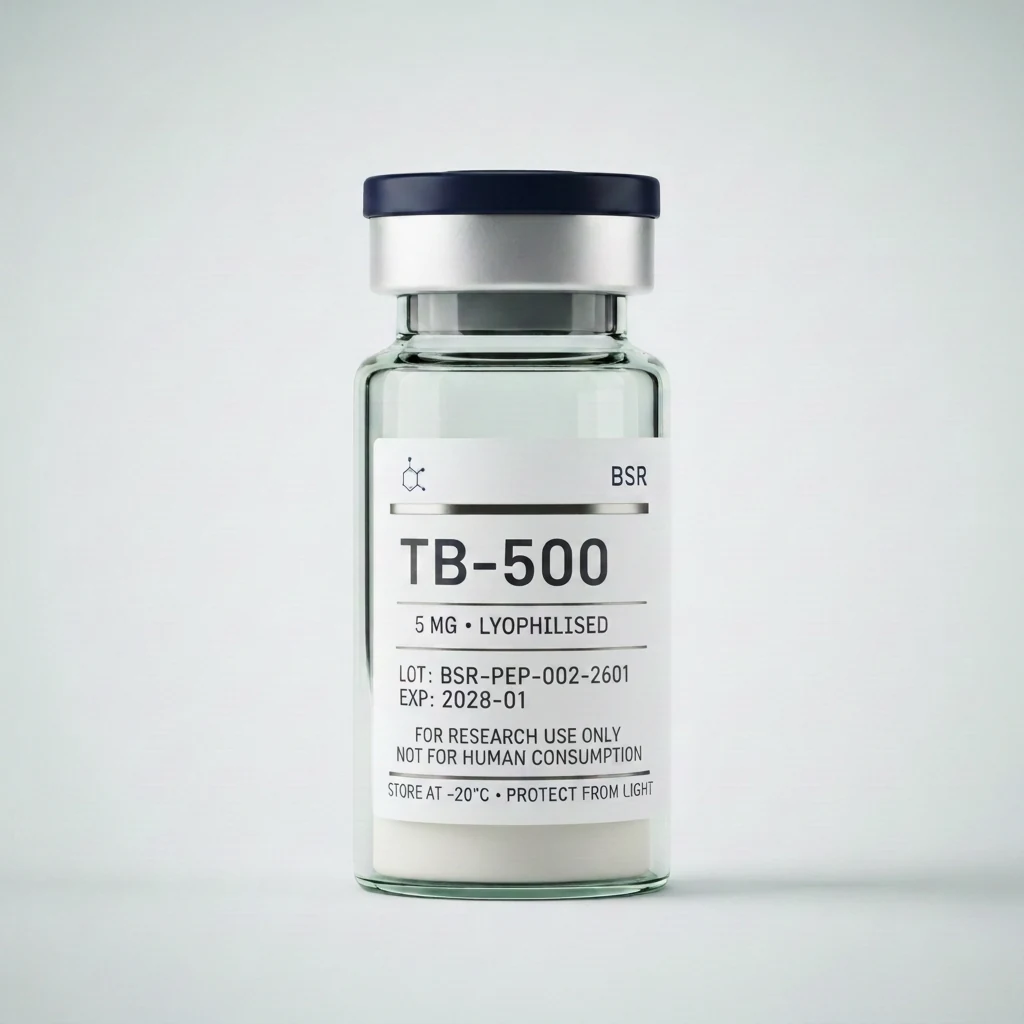
TB-500, a synthetic seven-amino-acid fragment of the endogenous protein thymosin beta-4, enters its most consequential regulatory moment on 23 July 2026, when the FDA's Pharmacy Compounding Advisory Committee votes on whether to recommend it for the Section 503A Bulk Drug Substances List. A June 2026 scoping review in Applied Sciences maps the evidence base: rich preclinical data, established veterinary use, and a critical absence of human RCTs for the injectable fragment itself — precisely…
12 sources cited
Key takeaways
- TB-500 is a synthetic seven-amino-acid fragment (Ac-LKKTETQ) derived from the endogenous 43-amino-acid protein thymosin beta-4 (Tβ4); the two are chemically and legally distinct.
- The FDA's Pharmacy Compounding Advisory Committee (PCAC) is scheduled to review TB-500 on 23 July 2026 for potential inclusion on the Section 503A Bulk Drug Substances List.
- FDA briefing documents propose that TB-500 not be listed, citing insufficient human safety and efficacy data for the compounded injectable route.
- A June 2026 scoping review in Applied Sciences (MDPI) confirms that the available human evidence is concentrated in ocular and soft-tissue models using full-length Tβ4, not the TB-500 fragment specifically.
- The World Anti-Doping Agency prohibits TB-500 at all times under the 2026 Prohibited List; UK Anti-Doping (UKAD) applies the same restriction.
- TB-500 holds no marketing authorisation from the FDA, EMA, or MHRA; it remains a research-use-only compound in the United Kingdom.
What TB-500 is — and what it is not
TB-500 is a synthetic peptide based on a fragment of thymosin beta-4 (Tβ4), a naturally occurring protein found in nearly all human and animal cells. The active sequence — LKKTETQ — is considered responsible for many of Tβ4's regenerative effects. Structurally, it is described as a seven-amino-acid peptide with an acetylated N-terminus (Ac-Leu-Lys-Lys-Thr-Glu-Thr-Gln-OH), corresponding to a fragment of thymosin β-4.
This distinction between the fragment and the parent molecule matters considerably for regulatory and evidentiary purposes. The clinical trial data that exists for corneal wound healing and venous ulcers was generated using full-length thymosin beta-4, not the TB-500 fragment. Researchers and procurement professionals should be careful not to conflate the two when evaluating source literature.
Mechanism of action
TB-500 is a synthetic peptide fragment derived from thymosin β-4. It functions as a G-actin sequestering protein, supporting the actin dynamics that enable cell migration. Cell migration is upstream of wound healing, angiogenesis, and tissue remodelling.
More specifically, TB-500 wound healing research encompasses multiple interacting biological processes: G-actin sequestration driving keratinocyte and fibroblast migration, ILK-Akt signalling promoting cell survival and MMP remodelling, multi-pathway angiogenesis via VEGF upregulation and endothelial activation, macrophage polarisation toward pro-resolution phenotypes, and TGF-β isoform modulation affecting scar quality.
These mechanisms help explain why the compound has attracted research interest spanning skin wound healing, soft-tissue repair, cardiac regeneration models, and, historically, veterinary musculoskeletal use. TB-500 has a profile of strong animal data, particularly from equine medicine where it has been used for decades, alongside thin human clinical literature.
State of the evidence: the preclinical/clinical gap
The most comprehensive recent synthesis of this literature is a scoping review published in Applied Sciences in June 2026. The authors note that thymosin beta-4 (TB4) and the related compound commonly referred to as TB-500 are widely discussed in tissue healing and musculoskeletal medicine, but the scope and nature of the supporting literature remain unclear.
Their findings are instructive for UK research procurement decisions. Human evidence was concentrated in ocular/cornea and wound/skin/soft tissue settings, whereas direct TB-500 evidence was limited to a single included study. Overall, the mapped literature supports popular interest in several repair-related pathways but remains unevenly distributed and largely preclinical, with limited human evidence directly relevant to musculoskeletal applications.
Recent sports medicine and peptide reviews have emphasised that patient demand, direct-to-consumer marketing, and off-label or unapproved peptide use are expanding faster than the human evidence base.
The most advanced human clinical programme in this space involves full-length Tβ4, not TB-500. RGN-259 (a 0.1% Tβ4 ophthalmic solution developed by RegeneRx) has completed Phase II and Phase III trials for dry eye and neurotrophic keratopathy and holds orphan drug designation; however, no FDA approval has been granted. Systemic injectable TB-500 has not been submitted through any IND pathway that has reached approval.
Regulatory pathway: the July 2026 PCAC vote
On 23 July 2026, the Committee will discuss TB-500-related bulk drug substances — covering both TB-500 (free base) and TB-500 acetate — for potential inclusion on the Section 503A Bulk Drug Substances List. The evaluation will be conducted alongside BPC-157, KPV, and MOTS-c, all four of which were removed from the FDA's Category 2 restricted list in April 2026.
It is important to understand what that removal does and does not mean. In April 2026, the FDA removed twelve peptides — including TB-500 — from Category 2. That removal is meaningful: it signals the FDA no longer considers these compounds to present significant safety risks at the compounding level. But it does not authorise compounding. The peptides now exist in a regulatory grey zone — off the prohibited list, but not yet on the approved list.
Based on the scientific briefing documents published ahead of the meeting, at the July 23, 2026 PCAC meeting, FDA proposed that TB-500 (free base) and TB-500 acetate not be added to the 503A Bulks List. The nomination sought TB-500 for wound healing. FDA found no adequate effectiveness or safety evidence for that use.
Across all seven peptides under review, FDA cited that the substances are not well-characterised, that there is little or no human evidence of effectiveness for the proposed (mostly injectable) routes, and that there is insufficient human safety data — including unassessed immunogenicity risk.
Even if the PCAC were to issue a positive recommendation, formal rulemaking would follow. If the FDA proceeds, it publishes a proposed rule, accepts a comment period, then publishes a final rule that officially adds the substance to the 503A bulks list. This means that even a unanimous positive PCAC vote does not immediately authorise compounding. The full rulemaking process typically takes 12 to 24 months after the hearing.
The PCAC's recommendation is non-binding, and formal rulemaking is what comes next. Even if PCAC recommends adding these peptides to 503A's Category 1 list, and even if FDA agrees, notice-and-comment rulemaking is still required — a process that, under standard timelines, can take more than a year.
UK and international regulatory status
In the United Kingdom, the picture is straightforward: TB-500 has no UK marketing authorisation. The MHRA opened investigations in April 2026 into UK clinics making therapeutic claims about unregulated peptide products.
For human use, TB-500 sits in the same regulatory category as most research peptides: it has not been approved by the FDA, EMA, or other major drug regulators for medical use.
For laboratories and institutions with connections to competitive sport, the WADA position is unambiguous. As of the 2026 WADA Prohibited List, TB-500 is prohibited at all times under Section S2 (Peptide Hormones, Growth Factors, Related Substances and Mimetics). The S2 category covers thymosin beta-4 and its fragments. The prohibition reflects the presumption of tissue-repair benefit, not a demonstrated performance effect. WADA-accredited laboratories run targeted assays for TB-500. Anyone competing under WADA, UK Anti-Doping (UKAD), professional federation rules or military testing should treat TB-500 as a detectable banned substance.
Implications for UK research procurement
For UK laboratory procurement teams, several practical points follow from the above.
Research-use-only status. TB-500 is available in the UK solely as a research-use-only reference compound. Batch-specific certificates of analysis, third-party HPLC purity data, mass-spectrometry identity confirmation, clear research-use-only labelling, and stability documentation are the minimum quality markers that procurement professionals should require from any supplier.
Distinguishing the fragment from full-length Tβ4. Because the most substantial clinical data involves full-length thymosin beta-4 — particularly in ophthalmic applications — researchers should be explicit about which compound they are procuring and take care not to extrapolate human clinical findings from the parent protein to the fragment. Dosing ranges used in the research community have not been validated in a human RCT of TB-500 (Ac-LKKTETQ). The strongest human evidence is still for full-length thymosin beta-4 in topical (RGN-137) or ophthalmic (RGN-259) formulations, not injectable TB-500.
Monitoring the PCAC outcome. PCAC recommendations are non-binding. The FDA ultimately decides whether to add a substance to the list. But PCAC recommendations carry significant weight. A positive recommendation tends to move the process forward. A negative one often means the substance stays off the list. A negative PCAC recommendation on 23 July would not alter TB-500's current legal status for research-use-only purposes in the UK, but it would close the most immediate pathway to regulated US compounding access, affecting the broader supply and demand dynamics of the compound.
A second PCAC meeting is planned. The FDA announced the PCAC will convene again before the end of February 2027 to review five additional peptides for the 503A Bulk Drug Substances List, including GHK-Cu, Melanotan II, Cathelicidin (LL-37), and Dihexa acetate. The outcome of the July 2026 meeting will set important precedent for how those subsequent reviews are conducted.
This briefing is produced for research-procurement professionals and does not constitute medical, legal, or regulatory advice. Regulatory status is subject to change; readers should verify current FDA and MHRA guidance before making procurement decisions.
Research-grade material, HPLC verified, certificate of analysis with every order.
The week's Intelligence in one email, every Friday morning.
Regulatory moves, trial readouts, supply-chain news. No product pitches. Unsubscribe in one click.
More in Research Pipeline
Thymosin Alpha-1: What 35 Countries of Clinical Use and a Lopsided PCAC Vote Mean for Research Access in 2026
07 Oct 2026
Viking Therapeutics Initiates Oral Maintenance Dosing Study for VK2735: What the GLP-1/GIP Dual Agonist's Two-Part Programme Tells Researchers About the Weight-Regain Problem
06 Oct 2026
GHK-Cu: What a Fresh Diabetic Wound Study and a Recruiting Phase 2 Trial Mean for the Copper Peptide's Research Standing
03 Oct 2026