Research Pipeline · 25 Jul 2026
Tesamorelin: The Only FDA-Approved GHRH Peptide — and What Its Regulatory Journey Tells the Research Community
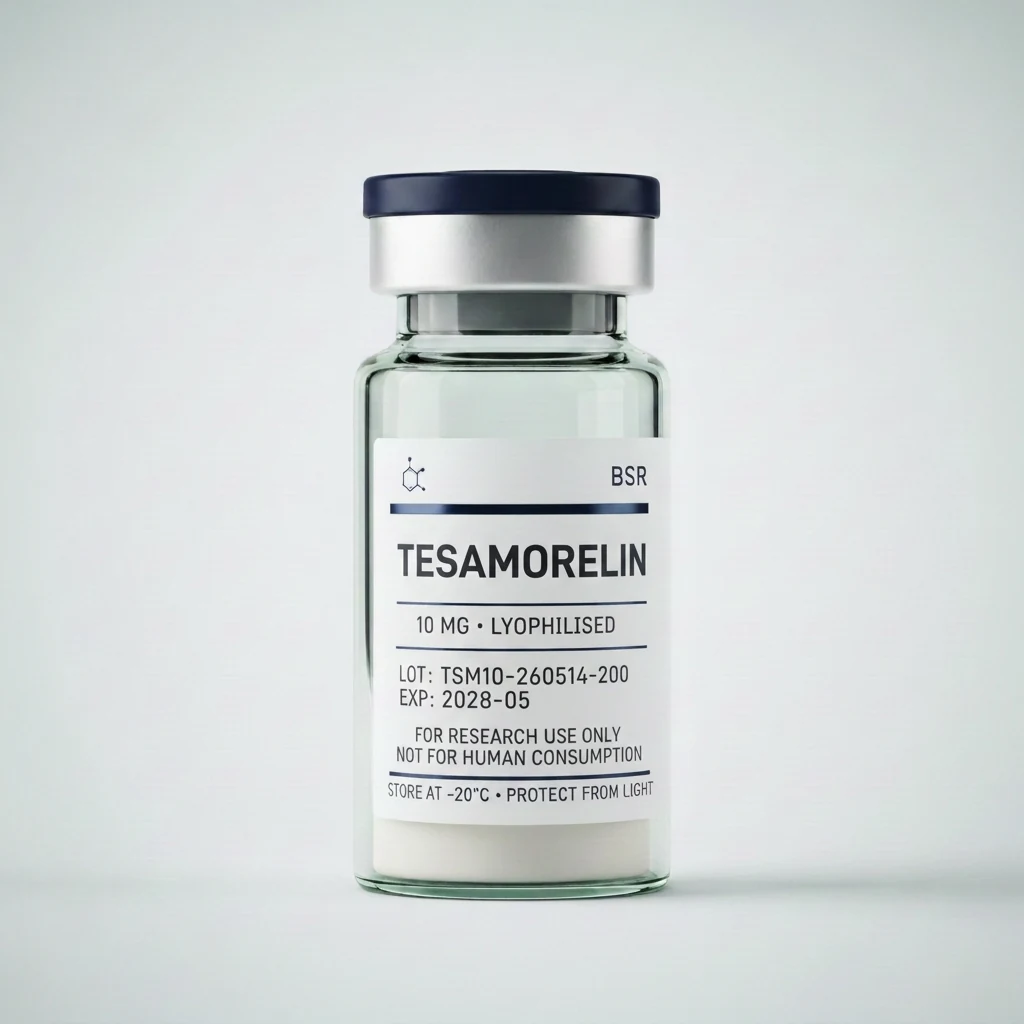
Tesamorelin (Egrifta) stands apart from the peptides currently before the FDA's Pharmacy Compounding Advisory Committee: it already holds three successive FDA approvals, backed by Phase III randomised controlled trials. Understanding how it got there — and what that means for compounding access, off-label research, and the GHRH class more broadly — is increasingly relevant for procurement professionals as the July 2026 PCAC meeting unfolds.
8 sources cited
Key takeaways
- Tesamorelin (brand names Egrifta, Egrifta SV, Egrifta WR) is the only FDA-approved growth-hormone-releasing hormone (GHRH) peptide, approved for excess visceral abdominal fat in adults with HIV-associated lipodystrophy.
- Its most recent formulation, Egrifta WR, received FDA approval in March 2025, simplifying reconstitution from daily to weekly.
- Phase III trials demonstrated approximately 15–18% reduction in visceral adipose tissue (VAT); a 12-month NAFLD-focused trial reported approximately 37% relative reduction in liver fat versus placebo.
- Unlike the seven peptides before the FDA's Pharmacy Compounding Advisory Committee (PCAC) this week, tesamorelin has navigated the full NDA pathway — making it a useful reference point for what evidence-based regulatory clearance actually requires.
- The compound has no FDA-approved indication outside HIV-related lipodystrophy; off-label use in metabolic and longevity research operates in a distinct legal space.
- No MHRA-approved product containing tesamorelin exists in the UK; UK-based researchers must treat it as a research-use-only substance under MHRA jurisdiction.
What is tesamorelin?
Tesamorelin is a synthetic 44-amino acid polypeptide analogue of endogenous growth-hormone-releasing hormone (GHRH 1-44). According to Peptide Source Book, the molecule carries a trans-3-hexenoic acid modification at the N-terminus, a structural change that slows enzymatic degradation and extends the duration of pituitary signalling compared with native GHRH.
The mechanism is genuinely upstream: rather than administering exogenous growth hormone directly, tesamorelin acts on GHRH receptors in the anterior pituitary, stimulating pulsatile growth hormone (GH) secretion within the body's own feedback architecture. As described by Peptibase, the downstream rise in GH and insulin-like growth factor 1 (IGF-1) is what drives the reduction in visceral fat observed in clinical trials — a receptor-based mechanism that has been characterised in human studies to a degree that most research peptides have not approached.
Three FDA approvals: a condensed regulatory history
Tesamorelin's regulatory history is unusually substantive for a GHRH-class peptide. According to Peptide Source Book, the compound has received three successive FDA approvals:
- Egrifta (2010): The original approval for reducing excess visceral abdominal fat in HIV-positive adults with lipodystrophy.
- Egrifta SV (2019): A sterile, lyophilised reformulation requiring refrigeration but simplifying the preparation process compared with the original product.
- Egrifta WR (March 2025): According to Peptides:Enhanced, the F8 formulation changed reconstitution logistics materially: each vial now contains 11.6 mg of tesamorelin sufficient for seven doses, reconstituted weekly rather than daily, and is stable at room temperature before and after reconstitution, while the daily 2 mg dose remains unchanged.
This sequence of approvals — original NDA followed by successive reformulations — represents a development pathway that the peptides currently under PCAC review have not entered.
Clinical evidence: what the Phase III data show
The evidentiary base for tesamorelin's approved indication rests on randomised controlled trials, a standard that distinguishes it sharply from the seven peptides reviewed at the July 2026 PCAC meeting, for each of which FDA staff found insufficient human efficacy data.
According to Peptide Deck, Phase III trials demonstrated a 15–18% reduction in visceral adipose tissue over 26 weeks, targeting the deep abdominal fat associated with metabolic disease. According to Peptides:Enhanced, a 12-month trial focused on liver fat reported approximately a 37% relative reduction versus placebo. The Phase III effect size has been described as real and reproducible across trials.
A 2025 paper, according to Peptide Deck, confirmed reduced cardiovascular risk markers in HIV patients taking tesamorelin — an indirect benefit attributed to the compound's visceral fat-reduction mechanism rather than any direct cardioprotective effect.
As noted by Peptide Source Book, use outside the approved HIV-lipodystrophy indication is off-label and not FDA-approved; the evidence base for those applications is more limited and generally does not approach the same standard of controlled trial data.
PCAC context: why tesamorelin matters to the 23–24 July 2026 debate
The FDA's PCAC is meeting today (23 July) and tomorrow (24 July) to consider seven peptides — BPC-157, KPV, TB-500, MOTS-c, Emideltide (DSIP), Semax, and Epitalon — for potential inclusion on the Section 503A Bulk Drug Substances List. According to the FDA's advisory committee notice, BPC-157, KPV, TB-500, and MOTS-c are on the Day 1 agenda.
According to Orrick's PCAC preview, the agency's briefing documents propose the same conclusion for each of the seven peptides: do not add them to the 503A Bulks List. The docket, FDA-2025-N-6895, had attracted approximately 1,860 public comments. According to National Law Review, removal of a substance from Category 2 does not, on its own, authorise its use in compounding or place it within FDA's interim enforcement discretion policy.
Tesamorelin illustrates what the alternative pathway looks like. It required multiple Phase II and Phase III trials, a full New Drug Application, and three rounds of FDA review before receiving its approved indication. According to PeptideStaff, even a positive PCAC recommendation — should the committee diverge from staff guidance — would initiate FDA rulemaking that typically takes twelve months or more before compounding pharmacies could legally compound these substances under 503A. Approval would be a further, distinct step beyond that.
Off-label and longevity research use
Outside its approved indication, tesamorelin has attracted interest in two areas: general visceral fat reduction in adults without HIV, and GH-optimisation stacks in longevity and anti-ageing research contexts. According to Peptide Deck, the compound is increasingly used off-label for visceral fat reduction in metabolically healthy adults, age-related GH decline protocols, and — with less evidence — cognitive enhancement, given the IGF-1/brain axis that some researchers are investigating.
According to Peptides:Enhanced, tesamorelin is not a replacement for GLP-1 receptor agonists and works through an entirely different axis. Whereas GLP-1 agents suppress appetite and slow gastric emptying, tesamorelin acts upstream on the hypothalamic-pituitary axis to promote endogenous GH pulses. Researchers exploring body composition in metabolic-disease models have shown interest in both axes independently.
Tesamorelin is commonly studied alongside ipamorelin, a growth hormone releasing peptide (GHRP), because the two act on complementary receptors — GHRH-R and ghrelin-R respectively — with some researchers proposing additive GH secretion. That combination does not alter the regulatory or safety status of either compound.
UK and MHRA regulatory position
No MHRA-approved medicinal product containing tesamorelin is currently listed in the UK. In the UK, tesamorelin would be classified as an unlicensed medicine if used clinically, requiring import under a Specials licence or supply under Named Patient arrangements. For laboratories, it falls within research-use-only supply frameworks, which require appropriate ethical oversight and institutional authorisation.
Procurement professionals in the UK should note that the FDA's NDA approval for Egrifta in the US has no direct effect on UK regulatory status. UK-based researchers sourcing tesamorelin for laboratory use must verify that suppliers can provide valid Certificates of Analysis (CoA) with HPLC purity data, endotoxin testing results, and documented storage-chain integrity, irrespective of the compound's US regulatory history.
Summary
Tesamorelin occupies a genuinely distinct position in the GHRH peptide landscape. As the only member of its class to have navigated the full FDA NDA process — across three approved formulations, the most recent as recently as March 2025 — it provides a calibration point for what evidence-based regulatory clearance entails. The Phase III VAT-reduction data that underpinned its original 2010 approval represent a standard that the seven peptides currently before the PCAC are, by the FDA staff's own assessment, not yet close to meeting. For research-procurement professionals monitoring this space, tesamorelin is both a useful comparator and, for off-label research applications, a compound that still requires the same rigorous sourcing and institutional oversight as any other research-use-only peptide in the UK market.
Research-grade material, HPLC verified, certificate of analysis with every order.
The week's Intelligence in one email, every Friday morning.
Regulatory moves, trial readouts, supply-chain news. No product pitches. Unsubscribe in one click.
More in Research Pipeline
Beyond the GLP-1 Duopoly: Three October Developments That Signal a Broadening Obesity Pipeline
22 Oct 2026
Thymosin Alpha-1: What 35 Countries of Clinical Use and a Lopsided PCAC Vote Mean for Research Access in 2026
07 Oct 2026
Viking Therapeutics Initiates Oral Maintenance Dosing Study for VK2735: What the GLP-1/GIP Dual Agonist's Two-Part Programme Tells Researchers About the Weight-Regain Problem
06 Oct 2026