Research Pipeline · 23 Aug 2026
CJC-1295 and Ipamorelin: Mechanism, Evidence Base, and Regulatory Position in 2026
CJC-1295 and ipamorelin are the two most widely researched growth hormone secretagogue peptides in research procurement. Both remain on the FDA's Category 2 list pending further review, carry a mechanistically coherent combined-use rationale, and yet lack the clinical trial depth that would support approved compounding. This briefing covers their pharmacology, the state of the evidence, and what their regulatory position means for UK research laboratories.
9 sources cited
Key takeaways
- CJC-1295 and ipamorelin act on two distinct receptor pathways — GHRH-R and GHSR-1a respectively — that converge on GH release from anterior pituitary somatotrophs; co-activation produces synergistic pulse amplitude in preclinical models.
- The combination lacks published randomised controlled trial evidence; the clinical data for each compound individually are limited in scale and scope.
- Both peptides were designated FDA Category 2 bulk drug substances in October 2023 and remain there following the July 2026 PCAC meeting, which addressed a different cohort of peptides.
- Ipamorelin's only published Phase 2b human efficacy trial did not meet its primary endpoint.
- In the UK, neither compound holds MHRA authorisation; the MHRA's focus in the peptide-adjacent GLP-1 space has been on approved medicines rather than unapproved secretagogues.
- Research-grade procurement in the UK is lawful for in vitro and preclinical studies under research-use-only (RUO) conditions; the compounds may not be supplied for human administration.
What the peptides are
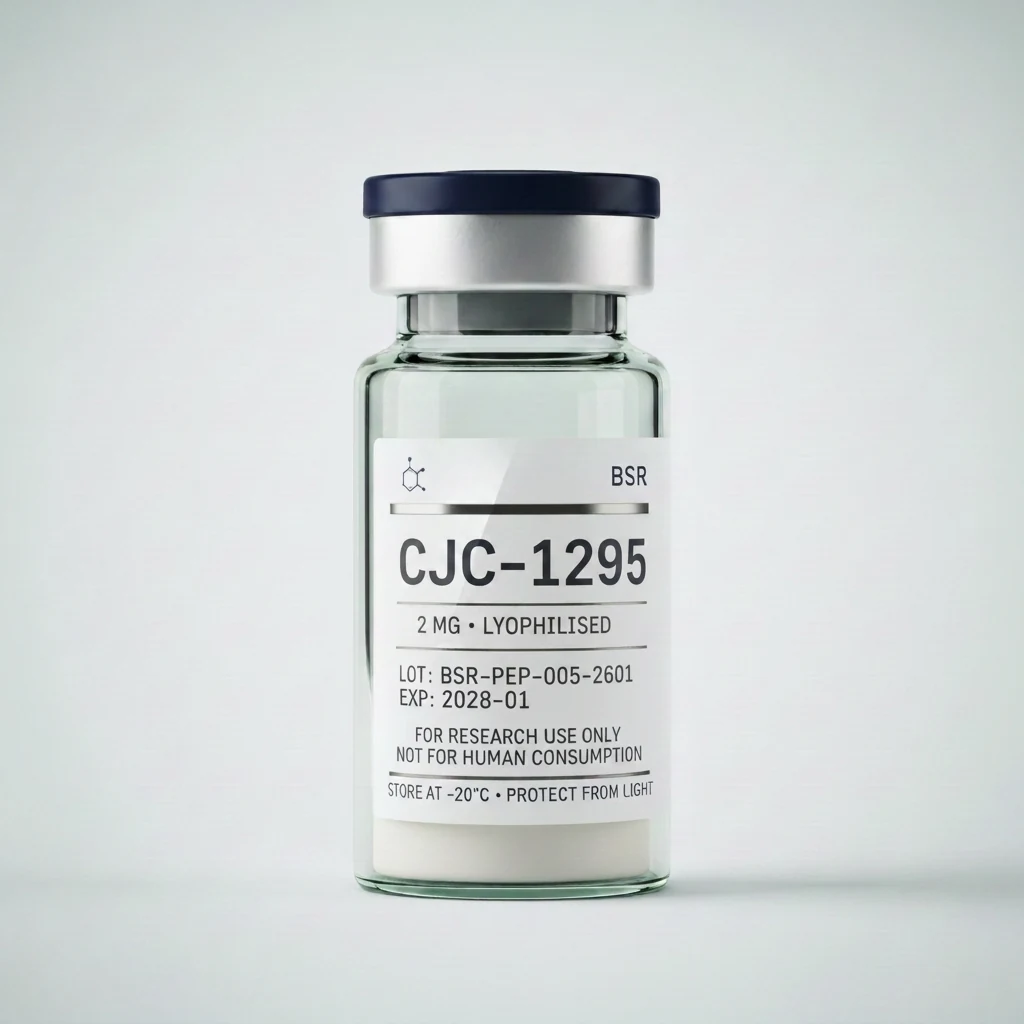
CJC-1295 is a synthetic analogue of growth hormone-releasing hormone (GHRH), derived from the biologically active GHRH(1-29) fragment. Peptides Lab UK notes that CJC-1295 is available in two pharmacokinetic variants: a "no DAC" form (modified GRF 1-29) with a plasma half-life of approximately 30 minutes, and a "with DAC" form that incorporates a drug affinity complex enabling albumin binding and a half-life of roughly eight days. The extended-acting DAC form produces sustained IGF-1 elevation rather than discrete GH pulses, and the distinction matters substantially for study design.
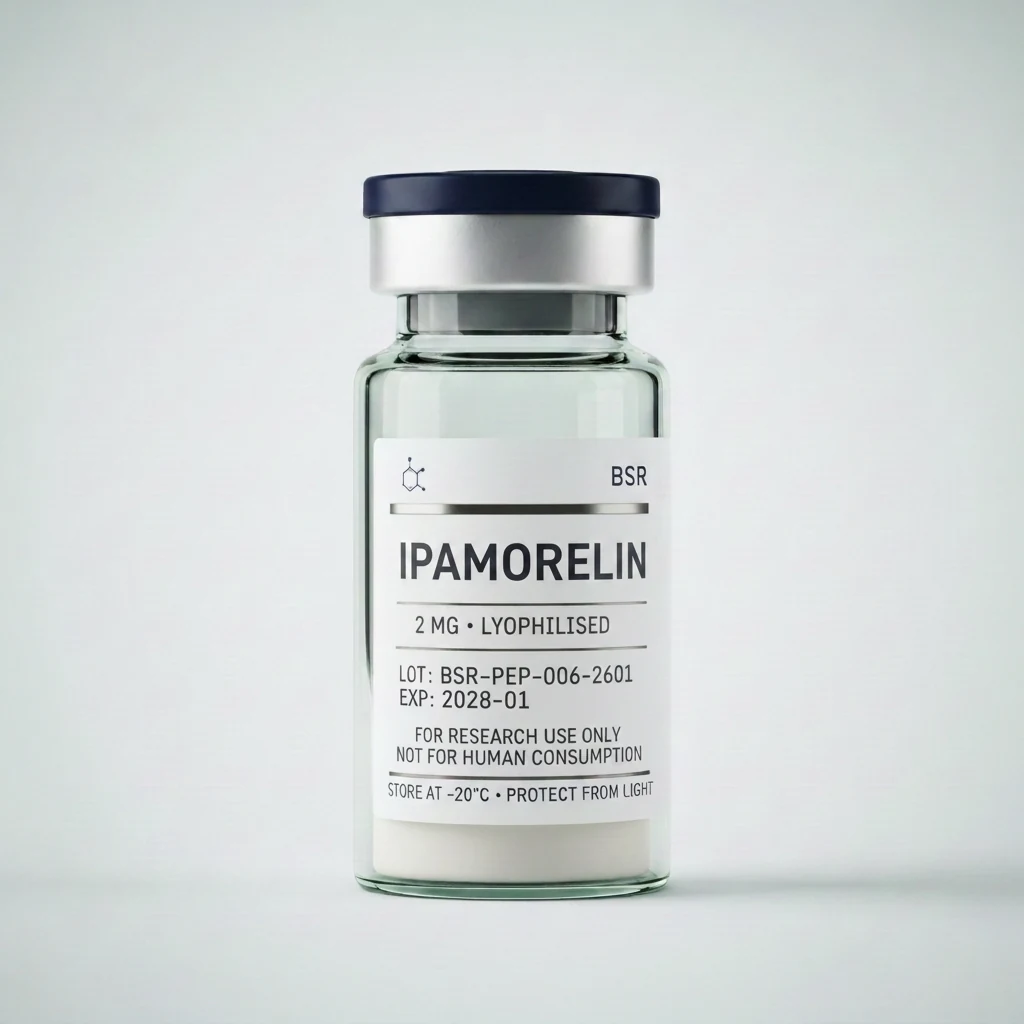
Ipamorelin is a pentapeptide growth hormone secretagogue (GHS) and selective ghrelin receptor agonist (GHSR-1a). It was characterised in 1998 by Raun and colleagues at Novo Nordisk, who demonstrated that ipamorelin releases growth hormone without the cortisol, prolactin, or ACTH elevations observed with earlier GHRPs such as GHRP-2 and GHRP-6. Superpower describes this selectivity for the GH axis relative to the hypothalamic-pituitary-adrenal axis as ipamorelin's defining pharmacological characteristic and the reason it became the preferred GHS in combination research contexts.
Receptor pharmacology and the combined-use rationale
The mechanistic case for combining the two compounds rests on receptor-level complementarity. According to Peptides Lab UK, CJC-1295 binds the GHRH receptor (GHRHR), a Class B GPCR expressed primarily on anterior pituitary somatotrophs. Its intracellular signal proceeds via Gαs → adenylyl cyclase → cAMP → PKA → CREB phosphorylation → GH gene transcription and vesicle exocytosis. Ipamorelin binds the ghrelin receptor (GHSR-1a), a Class A GPCR, signalling via Gαq → phospholipase C → IP₃/DAG → intracellular calcium release and PKC activation.
Because the two pathways are mechanistically independent, co-activation simultaneously engages the cAMP-driven transcriptional priming of somatotrophs (CJC-1295) and the calcium-dependent exocytosis cascade (ipamorelin). Spartan Peptides reports that preclinical pituitary slice data show GH pulses of three to five times baseline amplitude with the combination, versus 1.5 to two times with either compound alone, and that dual-pathway stimulation appears to recruit a larger proportion of the somatotroph population per pulse. This is a scientific rationale for combined use, not a clinically validated protocol.
Veldhuis and Bowers documented in 2009 that simultaneous GHRH receptor and ghrelin receptor activation produces a synergistic GH pulse larger than either pathway alone generates, according to Superpower. As of mid-2026, no published human RCTs of the specific CJC-1295/ipamorelin combination exist.
State of the clinical evidence
CJC-1295
The most commonly cited human data for CJC-1295 come from a 2006 study by Teichman and colleagues published in the Journal of Clinical Endocrinology & Metabolism (PMID: 16352683). Spartan Peptides notes that the study documented GH and IGF-1 elevations alongside changes in body composition parameters in healthy adults, and that the specificity of the GHRH-receptor response preserves the feedback regulation of the hypothalamic-pituitary axis — a stated advantage over exogenous GH administration.
Researchers studying circadian aspects of the GH axis have incorporated CJC-1295 into sleep architecture studies, given that growth hormone is naturally secreted predominantly during slow-wave sleep. According to Spartan Peptides, formal published data on this specific application remain limited, and it represents an emerging rather than established area of investigation.
Ipamorelin
The evidence base for ipamorelin in humans is thin. Superpower states that the only published Phase 2b human efficacy trial — conducted by Beck, Sweeney, and McCarter and published in 2014 — tested ipamorelin for postoperative ileus and did not meet its primary endpoint. A 2024 paper by Borner and colleagues in the British Journal of Pharmacology (PMID: 39043357) examined ipamorelin's capacity to inhibit cisplatin-induced weight loss in ferrets, reflecting ongoing preclinical interest in its role in cachexia and chemotherapy-related anorexia, but this remains animal-model work.
A 2026 review by Mayfield and colleagues in the American Journal of Sports Medicine (PMID: 41476424) included injectable peptide therapy as a topic for orthopaedic and sports medicine physicians, reflecting the compounds' growing visibility in clinical and performance-medicine contexts — but Springfield Physical Therapy & Wellness notes that the human clinical research on CJC-1295 and ipamorelin "is limited in scale and scope compared to FDA-approved medications."
Regulatory position
United States
In October 2023, the FDA designated both CJC-1295 and ipamorelin as Category 2 bulk drug substances under Section 503A of the Federal Food, Drug, and Cosmetic Act, according to Springfield Physical Therapy & Wellness. Category 2 signals that the FDA has identified significant safety concerns sufficient to preclude compounding; the agency cited potential cardiac-related adverse event signals in the available data.
The July 2026 PCAC meeting addressed seven different peptides — including BPC-157, TB-500, Semax, KPV, MOTS-c, Epitalon, and Thymosin Beta-4 — and did not consider CJC-1295 or ipamorelin. GoodRx confirms that a further PCAC meeting is scheduled before the end of February 2027, at which Newtropin reports the agenda will include LL-37, Dihexa, Melanotan II, GHK-Cu, and PEG-MGF — not CJC-1295 or ipamorelin. No public announcement of a scheduled PCAC review of these two compounds has been made as of August 2026.
Superpower notes that sermorelin — a related 29-amino-acid GHRH fragment — occupies a distinct regulatory position from CJC-1295 and should not be treated as a compounding-status proxy for it. GHRP-2 and GHRP-6, the earlier-generation GH secretagogues that ipamorelin was designed to supersede, are Category 3 substances and cannot be compounded.
United Kingdom
Neither CJC-1295 nor ipamorelin holds MHRA authorisation as a licensed medicinal product. The MHRA's recent regulatory activity in the GLP-1 and peptide-adjacent space has focused on approved therapeutics: on 11 June 2026, Medscape reports that the MHRA approved an oral formulation of semaglutide (Wegovy tablet) for weight management — the first oral GLP-1 receptor agonist tablet licensed for this indication in the UK, and the first such approval in Europe. There is no equivalent MHRA pathway for unapproved secretagogue peptides at this time.
UK research procurement of CJC-1295 and ipamorelin is lawful under research-use-only conditions for in vitro and preclinical work. The compounds may not be supplied, labelled, or used for human administration. Procurement teams should source material with accompanying Certificates of Analysis specifying purity (minimum 98% by HPLC), absence of endotoxin, and lot-level mass spectrometry confirmation of the peptide sequence.
What this means for research procurement
The scientific rationale for studying CJC-1295 and ipamorelin together remains mechanistically coherent and is supported by published receptor pharmacology. However, the clinical evidence trail is materially thinner than for several other peptides that have progressed through PCAC review. No PCAC review date for either compound has been announced, meaning their regulatory path toward potential US compounding approval is not merely uncertain but is not yet scheduled. In the UK, the absence of any MHRA review process places them firmly in the preclinical research tier.
For UK research laboratories procuring these compounds, the practical implications are: (1) procurement is lawful under RUO classification with appropriate documentation; (2) the distinction between CJC-1295 with DAC and without DAC is material to study design and should be specified precisely in procurement orders; (3) the regulatory trajectory suggests no near-term change in their unapproved status in either jurisdiction; and (4) any published combination protocol should be treated as a mechanistic hypothesis rather than a validated clinical intervention.
Research-grade material, HPLC verified, certificate of analysis with every order.
The week's Intelligence in one email, every Friday morning.
Regulatory moves, trial readouts, supply-chain news. No product pitches. Unsubscribe in one click.
More in Research Pipeline
Thymosin Alpha-1: What 35 Countries of Clinical Use and a Lopsided PCAC Vote Mean for Research Access in 2026
07 Oct 2026
Viking Therapeutics Initiates Oral Maintenance Dosing Study for VK2735: What the GLP-1/GIP Dual Agonist's Two-Part Programme Tells Researchers About the Weight-Regain Problem
06 Oct 2026
GHK-Cu: What a Fresh Diabetic Wound Study and a Recruiting Phase 2 Trial Mean for the Copper Peptide's Research Standing
03 Oct 2026