Research Pipeline · 27 Jun 2026
MOTS-c: The Mitochondrial-Derived Peptide Facing Its First Major Regulatory Reckoning at the July 2026 PCAC
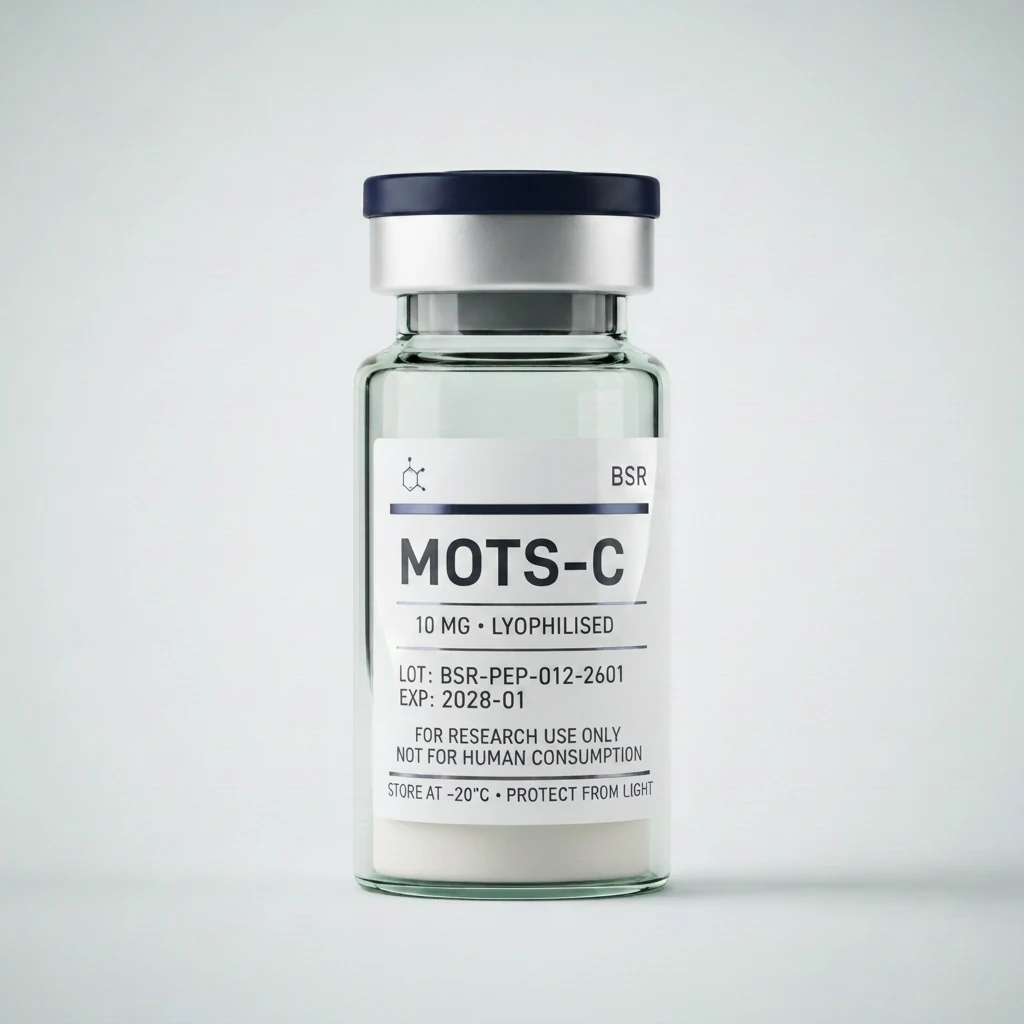
MOTS-c — a 16-amino-acid peptide encoded by the mitochondrial genome — is scheduled for FDA Pharmacy Compounding Advisory Committee review on 23 July 2026, making it one of the more scientifically distinctive compounds on the Day-One agenda. This briefing covers its mechanism, the state of clinical evidence, its WADA prohibition, current regulatory grey-zone status, and what the PCAC outcome means for UK research procurement teams.
12 sources cited
Key takeaways
- MOTS-c is scheduled for FDA Pharmacy Compounding Advisory Committee (PCAC) review on 23 July 2026 — Day One of the two-day meeting — to determine whether it should be added to the Section 503A Bulks List.
- The peptide was removed from Category 2 (the "significant safety risk" designation) effective 23 April 2026, but has not yet been assigned to Category 1; it currently occupies a regulatory grey zone in the United States.
- No large-scale human clinical trials of native MOTS-c exist as of mid-2026; the most advanced analogue programme (CohBar's CB4211) reached Phase 1 but was discontinued before Phase 2.
- WADA added MOTS-c to its Prohibited List in 2024 as an AMPK activator with exercise-mimetic properties, a designation that carries direct implications for any research supplier whose customers include elite sport or military programmes.
- The PCAC recommendation is non-binding, and formal rulemaking — which can take more than a year under standard FDA timelines — is required before compounding pharmacies may act on any reclassification.
- For UK laboratories, MOTS-c has no approved medicinal product status in the UK or EU; procurement remains subject to standard research-use-only conditions and MHRA importation rules.
What is MOTS-c?
MOTS-c (Mitochondrial ORF of the 12S rRNA Type-C) is a 16-amino-acid peptide encoded by the mitochondrial genome — specifically within the MT-RNR1 gene encoding the 12S ribosomal RNA. Frontiers in Endocrinology describes it as part of a small family of mitochondrial-derived peptides (MDPs) discovered in 2015 by Dr Changhan David Lee and colleagues at the University of Southern California.
What distinguishes MOTS-c from most other peptides under regulatory scrutiny is its endogenous origin: it is not a synthetic construct designed to mimic a hormone, but a naturally occurring signalling molecule that the body itself produces, with concentrations that rise during aerobic exercise and decline with advancing age.
Mechanism of action
Emerging data suggest that MOTS-c regulates cellular metabolism through AMPK-dependent pathways, enhancing glucose utilisation and stress responses. More precisely, the MOTS-c protein is transferred to the nucleus during metabolic stress and directs the expression of nuclear genes to promote cell balance. This mitochondrial-to-nuclear communication makes it unusual among the peptides currently before the PCAC — most of which act through extracellular receptor binding rather than intranuclear gene regulation.
As a naturally occurring protein hormone, MOTS-c is primarily activated by exercise or some type of stress, whereupon it translocates to the cell's nucleus and mediates mitochondrial-nuclear communication. MOTS-c also activates the AMP-activated protein kinase (AMPK) pathway, a key regulator of cellular metabolism and homeostasis that helps produce energy by stimulating glucose uptake and fat oxidation, with much of this activity taking place in the skeletal muscles.
The exercise-mimetic framing has attracted significant research interest in the context of metabolic disease. Type 2 diabetes is a global epidemic, and heart failure is the primary cause of premature death among T2D patients. Mitochondrial dysfunction has been linked to decreased contractile performance in diabetic hearts, partly due to a disturbance in mitochondrial capacity to supply adequate metabolic energy to contractile proteins. MOTS-c, a newly discovered mitochondrial-derived peptide, has shown promise as a therapeutic for restoring energy homeostasis and muscle function in metabolic diseases. A 2025 study published in Frontiers in Physiology by researchers at the University of Auckland examined this cardiac hypothesis in pre-clinical T2D models.
State of clinical evidence
The evidence base, while scientifically credible, remains modest by conventional pharmaceutical standards.
As of March 2026, no completed large-scale human clinical trials of MOTS-c exist. All therapeutic claims remain preclinical. CohBar's MOTS-c analogue CB4211 demonstrated safety and reduced liver fat markers (ALT −21%, AST −28%) in obese subjects with fatty liver disease in a Phase 1 trial. However, CB4211 clinical development was discontinued, and no new MOTS-c-based drugs have entered Phase 2 trials.
MOTS-c is one of the more interesting peptides in the current compounding ecosystem because it has a well-characterised mechanism (AMPK activation via folate cycle inhibition), a clear endogenous role (it rises with exercise and declines with age), and meaningful human data — specifically a Phase 1a/1b trial of its analogue CB4211 and a 7-day intravenous trial of native MOTS-c.
The body of evidence is preliminary but not bone-dry. Whether that characterisation satisfies the PCAC's evidence standards for placement on the 503A Bulks List remains the central question of the 23 July hearing.
A 2026 pilot study published in International Urology and Nephrology examined associations between MOTS-c levels, oxidative stress, and arterial stiffness in peritoneal dialysis patients — illustrating that human observational work is accumulating even in the absence of interventional trials. Delivery, however, remains a structural limitation: reliable delivery systems for mitochondrial-derived peptides are still lacking, limiting clinical translation.
WADA prohibition and sport/military implications
WADA banned MOTS-c in 2024, adding it to the Prohibited List as an AMPK activator due to its exercise-mimetic properties. This is a material consideration for any UK research supplier whose customer base includes sports science institutions, military research programmes, or anti-doping analytical laboratories. Procurement of MOTS-c for any research purposes involving elite athletes or service personnel requires documented research-use-only frameworks and careful chain-of-custody management to avoid inadvertent exposure scenarios.
Current regulatory status: United States
The US regulatory position is in flux. The HHS Secretary confirmed removal of twelve peptides from Category 2 on 15 April 2026, including MOTS-c, following withdrawal of the original nominations.
However, removal from Category 2 does not confer Category 1 status. The FDA has removed twelve peptides from the Category 2 list, taking them out of the "significant safety risk" designation. With the exception of GHK-Cu, none of these peptides have been recategorised to Category 1, and they currently do not appear on any of FDA's 503A drug substance nomination lists. The practical consequence of this interim status cannot be overstated: these substances currently exist in a regulatory grey zone. They are no longer designated as posing a "significant safety risk," but they have not been affirmatively authorised for compounding under Section 503A or FDA guidance.
Compounders who interpret removal from Category 2 as implicit permission to compound do so at considerable enforcement risk.
At its July 23–24, 2026 meeting, the FDA's Pharmacy Compounding Advisory Committee reviews seven peptides for 503A eligibility: on July 23, BPC-157, KPV, TB-500, and MOTS-c; on July 24, Emideltide (also called DSIP), Semax, and Epitalon.
The July 23 review agenda for MOTS-c specifically frames its proposed indications as obesity and osteoporosis.
The PCAC process and what follows
The July 2026 meeting is likely a necessary procedural step, not the finish line. Under FDA's typical process, changes to the 503A Bulk Drug Substances List are routed through the PCAC; without such a review, any modification would likely face a legal challenge. Notably, PCAC's recommendation is non-binding, and formal rulemaking is what comes next. Even if PCAC recommends adding these peptides to 503A's Category 1 list, and even if FDA agrees, notice-and-comment rulemaking is still required — a process that, under standard timelines, can take more than a year.
An additional upstream constraint applies regardless of the Committee's recommendation. There is a supply chain issue that sits upstream of any FDA regulatory authorisation of peptide use in compounding. Pursuant to Section 503A, the bulk API used in the compounding of peptide products must be manufactured at an FDA-registered drug establishment and accompanied by a Certificate of Analysis. Because they are likely sterile injectable products, they should be pharmaceutical-grade. As the Alliance for Pharmacy Compounding's CEO Scott Brunner noted, even if FDA acted immediately, pharmacies would still have to turn away prescriptions because they could not acquire compliant API to prepare the drugs.
The Category 2 removals and the ensuing July 2026 and early 2027 PCAC meetings are seemingly meaningful procedural steps, and the political momentum behind this shift is real. That said, compounders and industry participants should plan around a realistic timeline: while there may be an interim period of enforcement discretion announced around the time of the PCAC meetings, final rulemaking, if it proceeds smoothly, is still likely more than a year away; pharmaceutical-grade API supply chains need to be developed in parallel; and promotional restrictions will remain stringent regardless of what happens to the 503A list.
A second PCAC meeting is scheduled before the end of February 2027 to address the five remaining peptides not on the July agenda. A second PCAC meeting will be scheduled before the end of February 2027 to discuss an additional five peptides.
Regulatory status: UK and EU
MOTS-c has no approved medicinal product status in the United Kingdom or the European Union. There is no MHRA-licensed product, no EMA marketing authorisation, and no recognised indication under either regulatory framework. UK laboratories procuring MOTS-c do so under research-use-only conditions as a non-clinical grade peptide, subject to standard MHRA importation rules for unlicensed substances. The US PCAC process has no direct bearing on UK regulatory status, though MHRA typically monitors FDA decisions on unapproved substances as part of its broader horizon-scanning function.
Implications for research procurement
Research-procurement teams assessing MOTS-c supply ahead of the 23 July PCAC should bear several points in mind:
Quality documentation. Because MOTS-c has no pharmacopoeial monograph and no approved reference standard, Certificates of Analysis from suppliers should include third-party mass spectrometry identity confirmation and HPLC purity data (≥98% typically required for research-grade work). Lot-to-lot peptide sequence verification is advisable given the complexity of the mitochondrial-encoded sequence.
Supply chain stability. The grey-market API supply chain for MOTS-c is structurally fragile. Compounding industry representatives have argued that the FDA must provide clearer forward-looking regulatory signals to incentivise investment in pharmaceutical-grade supply chains. Without that signal, manufacturers have little economic reason to build the infrastructure the market will need. This applies equally to research-grade suppliers, where volume economics are thinner still.
WADA traceability. Given the 2024 WADA prohibition, any institution with sport science or military research affiliations should apply strict sample handling and documentation protocols and ensure that MOTS-c research materials are stored and tracked separately from general peptide stocks.
Timeline expectations. The July 23, 2026 PCAC hearing will determine whether US patients keep legal access through compounding pharmacies, and the outcome will signal the FDA's broader posture toward peptide compounding for the next several years. For UK procurement, the near-term regulatory position will not change as a direct result of the PCAC vote. The longer-term signal — whether the FDA is willing to place exercise-mimetic, mitochondrially-derived peptides without completed Phase 2 data onto the 503A Bulks List — will be informative for UK and EU regulatory discussions about the appropriate framework for novel endogenous peptides.
The July PCAC meeting is the most significant regulatory event for MOTS-c since its discovery in 2015. The scientific case is substantive, the human data are limited, and the path from a favourable PCAC recommendation to legal, pharmaceutical-grade compounding availability remains long. Procurement teams sourcing MOTS-c for legitimate research purposes should monitor the meeting outcome and plan for a sustained period of regulatory ambiguity on both sides of the Atlantic.
Research-grade material, HPLC verified, certificate of analysis with every order.

The week's Intelligence in one email, every Friday morning.
Regulatory moves, trial readouts, supply-chain news. No product pitches. Unsubscribe in one click.
More in Research Pipeline
Thymosin Alpha-1: What 35 Countries of Clinical Use and a Lopsided PCAC Vote Mean for Research Access in 2026
07 Oct 2026
Viking Therapeutics Initiates Oral Maintenance Dosing Study for VK2735: What the GLP-1/GIP Dual Agonist's Two-Part Programme Tells Researchers About the Weight-Regain Problem
06 Oct 2026
GHK-Cu: What a Fresh Diabetic Wound Study and a Recruiting Phase 2 Trial Mean for the Copper Peptide's Research Standing
03 Oct 2026