Research Pipeline · 26 Jun 2026
Selank: The Tuftsin-Derived Anxiolytic Peptide Absent from the July PCAC — What the Regulatory Grey Zone Means for Research Procurement
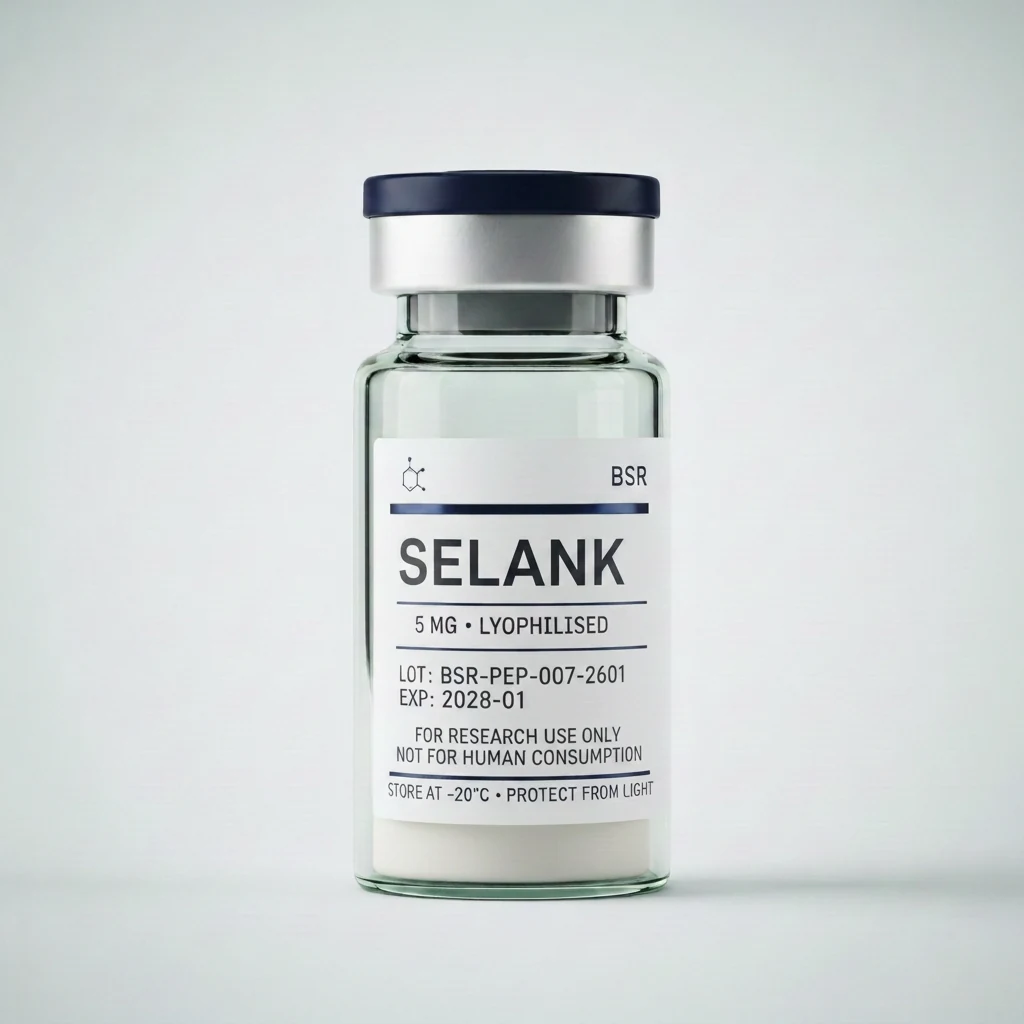
Selank is a synthetic heptapeptide with Russian clinical approval for generalised anxiety disorder and one of the better-documented evidence bases among research peptides. Yet it carries no July 2026 PCAC slot, no FDA-authorised compounding pathway, and sits in a regulatory grey zone that procurement teams must understand before sourcing.
17 sources cited
Key takeaways
- Selank (Thr-Lys-Pro-Arg-Pro-Gly-Pro) is a synthetic heptapeptide derived from the endogenous immunomodulatory tetrapeptide tuftsin, developed at the Institute of Molecular Genetics of the Russian Academy of Sciences.
- Its Category 2 nomination was withdrawn, removing it from the FDA's "significant safety risk" designation as of April 2026 — but it has not been placed on the 503A Bulks List and carries no active compounding authorisation.
- Unlike Semax, which appears on the July 23–24, 2026 PCAC agenda, Selank has no scheduled PCAC review, leaving it in a prolonged regulatory limbo distinct even from most of its peer peptides.
- The most credible human evidence comes from Russian Phase III trials; independent Western replication remains absent, which substantially limits the evidentiary confidence that Western regulators require.
- For UK research laboratories, the absence of MHRA authorisation and a dependable pharmaceutical-grade supply chain represents the central procurement risk.
What Selank is and how it was developed
Selank is a synthetic heptapeptide (Thr-Lys-Pro-Arg-Pro-Gly-Pro) developed by the Institute of Molecular Genetics of the Russian Academy of Sciences as an analogue of the endogenous immunomodulatory tetrapeptide tuftsin. The peptide sequence comprises the tuftsin fragment at the N-terminus and a tripeptide Pro-Gly-Pro (PGP) motif at the C-terminal end; the incorporation of the PGP sequence is suggested to influence the peptide's physicochemical potential in supporting interaction with lipid-rich biological membranes, and the modification was designed to improve metabolic stability and prolong half-life relative to the native peptide.
The C-terminal Pro-Gly-Pro extension dramatically improves metabolic stability, meaning the peptide survives long enough after intranasal delivery to exert meaningful effects. The resulting compound is also known as TP-7 in the Russian literature.
Selank is approved in Russia as a nasal spray for generalised anxiety disorder and neurasthenia, making it one of the few peptide anxiolytics with actual clinical approval. In Russia and Ukraine, Selank carries regulatory approval for indications including ischaemic stroke, encephalopathy, and optic nerve atrophy in addition to its primary anxiolytic indication.
Mechanism of action
Selank's pharmacological profile rests on several intersecting pathways. Its mechanisms include GABAergic modulation (allosteric modulation of GABA-A receptors), enkephalinase inhibition (stabilising endogenous anti-anxiety peptides), BDNF upregulation in the hippocampus, and serotonin metabolism modulation.
Selank's most studied mechanism is allosteric modulation of the GABAergic system — the primary inhibitory network in the central nervous system. This is distinct from the mechanism of classic benzodiazepines, which bind directly to the GABA-A receptor's benzodiazepine site and carry dependence liability. Comprehensive preclinical research has elucidated multifaceted mechanisms of action involving GABAergic system modulation, monoaminergic neurotransmitter effects, enkephalin metabolism, BDNF upregulation, and immune system influences.
Research suggests that Selank may also exert modulatory effects on immunological processes, with potential interactions involving T helper cells and interleukin-6 (IL-6) signalling pathways — a dimension that traces back to its tuftsin-derived structure, as tuftsin itself is an immunomodulatory tetrapeptide derived from immunoglobulin G.
State of clinical evidence
Unlike most research peptides that exist primarily in animal literature, Selank has substantial human clinical trial data — published trials enrolling over 800 patients with generalised anxiety disorder (GAD), neurasthenia, and cognitive complaints — making it one of the more clinically documented nootropic peptides in the research market.
A comparison study published in Zh Nevrol Psikhiatr found comparable anxiolytic efficacy to phenazepam (a Russian benzodiazepine) with a superior tolerability profile (PMID: 25176261). Selank completed Phase III clinical trials in Russia for anxiety-related indications. That does not confer FDA approval, but it represents a higher evidentiary tier than most nootropic peptides discussed in the cognitive-performance space.
Clinical trials have shown anxiolytic and mild cognitive-enhancing effects with a benign side-effect profile; unlike benzodiazepines, Selank does not produce sedation, dependence, or withdrawal.
That said, the evidence picture has a material limitation. The current evidence base remains predominantly from Russian research institutions, with limited international validation and long-term safety data. Neither Selank nor Semax has the large-scale, replicated human RCT data in healthy populations that would satisfy the highest evidentiary bar. The absence of Western RCTs means that clinical confidence in the compound rests on a body of Russian-language evidence that has not been independently verified; the honest framing is: promising, plausible, but incompletely characterised by the standards Western regulators require.
Selank has not been evaluated in any formal pharmacokinetic drug-drug interaction trial in humans, despite long Russian clinical use as an intranasal anxiolytic. There is no ClinicalTrials.gov-registered FDA-style Phase 1–3 programme in progress as of June 2026.
Regulatory status: United States
Selank's US regulatory trajectory diverges from most of its peer peptides in a consequential way. Selank is approved as a prescription drug in Russia but is not FDA-approved in the United States; its Category 2 compounding nomination was withdrawn in September 2024, and there is no PCAC review scheduled.
Selank was previously nominated to Category 2 and is listed as "Nominated but Withdrawn" from Category 2 as of April 22, 2026. This places it in the same general limbo as the twelve peptides removed from Category 2 in April 2026, but — crucially — it is not among the seven peptides scheduled for PCAC review on 23–24 July 2026.
Seven peptides are on the July PCAC agenda: BPC-157, KPV, TB-500, and MOTS-c on Day 1; Emideltide (DSIP), Semax, and Epitalon on Day 2. Selank is absent from this list.
These substances currently exist in a regulatory grey zone. They are no longer designated as posing a "significant safety risk," but they have not been affirmatively authorised for compounding under Section 503A or FDA guidance. Compounders who interpret removal from Category 2 as implicit permission to compound do so at considerable enforcement risk.
Removal from Category 2 does not confer Category 1 status automatically; each substance requires individual PCAC review prior to reclassification. The FDA requires formal rulemaking before compounding pharmacies may act on a reclassification, even with a favourable PCAC outcome.
A second PCAC meeting will be scheduled before the end of February 2027 to review five additional peptides for the 503A Bulks Drug Substances List, including GHK-Cu, Melanotan II, Cathelicidin (LL-37), Dihexa acetate, and Mechano Growth Factor, Pegylated (PEG-MGF). Selank does not appear on that list either, meaning no formal PCAC review date has been publicly announced for it at the time of writing.
Regulatory status: United Kingdom
In the United Kingdom, Selank has no MHRA marketing authorisation. It does not appear on any approved medicinal product register. As a peptide supplied for non-clinical research purposes, UK procurement is governed by the same general framework that applies to other unlicensed research chemicals: the compound may be lawfully imported and held for genuine research use, but it may not be administered to humans outside an authorised clinical trial.
The MHRA's enforcement approach to peptides has tracked broadly alongside FDA direction, though the UK operates an independent national framework post-Brexit. Laboratories procuring peptides for legitimate non-clinical research should ensure that supplier documentation includes a valid Certificate of Analysis, independent third-party analytical verification (HPLC purity data and mass spectrometry confirmation), and evidence of manufacture under appropriate GMP-equivalent conditions.
Supply chain and quality considerations
The withdrawal of Selank's Category 2 nomination in the United States has not created a licit pharmaceutical-grade supply chain. There is a supply chain issue that sits upstream of any FDA regulatory authorisation of use in compounding; under Section 503A, the bulk API used in the compounding of peptide products must be manufactured at an FDA-registered drug establishment and accompanied by a Certificate of Analysis.
As the Alliance for Pharmacy Compounding's CEO Scott Brunner noted: even if FDA acted tomorrow, pharmacies would still have to turn away those prescriptions because they could not acquire the compliant API to prepare the drugs.
For research institutions, this supply-chain gap has a direct practical implication. Selank is currently available through grey-market research-chemical vendors, but the quality controls applied by such vendors vary considerably. US access is limited to international or research-only sourcing, with significant quality and legal risk. UK laboratories should treat any vendor's purity claims as unverified until independently confirmed, and should conduct in-house or third-party HPLC and mass-spectrometry testing on each new lot.
Procurement implications for research laboratories
Several practical considerations follow from Selank's current status.
Evidence grade. The peptide's Phase III human trial data in Russia is a genuine differentiator from many research peptides, but the absence of independent Western replication means the evidence is not at the standard required for regulatory approval in the UK or US. Procurement teams should communicate this distinction clearly to principal investigators.
No authorised compounding pathway. Unlike peptides that are on, or likely to appear on, the FDA's 503A Bulks List in 2026–2027, Selank has no confirmed pathway to legitimate compounding in the United States and no timeline for PCAC review. Teams sourcing Selank for ongoing research programmes should factor in the possibility that regulatory status will remain unresolved for at least another 12–18 months.
No PCAC oral presentation deadline applies. Individuals wishing to make formal oral presentations at the July 23–24 PCAC meeting must notify the FDA contact person on or before June 30, 2026. As Selank is not on the July agenda, this deadline is not directly relevant — but stakeholders who wish to advocate for Selank's inclusion in a future PCAC review should engage with the public docket process proactively.
Quality documentation. Given the absence of a pharmaceutical-grade supply chain, procurement teams should require certificates of analysis from accredited third-party laboratories, confirm the supplier's manufacturing conditions, and document the research-only end use in procurement records. Under Section 503A, the bulk API used in compounding must be manufactured at an FDA-registered drug establishment and accompanied by a Certificate of Analysis — a standard that grey-market suppliers typically do not meet.
Looking ahead
Selank occupies an unusual position in the 2026 peptide regulatory landscape: better clinical evidence than many of its peers, regulatory approval in Russia, but no active pathway to legitimacy in the US or UK. The window for unregulated grey-market peptides may be closing, but the window for regulated compounded peptides is not yet fully open — and getting there likely will require navigating a more complex regulatory process than the current headlines may suggest.
For research-procurement professionals, the practical message is straightforward: Selank remains a legitimate subject of non-clinical and early-stage research, but procurement requires careful attention to quality verification, documentation, and evolving regulatory developments on both sides of the Atlantic. Any future announcement of a PCAC review date for Selank would represent a material change in its regulatory trajectory and should be monitored via the FDA's advisory committee calendar and the regulations.gov docket system.
Research-grade material, HPLC verified, certificate of analysis with every order.
The week's Intelligence in one email, every Friday morning.
Regulatory moves, trial readouts, supply-chain news. No product pitches. Unsubscribe in one click.
More in Research Pipeline
Thymosin Alpha-1: What 35 Countries of Clinical Use and a Lopsided PCAC Vote Mean for Research Access in 2026
07 Oct 2026
Viking Therapeutics Initiates Oral Maintenance Dosing Study for VK2735: What the GLP-1/GIP Dual Agonist's Two-Part Programme Tells Researchers About the Weight-Regain Problem
06 Oct 2026
GHK-Cu: What a Fresh Diabetic Wound Study and a Recruiting Phase 2 Trial Mean for the Copper Peptide's Research Standing
03 Oct 2026