Research Pipeline · 29 Aug 2026
Selank: The Tuftsin-Derived Heptapeptide With Russian Regulatory Approval, Modest Western Evidence, and a Changed FDA Compounding Status in 2026
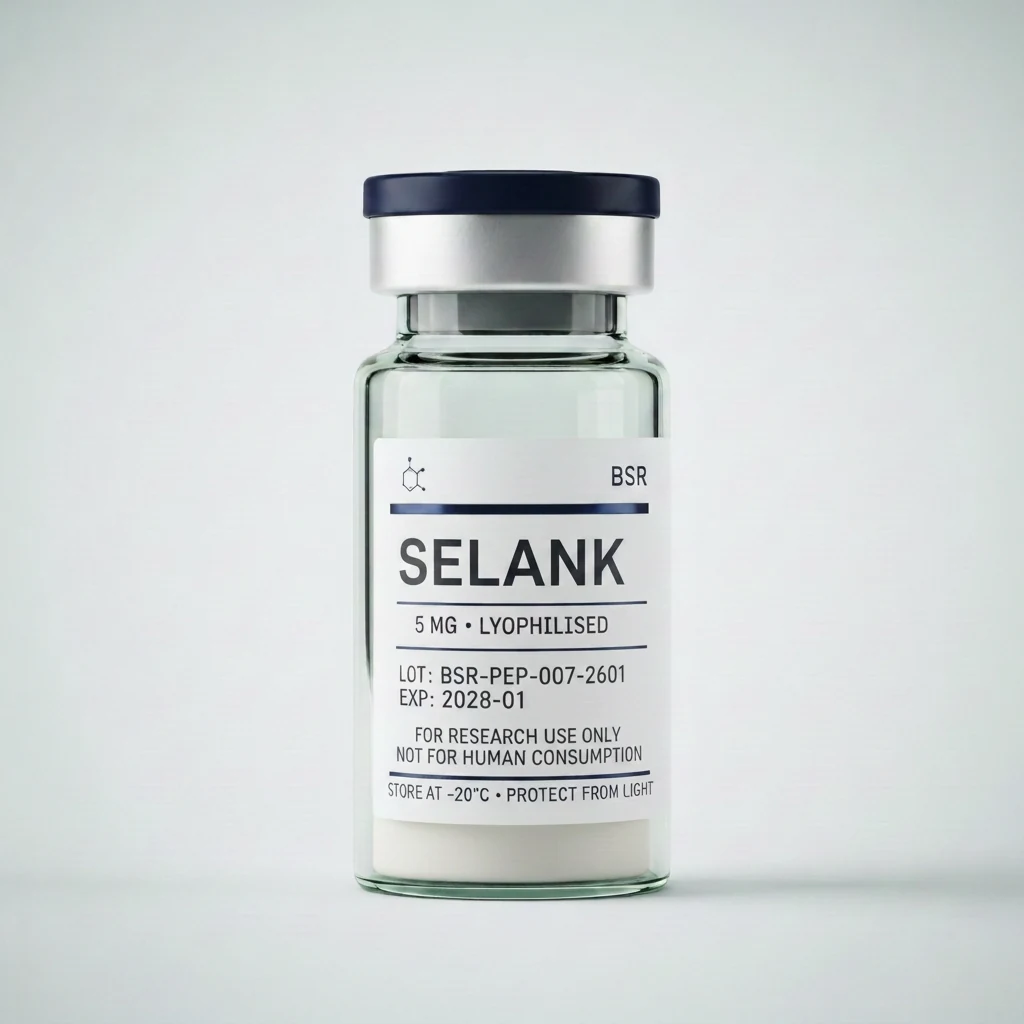
Selank is a synthetic heptapeptide developed in Russia that holds domestic regulatory approval as a prescription anxiolytic and has the most substantial human clinical dataset of any nootropic-class peptide in the Western research conversation. This briefing covers its mechanism, the state of the evidence, its 2026 FDA compounding reclassification, and what that means for UK research-procurement teams.
15 sources cited
Key takeaways
- Selank is a synthetic heptapeptide analogue of the endogenous immunopeptide tuftsin, developed at the Institute of Molecular Genetics of the Russian Academy of Sciences.
- It holds prescription-drug regulatory approval in the Russian Federation as an intranasal anxiolytic, giving it a clinical precedent that most research peptides entirely lack.
- Human trial data — mostly Russian-language, single-centre, and conducted before 2015 — cover generalised anxiety disorder, neurasthenic syndromes, and mild cognitive complaints in populations of up to several hundred patients.
- No large, independent, placebo-controlled Western RCT or published meta-analysis exists. The FDA, EMA, and MHRA have not approved Selank as a finished pharmaceutical for any indication.
- In April 2026, the FDA withdrew its Category 2 nomination for Selank, meaning standard 503A/503B compounding pharmacy rules now apply rather than the prior blanket restriction. Selank was not among the seven peptides reviewed at the July 2026 Pharmacy Compounding Advisory Committee (PCAC) meeting.
- In the UK, Selank has no MHRA marketing authorisation and is classified as a research chemical. Procurement for legitimate laboratory use is lawful; any supply or promotion for human therapeutic use is not.
What Selank is
Selank is a seven-amino-acid synthetic peptide with the sequence Thr-Lys-Pro-Arg-Pro-Gly-Pro. It was developed by the Institute of Molecular Genetics of the Russian Academy of Sciences as an analogue of the endogenous immunomodulatory tetrapeptide tuftsin. The tuftsin backbone (Thr-Lys-Pro-Arg) was extended with a Pro-Gly-Pro tripeptide tail to improve metabolic stability — tuftsin itself degrades rapidly in plasma, limiting its utility as a therapeutic candidate.
Selank is administered primarily via the intranasal route, which is the formulation studied in Russian clinical trials and the route under which it holds domestic approval. Subcutaneous injection is also reported in the research literature, though the evidence for that route is considerably thinner.
Mechanism of action
Selank's pharmacology involves several overlapping pathways, which partially explains why its effects span anxiety reduction, cognitive enhancement, and immunomodulation.
Enkephalinase inhibition. The leading mechanistic hypothesis is that Selank inhibits enzymes responsible for degrading endogenous enkephalins — opioid-like neuropeptides that modulate stress responses and emotional tone. A pivotal Russian comparative trial documented Selank's enkephalin mechanism directly in patients: baseline Leu-enkephalin half-life was reduced in anxiety patients and correlated with symptom severity, and Selank produced anxiolytic efficacy similar to medazepam, while additionally producing antiasthenic and mild psychostimulant effects with no sedation, no cognitive impairment, and no dependence or withdrawal.
GABAergic modulation. Selank's mechanism of action through GABAergic system modulation, combined with neuroprotective and cognitive-enhancing effects, is proposed to offer potential advantages over traditional anxiolytic medications. Unlike benzodiazepines, Selank does not appear to act directly at the GABA-A receptor, which is thought to underlie its lack of sedation and dependence risk in the trial literature.
BDNF upregulation and synaptic plasticity. Like Semax, Selank upregulates brain-derived neurotrophic factor — the key protein supporting neuronal survival, synaptic plasticity, and memory consolidation. This mechanism is consistent with reported improvements in attention and memory tasks observed in Russian trials.
Serotonergic interactions. Selank has demonstrated interactions with serotonergic pathways — modulating serotonin metabolism and receptor sensitivity in ways that contribute to its mood-stabilising and anxiolytic profile — and this serotonergic activity is distinct from the mechanisms of SSRIs and does not produce the side-effect profile associated with chronic serotonin reuptake inhibition.
Neuroinflammation. Selank's immune-modulating dimension connects it to the broader neuroinflammation research space — the hypothesis that immune dysregulation in the CNS contributes to anxiety, depression, and cognitive decline is one of the most active areas of neuroscience in 2026.
Clinical evidence: what has actually been studied
The evidence base for Selank is predominantly Russian-language, conducted at single centres in the Russian Federation, and predates modern trial-registration standards. That context matters for anyone evaluating it against contemporary regulatory criteria.
Generalised anxiety disorder (GAD) and neurasthenia. In Russian Federation clinical trials, Selank has been studied primarily in generalised anxiety disorder, adjustment disorders, asthenic syndromes, and mild neurocognitive complaints. Results in those trials have generally reported reductions in state anxiety, improvements in attention and short-term memory tasks, and a favourable side-effect profile compared with benzodiazepines.
The most frequently cited pivotal trial enrolled 62 patients with GAD and neurasthenia and compared Selank (intranasal) directly against the benzodiazepine medazepam. Selank is the clear evidence leader in the nootropic-anxiolytic peptide category and the only compound in that group with a published human trial in an actual anxiety patient population. The pivotal study was a Russian comparative trial in 62 patients (Selank n=30 versus medazepam n=32) using Hamilton, Zung, and CGI scales plus serum enkephalin assays.
A broader characterisation of the dataset suggests the total enrolled population across published studies is larger: unlike most research peptides that exist primarily in animal literature, Selank has substantial human clinical trial data behind it — published trials enrolling over 800 patients with generalised anxiety disorder, neurasthenia, and cognitive complaints — making it one of the most clinically documented nootropic peptides in the current research and compounding market.
Limitations the evidence carries. This is still only a Grade B signal: the dataset is small, single-region, and largely Russian-language, with no large independent placebo-controlled Western RCT or meta-analysis. Crucially, there is no large, independent, placebo-controlled head-to-head trial against modern benzodiazepines, and the English abstracts do not publish scale deltas, p-values, or responder percentages, so precise effect sizes circulating online should be treated cautiously. Benzodiazepines, for all their downsides, carry decades of regulated clinical data that Selank simply lacks.
Future international clinical trials will be critical in establishing the safety, efficacy, and appropriate clinical applications of Selank in human medicine. Until comprehensive clinical validation is completed, its use should remain limited to research settings and experimental protocols under appropriate medical oversight.
Regulatory status
Russian Federation
Selank received regulatory approval in the Russian Federation as a prescription anxiolytic and is marketed there in an intranasal formulation. That regulatory status, however, is specific to Russia. The peptide is not approved by the U.S. Food and Drug Administration, the European Medicines Agency, or other major Western regulatory bodies as a finished pharmaceutical product with a registered indication.
United States — FDA compounding framework
Prior to April 2026, Selank had been nominated for placement on the FDA's Section 503A Category 2 bulk drug substances list — a classification applied to substances considered to present significant safety risks and therefore ineligible for compounding absent specific FDA authorisation. Selank was among the set of peptides whose Category 2 nominations HHS Secretary Robert F. Kennedy Jr. announced would be moved back towards Category 1 eligibility, a list that also included BPC-157, Thymosin Alpha-1, TB-500, CJC-1295, Ipamorelin, AOD-9604, GHK-Cu, Semax, KPV, MOTS-C, and others.
Selank was listed as "nominated but withdrawn" from Category 2 as of April 22, 2026, and is not approved for therapeutic use in the US. Standard 503A/503B pharmacy regulations now apply. This is a meaningful practical change: it removes the blanket prohibition on compounding, but it does not constitute FDA approval, does not establish validated indications, and does not provide standardised dosing. Moving from Category 2 to Category 1 eligibility is not FDA approval — it means compounding pharmacies can legally prepare these peptides again. FDA approval requires Phase I–III clinical trials and a formal New Drug Application, which is a completely different process.
Selank was not among the seven peptides reviewed at the FDA's PCAC meeting on 23–24 July 2026. A second PCAC meeting is scheduled before the end of February 2027 to discuss an additional five peptides, and it remains possible — though not confirmed — that Selank will be among those reviewed at a future session.
United Kingdom — MHRA position
Selank has no MHRA marketing authorisation and is not listed in the British National Formulary. It does not appear on any MHRA-approved product licence. Under UK law, supply of an unlicensed medicinal product for therapeutic use requires either a Specials licence (for named patients, with a prescriber declaration of unmet need) or import through formal unlicensed medicines channels — neither of which provides a routine procurement route for most research organisations. For certified research use, Selank may be lawfully procured as a research chemical provided it is not intended for human administration and is handled in accordance with applicable laboratory regulations.
What distinguishes Selank from Semax in the research context
Both peptides are synthetic neuropeptides with Russian origins and overlapping evidence bases. Selank and Semax have the most clinical history of any cognitive peptides, having been studied and used in Russia for decades, though large international randomised controlled trials are still lacking. The key distinction lies in primary indication: Semax (an ACTH-derived heptapeptide) is studied chiefly for neuroprotection and ischaemia, whereas Selank's published trial record is anchored to anxiety and neurasthenia. For research programmes focused on the GABAergic system, neuroinflammation, or peptide-based anxiolytic pharmacology, Selank's dataset — however modest by Western standards — provides more directly relevant signal than Semax.
Procurement considerations for UK research labs
- Purity specification. Given Selank's instability as a tuftsin analogue — the motivation for its synthetic extension — lot-to-lot analytical confirmation matters. Laboratories should require ≥98% HPLC purity certificates and mass spectrometry identity confirmation before use.
- Storage and stability. Lyophilised Selank is typically stable at −20 °C for extended periods; reconstituted solutions should be used promptly and stored at 4 °C, protected from light. Freeze-thaw cycles degrade the peptide.
- Route of administration in study design. The human evidence base is entirely intranasal. Researchers designing subcutaneous or IV protocols should treat the translational basis as preclinical, not clinical.
- Source jurisdiction. Since Selank is an approved pharmaceutical in Russia, importation of finished Russian-market product for use as a research standard requires appropriate customs and import procedures under UK law. Synthetic research-grade material from certified CDMO or specialist peptide suppliers is the standard approach for Western labs.
- Documentation. Maintain clear records distinguishing research use from any therapeutic application. MHRA enforcement in this area has increased alongside wider UK-government focus on unlicensed injectable products.
Research-grade material, HPLC verified, certificate of analysis with every order.
The week's Intelligence in one email, every Friday morning.
Regulatory moves, trial readouts, supply-chain news. No product pitches. Unsubscribe in one click.
More in Research Pipeline
Thymosin Alpha-1: What 35 Countries of Clinical Use and a Lopsided PCAC Vote Mean for Research Access in 2026
07 Oct 2026
Viking Therapeutics Initiates Oral Maintenance Dosing Study for VK2735: What the GLP-1/GIP Dual Agonist's Two-Part Programme Tells Researchers About the Weight-Regain Problem
06 Oct 2026
GHK-Cu: What a Fresh Diabetic Wound Study and a Recruiting Phase 2 Trial Mean for the Copper Peptide's Research Standing
03 Oct 2026